Business scaling steps: grow revenue without the chaos
- karl7209
- Jun 23
- 8 min read

TL;DR:
Business scaling involves increasing revenue faster than costs to ensure sustainable growth. Small business owners should assess readiness, automate operations, hire strategically, and plan finances before scaling. Overcoming the founder’s identity of doing everything and managing burnout are crucial to successful expansion.
Business scaling is defined as growing your revenue faster than your costs, and the business scaling steps you choose determine whether that growth is sustainable or a slow-motion disaster. Most small business owners confuse scaling with plain old growth. Growth means revenue and costs rise together, like a seesaw that never tips in your favour. Scaling means revenue climbs exponentially while operational costs stay relatively flat. That distinction matters enormously. Get it right, and you build a business that works without you carrying it on your back every single day.
What are the core business scaling steps to follow?
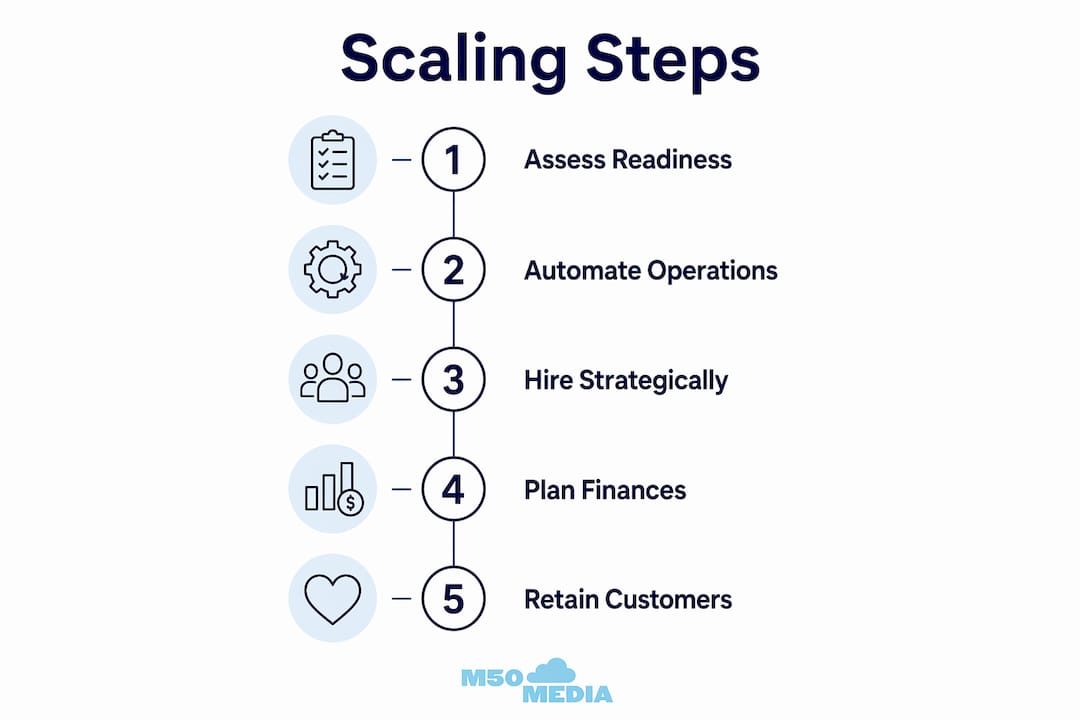
The core business scaling steps are: assess readiness, automate operations, hire strategically, plan finances, and retain customers. Think of it like prepping for a road trip. You would not just floor it out of the driveway without checking the oil, mapping the route, and making sure everyone has snacks. Skipping any of these steps is how businesses end up scaling chaos instead of scaling revenue.

Is your business actually ready to scale?
Readiness is the most skipped step in any scaling strategies for growth conversation, and skipping it is expensive. A methodical approach to capacity-building and standardising processes must come before aggressive sales growth. Without that foundation, you are pouring water into a leaky bucket and wondering why it is empty.
Here are the signs your business is ready to scale:
Consistent revenue growth for at least 6 months. Six months of revenue consistency is the baseline signal that demand is real, not a lucky streak.
Your team is overwhelmed. Leads outpacing capacity is a good problem. It means demand exists. Now you need systems to handle it.
Processes are documented. Documenting SOPs early prevents bottlenecks caused by institutional knowledge living only in your head.
Infrastructure is stable. Your software, fulfilment, and customer service can handle a 30% volume increase without breaking.
You have a repeatable sales process. If every sale requires your personal involvement, you do not have a business yet. You have a job.
Pro Tip: Survey your team before you decide to scale. If your employees are already stretched thin and morale is shaky, scaling will amplify those problems, not fix them. Use a simple anonymous form and ask two questions: “What is slowing you down?” and “What would help you do more?”
Which automation tools actually support scaling?
Automation is the closest thing to cloning yourself without getting into science fiction territory. Investing in technology automation allows your team to focus on work that actually moves the needle, rather than repetitive admin tasks that eat hours and produce nothing memorable.
The four areas where automation delivers the biggest payoff during scaling are HR, finance, marketing, and sales. Payroll platforms like Rippling handle onboarding, scheduling, and compliance automatically. Marketing tools like Mailchimp, HubSpot, and ActiveCampaign run customer follow-up sequences without anyone lifting a finger. Appointment scheduling tools like Calendly eliminate the back-and-forth email tennis that wastes everyone’s afternoon.
Automation category | Key function | Example tools |
HR and payroll | Onboarding, scheduling, compliance | Rippling, Gusto |
Marketing | Email sequences, lead nurturing | HubSpot, Mailchimp, ActiveCampaign |
Sales CRM | Pipeline tracking, follow-up | HubSpot CRM, Zoho CRM |
Appointment booking | Scheduling without manual coordination | Calendly, Acuity Scheduling |
Finance and invoicing | Billing, expense tracking | QuickBooks, FreshBooks |
Customer retention also benefits directly from automation. Automated loyalty programmes and CRM follow-ups keep existing customers engaged without requiring a dedicated team member to babysit every relationship. That matters because acquiring a new customer costs up to 5 times more than retaining one you already have. Keeping your current customers happy is not just good service. It is a financial strategy.
Pro Tip: Do not automate broken processes. If your customer follow-up sequence is confusing and unhelpful, automating it just delivers confusion faster. Fix the process first, then automate it.
How should you hire and build your team for growth?
Strategic hiring is one of the most misunderstood ways to scale a business. The instinct is to hire fast and hire full-time. The smarter move is to hire for specific functions that are creating bottlenecks, and use flexible talent everywhere else. Hiring modular roles and using freelancers before committing to full-time hires minimises overhead risk during scaling. Platforms like Upwork make this genuinely practical for small businesses.
Flexible talent solutions let you scale your team up or down based on actual demand, not projections you made on an optimistic Tuesday. That flexibility is worth more than most owners realise until they are stuck paying salaries during a slow quarter.
Roles that typically become bottlenecks first during scaling include:
Operations manager. Someone who owns the day-to-day so you can work on the business instead of in it.
Customer success lead. Retention does not happen by accident. Someone needs to own it.
Marketing coordinator. Consistent content and campaign execution requires dedicated attention.
Bookkeeper or financial controller. Cash flow visibility is non-negotiable at scale.
Sales development representative. Outbound pipeline does not fill itself.
Leadership development is equally critical. The transition from founder-led reactive management to function-driven proactive scaling requires real investment in your managers. Improving schedule stability and employee engagement directly increases revenue by reducing turnover and maintaining team output. Losing a key employee during a growth phase is like losing a wheel on that road trip we talked about earlier.
What does financial planning for scaling actually look like?
Financial planning for scaling is not glamorous, but it is the difference between a business that grows and one that grows broke. Here is a practical sequence:
Set milestone-based budgets. Break your scaling plan into 90-day milestones with specific revenue and cost targets. Avoid annual projections that become fiction by month three.
Build a contingency fund. Set aside at least three months of operating expenses before scaling aggressively. Scaling creates cash flow gaps even when things go well.
Explore external funding. Options include small business loans, government grants (the Canada Small Business Financing Program is worth researching), and angel investors. Prepare a clear pitch that shows your revenue trajectory and unit economics.
Monitor cash flow weekly. Revenue growth does not equal cash in the bank. Track accounts receivable, payables, and runway every single week.
Run scenario planning. Model a best case, a base case, and a worst case for every major scaling decision. Know your break-even point before you commit.
Startups and small businesses should prioritise growth areas based on feasibility and resource availability rather than trying to do everything at once. Stripe’s guidance on this is blunt and correct. Spreading your budget across five initiatives produces five mediocre results. Concentrating it on two produces two wins.
What marketing strategies actually scale with your business?
Marketing is where most scaling efforts fall apart, and the culprit is almost always inconsistency. Nearly 50% of small businesses attempt digital marketing without a clear, documented strategy. That is like running a marathon with no training plan and wondering why you hit the wall at kilometre 10.
Scalable marketing is built on repeatable processes, not heroic one-off efforts. Here is what that looks like in practice:
CRM-driven follow-up. Every lead enters a documented sequence. No lead falls through the cracks because someone forgot to send an email.
Content that compounds. Blog posts, videos, and guides that rank on Google keep working long after you publish them. Check out M50media’s digital marketing strategy guide for a practical framework.
Loyalty programmes. Rewarding repeat customers costs far less than acquiring new ones. Given that retention is five times cheaper than acquisition, even a simple points programme pays off.
Multichannel presence. Email, social media, and search working together produce better results than any single channel alone. M50media’s guide to multichannel marketing for small businesses breaks this down clearly.
Marketing automation. Tools like HubSpot and ActiveCampaign run nurture sequences, segment your audience, and trigger campaigns based on behaviour. See marketing automation examples that work specifically for small businesses.
A solid marketing automation checklist helps you build these systems without missing critical steps. The goal is a marketing engine that runs consistently whether you are at your desk or on a patio in Kelowna.
Key takeaways
Sustainable scaling requires readiness, automation, strategic hiring, financial discipline, and consistent marketing working together before you push for aggressive growth.
Point | Details |
Confirm readiness first | Look for six months of consistent revenue growth before committing to scaling. |
Automate the repetitive stuff | Use CRM, payroll, and marketing tools to free your team for higher-value work. |
Hire for bottlenecks, not vanity | Use freelancers and modular roles before committing to full-time overhead. |
Plan finances in 90-day blocks | Build contingency funds and run scenario planning before every major spend. |
Make marketing repeatable | Document your strategy and automate follow-up so growth does not depend on heroics. |
The thing nobody tells you about scaling
Here is my honest take after working with dozens of small business owners: the biggest obstacle to scaling is not money, technology, or even the market. It is the founder’s identity.
Most owners built their business by being the person who does everything. They know every client, handle every problem, and make every call. That identity is an asset in year one and a liability in year three. The transition from “I do it all” to “my team handles it” is genuinely uncomfortable. It feels like losing control, even when it is actually gaining leverage.
What I have seen work is this: pick one function to hand off completely, document it obsessively, and let someone else own it for 90 days. Not “kind of” own it. Fully own it. You will mess with it at first. Resist that urge. The discomfort of letting go is the price of scaling.
The other thing I will say is that burnout during scaling is real and it sneaks up on you. Growth feels exciting until it does not. Build rest into your plan the same way you build revenue targets. A founder running on fumes makes bad decisions, and bad decisions at scale cost a lot more than bad decisions at startup size.
Scaling is not one-size-fits-all. The strategies that work for a service business in Halifax look different from those for a product business in Calgary. Know your model, know your constraints, and build a scaling plan that fits your actual business, not someone else’s success story.
— Karl
Ready to put these steps into action?
Knowing the steps is one thing. Building a plan that actually fits your business is another. That is exactly where coaching and expert marketing support make a real difference.
At M50media, Karl works directly with small business owners to turn scaling theory into a concrete plan. Whether you need help with your marketing systems, your team structure, or your overall growth strategy, the business coaching programme is built for exactly this stage of your journey. If marketing is the piece that feels most stuck, book a free Marketing SOS call and get clarity on your next move in one focused conversation. No fluff, no generic advice. Just real help for where you actually are.
FAQ
What is the difference between scaling and growing a business?
Growth means revenue and costs rise together. Scaling means revenue increases significantly while costs stay relatively flat, producing better margins over time.
How do I know when my business is ready to scale?
Look for at least six months of consistent revenue growth, a team that is at capacity, and documented processes that do not rely on you personally to function.
What automation tools help small businesses scale?
CRM platforms like HubSpot, payroll tools like Rippling or Gusto, and email marketing tools like Mailchimp or ActiveCampaign are the most practical starting points for small business automation.
Why is customer retention so important during scaling?
Acquiring a new customer costs up to five times more than keeping an existing one. Prioritising retention through loyalty programmes and CRM follow-up protects your margins while you grow.
Should I hire full-time staff before scaling?
Not necessarily. Using freelancers and modular roles for non-core functions reduces overhead risk. Commit to full-time hires only for roles that create consistent bottlenecks in your operations.
Recommended
Comments