Brand positioning: stand out and win loyal customers

You’ve got a great logo. Maybe even a catchy tagline. So why does it feel like customers still can’t quite explain what makes your business special? Here’s the thing: a logo is just a pretty face, and a tagline is just a clever line. Brand positioning is the whole personality behind them. It’s the reason someone picks your coffee shop over the Starbucks on the corner, or chooses your boutique agency over the big guys downtown. If you’ve ever felt fuzzy on what brand positioning actually means (or how to use it), this guide is going to clear that right up.
Table of Contents
Key Takeaways
Point | Details |
Brand positioning defined | It’s how your business is perceived and compared in the minds of customers. |
Five key pillars | Strong positioning is built from targeting, category, USP, benefit, and support. |
Use a clear statement | A brand positioning statement aligns your team and message for market impact. |
Activate and monitor | Share your positioning consistently across touchpoints and track results to evolve it. |
Expert help available | Coaching or a consultation call can speed up and sharpen your positioning efforts. |
Defining brand positioning and why it matters
Let’s get one thing straight. Brand positioning is not your logo, your colour palette, or that witty tagline you spent three weeks perfecting. It’s something bigger. Brand positioning is a comprehensive strategy for how your business is perceived in the minds of your customers. It’s the mental real estate you own in someone’s head when they think about your category.
Think of it this way. When someone says “I need a coffee that feels like a warm hug from a friend,” they’re not thinking about a multinational chain. They’re thinking about that cosy local spot with the mismatched mugs and the barista who remembers their order. That’s positioning at work. It’s emotional, strategic, and incredibly powerful.
Here’s why it matters so much for small businesses:
Customers choose you for a reason, not just by accident
Strong positioning builds trust before a single word is spoken
It makes your marketing clearer, cheaper, and more effective
It protects you from competing purely on price (the race nobody wins)
It’s the foundation that branding builds loyalty upon
“Brand positioning is more than slogans — it’s a comprehensive strategy for how your business is perceived.”
When your positioning is sharp, everything else clicks. Your website copy makes sense. Your social posts feel consistent. Your customers become your best salespeople. That’s the magic.

The core elements of a brand positioning strategy
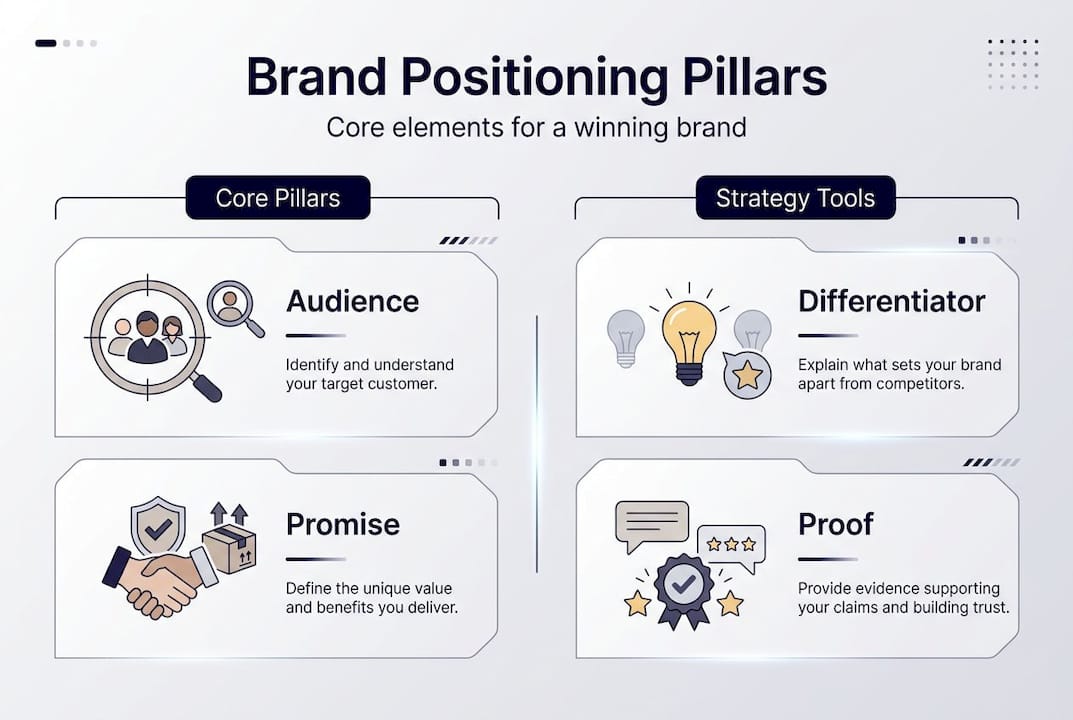
Now that you know what brand positioning is, let’s talk about what actually goes into one. Think of it like a recipe. Miss one ingredient and the whole dish falls flat. Key components include target audience, market category, USP, key benefit, and reason to believe. Here’s how each one works:
Pillar | Guiding question | Example |
Target audience | Who are you serving? | Busy mums aged 30 to 45 |
Market category | What space do you compete in? | Organic meal prep services |
Unique selling proposition | What makes you different? | Ready in 15 minutes, no compromise on nutrition |
Key benefit | What does the customer gain? | More family time, less kitchen stress |
Reason to believe | Why should they trust you? | Certified nutritionist, 500+ five-star reviews |
Each pillar answers a question your customer is already asking (even if they don’t say it out loud). When all five align, your positioning feels effortless and obvious. When they don’t, your marketing feels like shouting into a void.
Understanding these pillars also shapes your broader marketing strategy roles across every channel. And if you’re just starting to grow your brand online, these pillars give you a solid launchpad.
Pro Tip: Don’t try to be everything to everyone. The more specific your positioning, the more magnetic it becomes. Niche is not a dirty word. It’s a superpower.
How to craft a compelling brand positioning statement
Okay, you’ve got your pillars. Now it’s time to stitch them together into something you can actually use. Enter: the brand positioning statement. It’s not a tagline (we’ve been over this 😄). It’s an internal compass that guides every marketing decision you make.
The classic template looks like this: “For [target audience], [brand] is the [category] that [key benefit] because [reason to believe].” Simple, right? But the difference between a weak version and a strong one is enormous.
Weak statement | Strong statement |
We help people with their finances. | For freelancers overwhelmed by tax season, Clearbooks is the accounting tool that makes filing feel painless because it was built by a former freelancer who’s been there. |
We sell healthy food. | For busy parents in Vancouver, GreenPlate is the meal kit service that puts nutritious dinners on the table in under 20 minutes because every recipe is designed by a registered dietitian. |
See the difference? The strong versions are specific, emotional, and credible. They speak to a real person with a real problem.
Here’s how to write yours, step by step:
Define your target audience as specifically as possible (age, lifestyle, pain point)
Name the market category you compete in (be honest, not aspirational)
Identify your single most compelling benefit (just one, not five)
Write your reason to believe (proof, credentials, track record)
Plug it all into the template and read it out loud
Refine until it sounds like something a real human would say
You can find brand positioning templates and explore content creation for brand building to bring your statement to life across channels.
Pro Tip: Share your draft statement with three customers or trusted team members. If they say “yep, that’s you,” you’re on the right track. If they look confused, go back to step one.
Validating and activating your brand positioning
You’ve written your positioning statement. You’re feeling good. But before you plaster it everywhere, let’s make sure it actually holds up. Validation methods include competitive analysis and perceptual mapping, and activation means consistent messaging across every single touchpoint.
Start with a competitor audit. Map out how your top three to five competitors position themselves. Look for gaps. Is there a customer need nobody is addressing? That’s your opening. Then check your “reason to believe.” Is it genuinely credible? Testimonials, certifications, case studies, and data all count here.
Once validated, it’s time to activate. Here’s where your positioning needs to show up:
Your website homepage (especially the hero section)
Email marketing subject lines and body copy
Social media bios and post captions
Sales scripts and discovery call language
Physical signage, packaging, and in-store experience
Your marketing message alignment across all campaigns
Consistency is everything. If your Instagram sounds like a fun startup but your website reads like a 1998 corporate brochure, customers feel the disconnect. And disconnected customers don’t stick around.
Your branding and blog content is also a powerful activation channel. Every post you publish is a chance to reinforce your positioning in a natural, helpful way.
Pro Tip: Create a one-page internal brand messaging guide. List your positioning statement, key phrases, tone of voice, and what to avoid. Share it with everyone who communicates on behalf of your business. Consistency starts from the inside out.
If your positioning isn’t resonating after a few months, don’t panic. Treat it like a hypothesis, not a tattoo. Gather feedback, look at your data, and iterate. The best brands refine constantly.
Measuring and evolving your brand positioning
Here’s a truth that might sting a little: brand positioning is not a “set it and forget it” situation. It’s more like a garden. Ignore it and things get weedy fast. Regularly monitor metrics like market share, NPS, and brand recall to keep your positioning sharp and relevant.
For small businesses, the key metrics to watch include:
Brand recall (do people remember you unprompted?)
Net Promoter Score or NPS (would customers recommend you?)
Website engagement (time on site, bounce rate, return visits)
Market share trends (are you growing relative to competitors?)
Customer retention rate (are people coming back?)
Here’s a surprising one: companies that actively monitor their small business marketing metrics and adjust their positioning accordingly consistently outperform those that don’t in customer loyalty and long-term revenue growth. Positioning awareness pays off.
Here’s a simple quarterly review process to keep you on track:
Pull your key metrics and compare them to the previous quarter
Gather fresh customer feedback through a short survey (three to five questions max)
Review competitor positioning for any shifts or new entrants
Assess whether your messaging still reflects your current strengths and audience
Update your internal brand messaging guide if anything has changed
Share findings with your team and align on any adjustments
Tools like Google Analytics, simple NPS survey platforms, and even a well-crafted Instagram poll can give you real, actionable data without a massive budget. You don’t need a research department. You just need a habit of checking in.
Get help with your brand positioning journey
Even with a guide this thorough, putting it all into practice can feel like assembling IKEA furniture without the instructions (we’ve all been there). Sometimes you just need someone in your corner who’s done this before.

At M50 Media, Karl Lundgren works directly with small business owners to clarify, build, and activate brand positioning strategies that actually move the needle. Whether you’re starting from scratch or trying to figure out why your current positioning feels off, brand coaching for small business can give you the clarity and confidence to move forward. Not sure where to start? Book a free marketing SOS call and let’s figure it out together. No pressure, no jargon, just real talk about your brand.
Frequently asked questions
What is the difference between brand positioning and brand identity?
Brand positioning shapes broader perception in the marketplace, while brand identity covers the visual and verbal elements like logos, colours, and tone. Think of positioning as the strategy and identity as the expression of it.
How often should I review my brand positioning?
Regular reviews keep positioning effective in changing markets, so aim for at least once a year or whenever your audience, competitors, or offerings shift significantly.
What are some signs my brand positioning isn’t working?
If customers struggle to describe what makes you different, or you’re constantly competing on price, those are red flags. Weak market performance signals that your positioning needs a rethink.
Can I reposition my brand without a full rebrand?
Absolutely. Positioning updates can happen without changing your logo or visual identity at all. Clarifying your message, narrowing your audience, and sharpening your key benefit can shift perception significantly on their own.
Recommended
Comments