Content pillars explained: unlock brand growth in 2026
- karl7209
- Apr 17
- 8 min read

TL;DR:
Content pillars are core topics that provide structure and consistency in marketing efforts.
Choosing three to five relevant pillars helps small businesses build trust and improve content efficiency.
Regularly reviewing and adjusting pillars ensures ongoing relevance as business and audience needs evolve.
If you’ve ever stared at a blank screen wondering what to post next, you’re not alone. Most small business owners treat content like a random lucky dip, tossing out posts and hoping something sticks. Spoiler: it rarely does. The businesses that consistently show up, build loyal audiences, and grow their brand aren’t just winging it. They’re working from a set of content pillars, foundational topics that anchor every piece of marketing they create. In this article, we’ll break down exactly what content pillars are, why they matter more than you think, and how to build your own framework from scratch.
Table of Contents
Key Takeaways
Point | Details |
Pillars simplify strategy | Content pillars help small businesses focus their marketing and build a recognizable brand. |
Choose pillars mindfully | Select pillars based on customer needs and industry trends for maximum relevance. |
Pillars boost consistency | Using pillars ensures your messaging stays clear and unified across platforms. |
Apply pillars everywhere | Content pillars drive results for social media, websites, print, and events. |
What are content pillars and why do they matter?
Let’s clear something up right away. Content pillars aren’t some fancy marketing buzzword invented to make consultants sound smarter at networking events. They’re actually a brilliantly simple concept. A content pillar is one of the core topics or themes your brand consistently creates content around. Think of them as the load-bearing walls of your marketing house. Remove them, and the whole thing collapses into a pile of random posts and confused followers.
For small businesses, pillars are a game-changer. Without them, you’re basically showing up to every party with a different personality. Your audience never knows what to expect from you, and that unpredictability is the enemy of trust. Content pillars help brands organise their messaging around themes that matter most to their audience, which means every post, blog, reel, or email you create has a clear home base.
Here’s why pillars matter so much for your business specifically:
They save you serious time (no more 45-minute staring contests with a blank screen)
They keep your brand voice consistent across platforms
They make content planning feel less like pulling teeth
They help your audience understand exactly what you stand for
They improve your SEO by building topical authority over time
For most small businesses, strong pillars tend to fall into a few key categories. Your expertise (what you know), your solutions (what you solve), customer stories (social proof that warms hearts), and behind-the-scenes content (the human side of your brand). That’s a solid starting lineup right there.
Pro Tip: Resist the urge to pick pillars that sound impressive but don’t actually reflect your business. Generic pillars like “innovation” or “excellence” are about as useful as a chocolate teapot. Pick themes your audience genuinely cares about.
“A clear pillar strategy is less about being everywhere and more about being unmistakably you, consistently.” Pair that with smart content marketing tips and you’ve got a recipe for real traction.
Here’s a quick look at how pillar-based content compares to random posting:
Approach | Consistency | Audience trust | Time efficiency | SEO benefit |
Random posting | Low | Unpredictable | Poor | Minimal |
Pillar-based content | High | Strong | Excellent | Significant |
The data really does speak for itself here. Pillars aren’t just a nice-to-have. They’re the backbone of a content strategy that actually works.
How to identify strong content pillars for your business
Understanding what pillars are is just the beginning. Next, let’s explore how you can identify and select the ones that fit your business best. Because picking the wrong pillars is like buying shoes in the wrong size. Technically shoes, but not doing the job they should.
Start by asking yourself a few honest questions. What do your customers ask you about most often? What problems do you solve better than anyone else? What topics could you talk about for hours without getting bored? Your answers are basically a treasure map pointing straight to your pillars.
Successful small businesses group their content by pillar to streamline workflows and maximise impact, which is why getting this selection right matters so much.
Here’s a simple step-by-step process to identify your pillars:
List your top five customer pain points or questions
Identify the topics you have genuine expertise in
Research what your competitors are (and aren’t) covering
Check your existing content to see what’s already resonating
Narrow your list down to three to five core themes
Not sure whether to go broad or niche with your pillars? Here’s a handy comparison:
Pillar type | Best for | Risk | Reward |
Broad | New businesses building awareness | Less differentiation | Wider reach |
Niche | Established brands with a clear audience | Smaller reach | Stronger authority |
The biggest mistake most small business owners make? Choosing too many pillars. Five is the sweet spot for most businesses. More than that and you’re back to the chaos you were trying to escape. Use your content workflow tips to keep things manageable once your pillars are locked in.

Pro Tip: Run your shortlisted pillars by a loyal customer or two. If they nod enthusiastically when you describe them, you’re on the right track. If they look confused, back to the drawing board!
Real examples: Content pillars that drive business growth
With a selection strategy in place, let’s see what content pillars look like when applied to real businesses. Because theory is great, but examples are where things get exciting.
Imagine a local fitness studio. Their pillars might be: workout tips, nutrition advice, client transformation stories, and behind-the-scenes studio life. Every single piece of content they create fits neatly into one of those buckets. No confusion, no random posts about their weekend hike (unless it fits the fitness angle, of course).
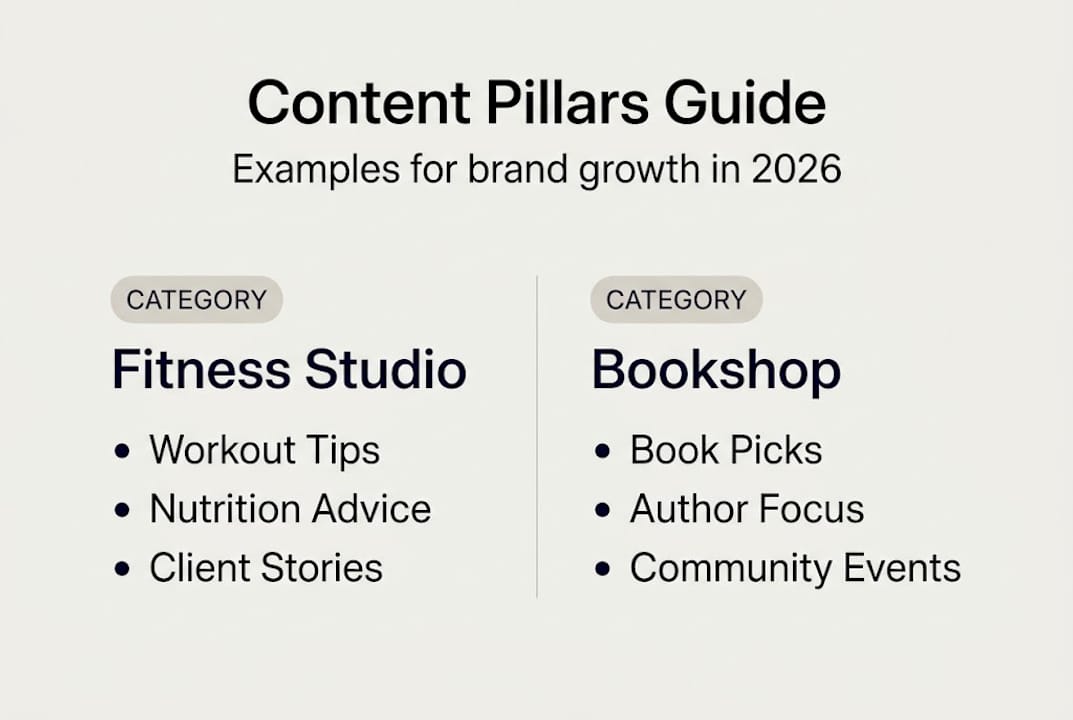
Now picture an independent bookshop. Their pillars could be: book recommendations, author spotlights, reading community events, and staff picks. Totally different business, same principle at work.
Digital marketing teams use content pillars like “How-to guides”, “Product stories”, and “Customer testimonials” to consistently engage their audiences, and the results speak for themselves in terms of brand recognition and loyalty.
Here are some real-world pillar sets worth borrowing inspiration from:
A bakery: Recipes and baking tips, behind-the-scenes kitchen content, seasonal specials, customer celebrations
A marketing consultant: Strategy tutorials, client success stories, industry news and commentary, tool reviews
A clothing boutique: Style guides, new arrivals, sustainable fashion education, customer outfit features
A plumber: DIY maintenance tips, project showcases, emergency advice, team introductions
Notice how none of these are vague or generic? Each pillar has a clear purpose and a clear audience benefit. That’s the magic. When your audience knows what to expect from you, they keep coming back. It’s as reliable as a Tim Hortons on every corner (and just as comforting, honestly).
Consistency is the real secret sauce here. Brands that stick to their pillars over months and years build a kind of content reputation. Audiences start to associate them with specific topics, and that association is worth its weight in gold when it comes to staying top of mind. Keep an eye on the latest marketing trends to make sure your pillars stay relevant as the landscape shifts.
Putting content pillars into practice: Social media and beyond
The value of pillars becomes fully apparent when you start using them. Let’s see how they work in action, especially on platforms where small businesses thrive.
The most practical way to activate your pillars is through a content calendar. Assign each pillar a set number of posts per week or month, then fill in the specifics from there. If you have four pillars and post five times a week, you’ve already got a rotation that keeps things varied without being chaotic.
Brands that align their social media with clear content pillars see up to 30% faster customer growth, which is a pretty compelling reason to get organised.
Here’s what pillar-based posting might look like in practice:
Monday: Share an expert tip from your “expertise” pillar
Wednesday: Post a customer story or testimonial from your “social proof” pillar
Friday: Go behind the scenes with your “brand culture” pillar
Sunday: Offer a helpful resource from your “solutions” pillar
For tracking performance, check your analytics weekly and look for patterns by pillar. Which themes get the most saves, shares, or comments? That data tells you exactly where to double down. Check out these social media tips for more on reading your results effectively.
Pro Tip: Batch-create content by pillar. Sit down and write five posts for your “expertise” pillar in one session. It’s faster, more cohesive, and saves you from the dreaded daily content scramble. Need inspiration? These creative post ideas can spark your next batch session.
“Pillar-based content isn’t about being rigid. It’s about giving yourself a framework so creativity can actually flourish.”
The biggest mistake in execution? Treating pillars as a one-time setup and never revisiting them. Your business evolves, your audience grows, and your pillars should too. Review them every six to twelve months and adjust as needed. Understanding the broader social media benefits will help you appreciate just how much a structured pillar approach amplifies your results across every platform.
A fresh perspective: Why most small businesses underestimate the power of content pillars
Here’s the thing most marketing articles won’t tell you. Content pillars aren’t just a marketing tactic. They’re a form of business discipline. When you commit to a set of pillars, you’re essentially making a promise to your audience about who you are and what you stand for. That’s a big deal.
We’ve seen businesses triple their engagement simply by narrowing their focus from ten vague topics to four sharp pillars. The counterintuitive truth? Less really is more. Trying to talk about everything means you’re saying nothing memorable to anyone.
The brands that grow fastest aren’t the loudest. They’re the most consistent. A solid content marketing strategy built around clear pillars creates a compounding effect over time. Each piece of content reinforces the last, building authority and trust with every post. Think of it like compound interest for your brand reputation. Start small, stay consistent, and watch it grow into something genuinely powerful.
Get expert support to build your content pillars
Ready to stop guessing and start growing? Building a pillar strategy that actually fits your business takes more than a good idea. It takes the right guidance, a clear plan, and someone in your corner who’s done it before.

At M50 Media, we help small business owners and entrepreneurs build content strategies that are focused, effective, and actually enjoyable to execute. Whether you’re starting from scratch or refining what you’ve already got, our business coaching and digital coaching programmes are designed to get you moving fast. Not sure where to start? Book a marketing SOS call and let’s figure it out together. Your pillars are waiting!
Frequently asked questions
How many content pillars should a small business use?
Most small businesses succeed with three to five pillars, ensuring focus and manageable content planning. Grouping content around 3 to 5 pillars streamlines workflow and maximises impact without overwhelming your team.
Can content pillars change over time?
Content pillars should be reviewed annually and adjusted as business goals or audience needs evolve. As pillars adapt as your brand and customer base grow, regular reviews keep your strategy fresh and relevant.
What’s the best way to track content pillar performance?
Monitor results by pillar in your analytics dashboard to spot which themes drive engagement and sales best. Tracking pillar performance reveals which messages resonate most with your specific audience.
Do content pillars work for non-digital marketing?
Yes, pillars provide structure for print and event marketing as well, ensuring your messaging is consistent across all channels. Pillars unify messaging whether online or offline, making your brand feel cohesive everywhere your audience encounters it.
Recommended
Comments