Email marketing guide for small business growth

TL;DR:
Email marketing offers high ROI and full control over audience data for small businesses.
Building a targeted, segmented list with clear consent is essential for successful campaigns.
Consistent, personalized emails with valuable content foster relationships and drive sales.
You’ve got a great product, a solid website, and a handful of social media followers who occasionally double-tap your posts. But converting those casual browsers into actual paying customers? That’s where things get a little… crickets. 🦗 Here’s the good news: email marketing is still one of the most powerful, cost-effective tools available to small business owners, and you don’t need a massive budget or a marketing degree to make it work. This guide walks you through every step, from setting up your tools to automating your campaigns, so you can start turning subscribers into loyal customers right away.
Table of Contents
Key Takeaways
Point | Details |
Start simple | You don’t need complex tools or a big list to get results from email marketing. |
Segment your list | Organising your subscribers lets you send more relevant content, boosting engagement. |
Focus on value | Consistent, helpful emails—no matter how often—build trust and long-term sales. |
Use automation | Automated flows save you time and ensure timely, targeted communication. |
Measure and adapt | Regularly review your data and tweak campaigns for better results over time. |
Why email marketing matters for small businesses
Let’s be honest. Social media is fun. It’s flashy, it’s social, and it feels productive when you’re scrolling through it at 11 pm “doing research.” But here’s the thing: you don’t own your social media audience. One algorithm change and poof, your reach drops like a soufflé in a thunderstorm. Email is different. It’s a direct line to your customers, sitting right there in their inbox.
“Email marketing consistently delivers one of the highest returns on investment of any digital channel, making it a non-negotiable tool for small business growth.”
Building an email list is one of the smartest moves you can make as a small business owner because that list belongs to you. No platform can take it away. And the benefits of email marketing go well beyond just sending a newsletter once in a blue moon.
Here’s a quick look at how email stacks up against other digital channels:
Channel | Average ROI | Audience ownership | Personalisation | Cost |
Email marketing | Up to 42:1 | Full control | High | Low |
Social media (organic) | Variable | Platform-dependent | Medium | Low |
Paid social ads | Variable | None | Medium | High |
SEO/content | Long-term | Partial | Low | Medium |
The numbers speak for themselves. Now here’s what email marketing specifically does for small businesses:
Lets you communicate directly with customers who already said “yes, I want to hear from you”
Allows personalisation based on purchase history, interests, and behaviour
Scales beautifully as your business grows, without costs skyrocketing
Drives repeat purchases and keeps your brand top of mind
Gives you full ownership and control of your audience data
Pretty compelling, right? Let’s get you set up.
Setting the foundation: Tools and preparation
Before you send a single email, you need a solid foundation. Think of it like building a house. You wouldn’t skip the blueprint and just start hammering nails (well, hopefully). The same logic applies here.
First, the legal stuff. Canadian businesses must comply with Canada’s Anti-Spam Legislation, known as CASL. This means you need explicit consent from subscribers before sending commercial emails. No buying lists. No sneaky pre-checked boxes. Real, genuine permission. Get that sorted first and you’ll sleep much better at night.
Next, you’ll need the right tools. Choosing the right email marketing tools is critical for efficiency, especially when you’re juggling a hundred other things as a small business owner. Here’s what to look for:
An email service provider (ESP) like Mailchimp, Klaviyo, MailerLite, or Constant Contact
A simple design tool like Canva for creating visuals and branded templates
An analytics dashboard (most ESPs have this built in)
A landing page or signup form builder (again, often included in your ESP)
A link to trusted software recommendations if you want vetted options
Here’s how some popular platforms compare for small businesses:
Platform | Free plan | Automation | Ease of use | Best for |
Mailchimp | Yes (up to 500) | Yes | Beginner-friendly | General small business |
MailerLite | Yes (up to 1,000) | Yes | Very easy | Budget-conscious owners |
Klaviyo | Limited | Advanced | Intermediate | E-commerce |
Constant Contact | Trial only | Basic | Easy | Service businesses |
Pro Tip: Start with a free or low-cost plan and only upgrade when your list or needs outgrow it. There’s zero shame in starting small. Even the biggest email empires started with a list of twelve people (one of whom was probably their mum).
Building and segmenting your email list
Tools? Check. Legal compliance? Check. Now it’s time to actually build your list. And no, “build it and they will come” is not a strategy. (Sorry, Field of Dreams fans.)
Here’s a step-by-step approach to collecting subscribers legally and effectively:
Create a clear value proposition. Tell people exactly what they’ll get by subscribing. “Get weekly tips on saving money” beats “Sign up for our newsletter” every single time.
Add a signup form to your website. Homepage, footer, blog posts, and pop-ups (used sparingly) are all prime real estate.
Collect emails at checkout if you sell products or services online.
Promote your list on social media with a compelling reason to join.
Capture emails at in-person events, markets, or pop-ups using a tablet or simple sign-up sheet.
Ensure every signup includes a clear consent statement that meets CASL requirements.
Smart places to capture emails include:
Your website homepage and blog sidebar
Checkout pages (online and in-store)
Social media bios and posts
Webinars or online workshops
Local events and trade shows
Referral programmes where existing subscribers invite friends
Once you’ve got subscribers rolling in, segmentation is your secret weapon. Segmentation means dividing your list into smaller groups based on shared traits. Think: new subscribers vs. loyal customers, people who bought Product A vs. Product B, or those who haven’t opened an email in three months. A well-built and segmented list is the foundation for successful campaigns because it lets you send the right message to the right person at the right time.

Pro Tip: Offer a lead magnet to accelerate list growth. This could be a discount code, a free checklist, a mini guide, or even a short video tutorial. Something genuinely useful that makes signing up feel like a no-brainer. Because honestly, “get our newsletter” is not a lead magnet. It’s a yawn.
Crafting engaging email content and campaigns
Alright, your list is growing. Now comes the fun part: actually writing emails people want to read. (No pressure.)
Every effective email has a clear structure:
Subject line: This is your first impression. Make it curious, specific, or a little cheeky. “You’re missing out on this” works better than “August Newsletter.”
Preheader: The little snippet of text that appears after the subject line in the inbox preview. Use it to extend the hook, not repeat the subject line.
Body: Keep it focused. One main message per email. No one wants to read a novel on their phone while waiting for their coffee.
Call-to-action (CTA): One clear, compelling action. “Shop now,” “Read the post,” “Book your call.” One. Not six.
Great email content is the difference between a campaign that converts and one that collects dust in the promotions tab. Here are the types of campaigns that consistently perform well for small businesses:
Welcome emails: Sent immediately when someone subscribes. Set expectations and make a great first impression.
Promotional emails: Announce sales, new products, or limited-time offers.
Educational newsletters: Share tips, how-tos, or industry insights that build trust and authority.
Re-engagement campaigns: Win back subscribers who’ve gone quiet.
Customer stories or testimonials: Real people, real results. Incredibly persuasive.
Speaking of stories, don’t underestimate the power of content marketing for emails. Sharing a brief customer success story or a behind-the-scenes peek at your business creates connection. People buy from people they like and trust. Your emails should feel like a message from a friend, not a flyer shoved under the door.
“The best emails feel personal, even when they’re sent to thousands of people. That’s the magic of good storytelling combined with smart segmentation.”
Also, design for mobile. Over 60% of emails are opened on a phone. If your email looks like a jumbled mess on a small screen, it’s going straight to the bin. Use single-column layouts, large fonts, and buttons that are easy to tap with a thumb. Check out some email campaign examples if you want real-world inspiration.
Pro Tip: Run A/B tests on your subject lines. Send version A to half your list and version B to the other half, then see which one gets more opens. Even small tweaks (“Free guide inside” vs. “Your free guide is here”) can make a surprisingly big difference. Data over guesses, always.
Optimising results: Automation and analytics
Here’s where things get really exciting. Once your emails are going out, you can set up automation to do a lot of the heavy lifting for you. It’s like having a marketing assistant who never sleeps, never complains, and never accidentally replies-all to the entire company. 🙌
Here’s how to set up your core automated workflows:
Welcome sequence: Trigger this the moment someone subscribes. Send 2 to 3 emails over the first week introducing your brand, your story, and your best content.
Post-purchase follow-up: Thank customers, offer care tips, or suggest complementary products.
Birthday or anniversary email: A simple “happy birthday” with a small discount goes a long way.
Re-engagement campaign: If a subscriber hasn’t opened anything in 90 days, send a “We miss you” email. If they still don’t engage, it’s okay to remove them. A clean list is a healthy list.
Abandoned cart sequence (for e-commerce): Remind shoppers what they left behind. This one alone can recover serious revenue.
Streamlining email workflows pays off fast. In fact, businesses that use content automation see up to 5x output boost, which means more consistent communication without burning yourself out.
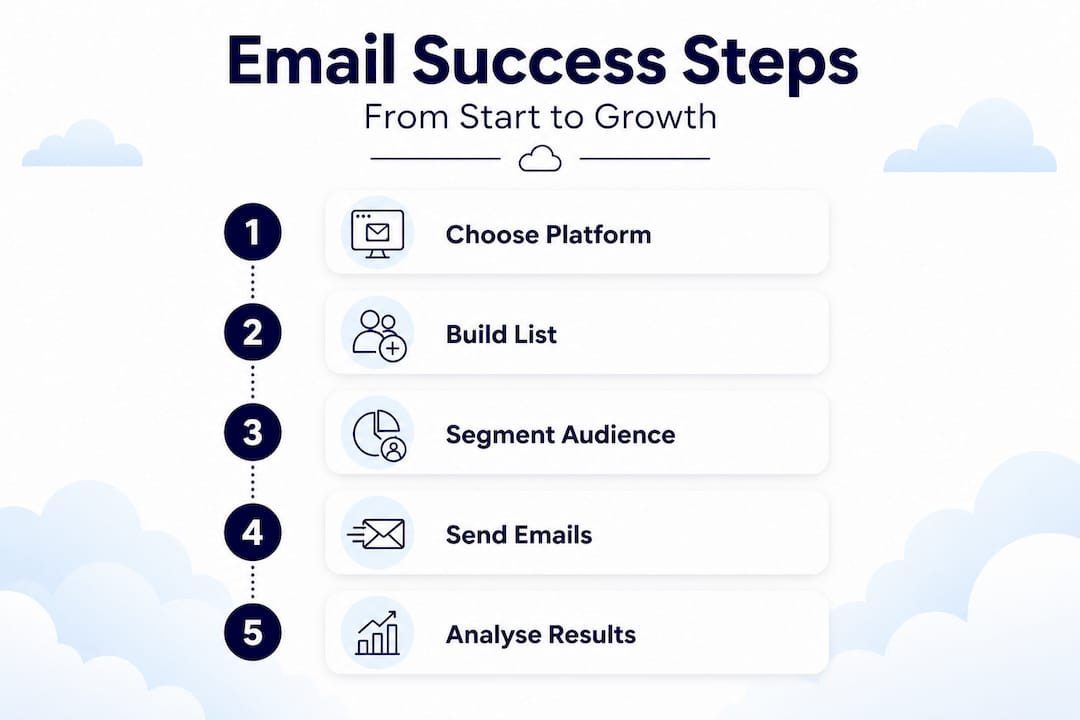
Now let’s talk analytics. Using analytics for email is how you stop guessing and start growing. Here are the key metrics to watch:
Metric | What it tells you | Healthy benchmark |
Open rate | Are people interested in your subject line? | 20 to 30% |
Click-through rate | Are people engaging with your content? | 2 to 5% |
Conversion rate | Are emails driving sales or sign-ups? | Varies by goal |
Unsubscribe rate | Are you sending too often or missing the mark? | Under 0.5% |
If your open rate is tanking, test your subject lines. If your click rate is low, revisit your CTA or the relevance of your content. Campaign analysis is not a one-time thing. It’s an ongoing conversation between you and your data. Check in monthly, adjust, and keep improving.
The unconventional key to email marketing success
Here’s something most email marketing guides won’t tell you: your list size matters a lot less than you think. We’ve seen small businesses with 200 subscribers outperform competitors with 20,000 because they showed up consistently and actually gave a hoot about their audience.
The obsession with growing a massive list fast is understandable. Bigger feels better. But a list of 500 people who genuinely love hearing from you will outperform a list of 10,000 cold, disengaged contacts every single time. Open rates, click rates, and actual sales all bear this out.
Consistent, monthly outreach with real value beats sporadic blasts to a giant list. Every time. We’ve watched business owners send one thoughtful email per month and build genuine community around their brand. Meanwhile, others send three emails a week, burn out their audience, and wonder why everyone’s unsubscribing.
Check out some real-world email campaign examples and you’ll notice a pattern: the most effective ones feel human. They’re not corporate. They’re not trying to sell you something every five seconds. They’re building a relationship.
So here’s our honest advice: pick a schedule you can actually stick to. Once a month is perfectly fine to start. Put it in your calendar like a non-negotiable appointment. Show up, deliver value, be genuine. That’s it. That’s the “secret.”
Trust compounds over time, just like interest in a savings account. The businesses that win with email are the ones that treat their subscribers like real people, not just potential transactions.
How M50 Media can help you master email marketing
You’ve now got a solid roadmap from zero to email marketing hero. But knowing the steps and actually executing them are two very different things, especially when you’re running a business at the same time. 😅
That’s exactly where M50 Media comes in. Whether you need help choosing the right platform, setting up your first automation, or reviewing a campaign that just isn’t clicking, personalized marketing coaching with Karl Lundgren gives you the real-world guidance to move forward with confidence. No fluff, no cookie-cutter advice. Just practical, tailored support built for small businesses like yours. Not sure where to start? Book a free Marketing SOS call and let’s figure it out together. Because you shouldn’t have to do this alone.
Frequently asked questions
What is the first step in email marketing for small businesses?
Start by choosing a reliable platform and ensuring your list-building practices comply with Canadian anti-spam laws (CASL). Getting the legal and technical foundation right saves you headaches down the road.
How often should I send emails to my subscribers?
Aim for consistent, value-driven emails. Monthly is a great starting point for most small businesses, and you can increase frequency as your audience grows and engagement improves.
What metrics should I track to evaluate email marketing success?
Key metrics include open rates, click-through rates, conversion rates, and unsubscribe rates. Tracking these consistently helps you spot what’s working and fix what isn’t.
How do I grow my email list quickly and legally?
Use lead magnets and signup forms across your website and social channels, and always get explicit consent. Effective list-building methods focus on genuine value exchange, not tricks.
Is email marketing effective for very small lists?
Absolutely. Even a small, engaged list of a few hundred subscribers can drive meaningful results when you communicate consistently and provide genuine value. Quality beats quantity every time.
Recommended
Why building an email list drives real growth for small businesses
Email marketing how to: boost engagement and sales in 2026 – Lind Creative
Comments