Harness social proof to build trust and grow sales

TL;DR:
Most eCommerce success relies on social proof, which builds trust by showcasing genuine customer reviews and stories. Displaying authentic, specific reviews early on significantly increases purchase likelihood, especially for higher-priced items, while poor management of negative or fake reviews can damage reputation. Strategically placing reviews on key pages and maintaining transparency enhances credibility, enabling small businesses to convert browsers into buyers more effectively.
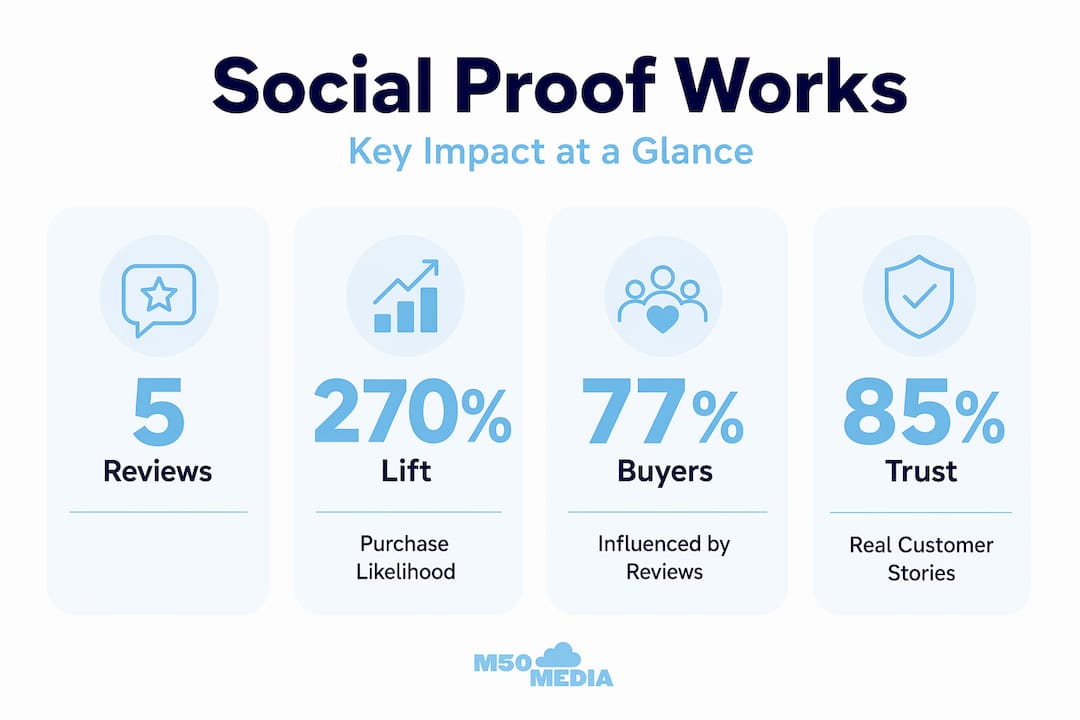
Imagine you’ve just launched your online shop, the products are gorgeous, the website looks sharp, and… crickets. Sound familiar? Here’s the thing most eCommerce entrepreneurs overlook: shoppers don’t trust you yet, they trust each other. In fact, displaying even five reviews on a product page is associated with a 270% greater purchase likelihood compared to showing none. That’s not a typo. A tiny handful of honest customer opinions can transform a lukewarm browser into a buyer faster than any flashy ad. This article breaks down the psychology, the evidence, the risks, and the practical tactics so you can put social proof to work immediately.
Table of Contents
Key Takeaways
Point | Details |
Small review threshold | Collecting just five credible reviews can create a huge jump in buyer confidence and sales conversion. |
Not all proof is good | Negative or fake reviews can hurt trust, so consistent monitoring and transparent responses are a must. |
Placement drives impact | Showing social proof at key touchpoints like the homepage, product pages, and checkout maximizes its conversion effect. |
Quality trumps quantity | Specific, detailed, and verified testimonials do more to build lasting trust than a flood of generic or unverified reviews. |
Ongoing strategy is key | A living process of collecting, curating, and displaying social proof keeps your business trustworthy and competitive. |
What is social proof and why does it matter?
Let’s start at the beginning. Social proof is not some fancy marketing buzzword invented in a boardroom. It’s actually rooted in psychology. Back in 1984, Dr. Robert Cialdini coined the term in his landmark book Influence, describing it as a fundamental trigger of human behaviour. Simply put, social proof is the tendency to look to others’ actions to determine how to behave, especially in uncertain situations.
“When we are unsure of what to do, we look at what others are doing and assume they know something we don’t.” — The Decision Lab
Sound familiar? Think about how you choose a restaurant. You’d probably pick the packed one over the empty one next door, even if the food is identical. The same psychological wiring kicks in when someone lands on your product page at midnight, credit card in hand, wondering if you’re legit.
Online, this uncertainty is amplified. Shoppers can’t touch the product, smell the candle, or try on the jacket. They’re making a leap of faith. Social proof bridges that gap. It’s essentially borrowed trust, the credibility of your existing customers handed off to your next one.
There are several types of social proof you can use in eCommerce and small business marketing:
Customer reviews and star ratings
Testimonials (written or video)
User-generated content (photos, videos, social posts)
Influencer or celebrity endorsements
Media mentions and press coverage
Trust badges and certifications
Real-time stats (e.g., “47 people viewing this right now”)
Case studies and success stories
You can dive deeper into how user-generated content and trust work together as a powerful combo for small businesses. And if you’re building trust online from scratch, layering multiple types of social proof is a smart play.
How social proof drives conversions: the evidence
Now that we understand what social proof is, let’s see exactly how it moves the needle for real-world conversions.
The numbers here are genuinely exciting (in a “run and tell your whole team” kind of way). Reviews boost purchase likelihood by 270% and the effect is even stronger for higher-priced items, where shoppers need more reassurance before parting with serious cash. And according to Trustpilot consumer research, 82% of shoppers say positive reviews make them more likely to purchase, with the biggest impact felt on homepages and product pages.
Here’s how the conversion uplift stacks up as reviews accumulate:
Number of reviews | Conversion uplift (lower-priced items) | Conversion uplift (higher-priced items) |
0 reviews | Baseline | Baseline |
1 to 4 reviews | Moderate uplift | Significant uplift |
5 to 10 reviews | Strong uplift (~270%) | Very strong uplift |
11 to 50 reviews | Continued growth | Continued growth |
50+ reviews | Diminishing marginal returns | Steady, credible trust signal |
The pattern here is clear. The first five reviews do the heavy lifting. After that, each additional review still adds value, but the jaw-dropping leaps happen early. For higher-ticket items like electronics, courses, or premium goods, the trust signal is even more critical because buyers are taking a bigger financial risk.
There’s also a nuance around star ratings. A perfect 5.0 can actually look suspicious (more on that in the next section). Ratings between 4.2 and 4.7 tend to perform best because they feel believable. Shoppers trust human, not perfect.
You can explore how reviews boost sales for small businesses specifically, and how social commerce and sales growth are increasingly intertwined. For more on the financial upside, the revenue growth from reviews data is eye-opening.
Pro Tip: Don’t wait until you have 50 reviews to start showcasing them. Hit that five-review threshold first, then focus on quality and specificity. A detailed review mentioning your product’s exact benefit beats ten vague “great product!” comments every single time.
Navigating risk: the double-edged sword of social proof
Social proof isn’t always positive, so let’s review how businesses can avoid the common pitfalls and protect against reputation threats.
Here’s the uncomfortable truth: bad social proof can hurt you more than having no social proof at all. A whopping 77% of consumers say negative reviews make them less likely to choose a business. That’s not a small margin. That’s nearly four out of five shoppers walking away.
And it gets trickier. Fake reviews (whether suspiciously glowing or unfairly negative) erode credibility fast. Savvy shoppers can spot a manufactured five-star flood from a mile away. It’s like showing up to a potluck with store-bought cookies in a Tupperware container claiming you baked them yourself. Everyone knows. Nobody is impressed.
Here’s how different types of social proof stack up from a trust perspective:
Type of social proof | Trust impact | Conversion impact |
Genuine positive reviews | High | High |
Genuine negative reviews (responded to well) | Medium (builds authenticity) | Neutral to positive |
Ignored negative reviews | Low | Negative |
Fake or incentivised reviews | Very low (if discovered) | Very negative |
No reviews at all | Neutral | Missed opportunity |
So what can you actually do to protect yourself? Here are the practical steps:
Monitor review platforms regularly (set up Google Alerts for your brand name)
Respond to every review, positive and negative, within 48 hours
Never incentivise reviews with discounts or gifts without full disclosure
Ask for reviews at the right moment (post-delivery, after a positive interaction)
Use verified purchase badges wherever possible to signal legitimacy
Flag and report genuinely fake reviews through the platform’s official process
Train your customer service team to treat complaints as trust-building moments
Managing your ecommerce marketing and risk proactively is way smarter than scrambling after a bad review goes viral. And if you need a solid framework, this reputation management guide is a great resource.
Pro Tip: Don’t delete genuine bad reviews. Seriously. A thoughtful, empathetic response to a negative review actually boosts credibility. It shows you’re human, you care, and you fix things. That’s gold.
Where and how to showcase social proof for maximum effect
Understanding risk is only half the puzzle. Next, let’s clarify where and how to showcase your strongest proof for maximum influence.
Here’s something that surprises a lot of business owners: placement matters just as much as volume. You could have 200 glowing reviews buried in a tab nobody clicks, and they’d be doing almost nothing for you. According to Trustpilot research, social proof on homepages influenced 86% of buyers and on product pages influenced 85%. Those are the two highest-impact real estate spots on your entire site.
The Baymard Institute also highlights that trust cues at key decision points, particularly during checkout, have a measurable effect on whether shoppers complete their purchase or abandon their cart. Strategically placed reassurance at high-anxiety moments is a conversion superpower.
Here’s a step-by-step approach to matching the right proof to the right spot:
Homepage: Use aggregate star ratings, media mentions, or a short rotating testimonial. This establishes broad brand credibility immediately. Think of it as a warm handshake.
Category pages: Display review counts and average ratings on product thumbnails. Shoppers scanning options use these as quick filters.
Product detail pages: Feature two to three detailed, specific reviews near the buy button. Include photos if possible. Specificity wins.
Checkout page: Add a reassurance badge, a brief “trusted by X customers” line, or a relevant testimonial. This is where cart abandonment peaks, so calm those last-minute nerves.
Email campaigns: Include a star rating snippet or customer quote in post-purchase and re-engagement emails. Social proof works in inboxes too.
Social media: Reshare user-generated content (with permission), customer stories, and real-life product photos. Authenticity here is everything.
Leveraging user-generated content and real customer stories creates a depth of engagement that stock photography simply cannot match. And if you want to build a trust framework that feels good AND does good, check out how ethical trust-building fits into your strategy. For a more advanced look at placement strategies, these advanced social proof strategies are worth bookmarking.
Turning insight into action: social proof tactics for small businesses
It’s time to move from ideas to action. Let’s break down tactics you can use this week.
One important reality check first: only about 49% of consumers say they trust online reviews as much as personal recommendations. That number has been declining as fake review culture grows. This is why quality, verification, and credibility cues are no longer optional extras, they’re essential.
Here’s your action list to gather and deploy social proof that actually works:
Ask at the right moment. Send a review request 3 to 7 days after product delivery, when the excitement is still fresh. Timing is everything.
Make it ridiculously easy. Include a direct link to your review page. Don’t make customers hunt for where to leave feedback.
Use automated follow-up tools. Email platforms and eCommerce integrations can trigger review requests automatically after purchase milestones.
Encourage specificity. Ask customers to mention the product name, the problem it solved, and who they’d recommend it to. This creates richer, more useful reviews.
Display verified proof prominently. Use “verified purchase” or “verified buyer” labels to signal authenticity to sceptical shoppers.
Curate, don’t fabricate. Choose your most detailed, authentic reviews to feature rather than cherry-picking only the most effusive ones.
Audit your proof quarterly. What’s visible? What’s outdated? What’s missing? A regular review audit keeps your social proof fresh and relevant.
Repurpose reviews as content. Turn strong testimonials into social media posts, email subject lines, or homepage headline copy.
You can see how content-led approaches work in practice through these content marketing success stories from small businesses. And for frameworks around gathering feedback strategically, explore these customer feedback strategies that tie directly to revenue growth.
Pro Tip: Don’t “set and forget” your social proof. Schedule a 30-minute audit every quarter to remove outdated testimonials, refresh featured reviews, and check that your star ratings are displaying correctly on all pages. Compounding trust is built through consistency, not a one-time setup.
What most small businesses miss about social proof
With tactics in hand, let’s step back and challenge the usual thinking about social proof’s real value.
Here’s an opinion that might ruffle some feathers: most small businesses treat social proof like a participation trophy. They collect a few reviews, slap them on a homepage, and call it done. But that’s confusing decoration with strategy.
The honest truth is that chasing review volume is often a distraction. After a credibility threshold is reached (somewhere around 15 to 30 solid reviews for most product categories), the marginal trust gain from each new review drops significantly. What matters infinitely more is the quality and specificity of what your existing customers are saying.
A single testimonial that says “this moisturiser cleared my cystic acne after 3 weeks and I’ve tried everything” is worth more than 40 generic five-star ratings. Why? Because it speaks directly to a real person with a real problem. It creates a “that’s me!” moment for the right buyer. That’s the moment conversion magic happens.
Social proof is really a customer conversation happening in public. Your job isn’t to game the system, it’s to make that conversation as honest and useful as possible. The businesses that win long-term are the ones treating testimonials as genuine authenticity and trust signals, not as marketing ornaments.
There’s also an ethical marketing perspective worth considering here: when you build your social proof strategy on genuine customer experiences, you’re not just boosting conversions, you’re building a brand reputation that compounds over years, not just weeks.
Stop counting stars. Start listening to the stories behind them.
Level up your trust strategy with expert guidance
You’ve now got the psychology, the data, the risk management playbook, and the tactical framework. But knowing is only half the battle, implementing it well is where most small businesses get stuck.

Whether you’re starting from zero reviews or trying to clean up a messy reputation, having an expert in your corner makes the process faster and far less frustrating. At M50 Media, we help small business owners and eCommerce entrepreneurs build trust strategies that actually convert. From a focused SOS marketing call to dig into your specific situation, to ongoing business coaching that covers everything from review strategy to full digital presence, we’ve got practical support at every level. You can also explore digital coaching support to get personalised guidance on your social proof and trust-building game plan. Let’s turn your customers’ voices into your most powerful marketing asset. 🚀
Frequently asked questions
How many reviews do I need to see a conversion boost?
Getting to at least five reviews per product is your first milestone, since five reviews yield a 270% lift in purchase likelihood compared to zero, making that early threshold the most impactful stage.
Does negative social proof always hurt sales?
Not necessarily. While 77% of consumers say negative reviews reduce their likelihood to buy, a well-handled public response can actually rebuild trust and demonstrate that your business genuinely cares about customers.
Where should I display social proof on my site for best results?
Prioritise your homepage and product pages first, since 86% of buyers are influenced by proof on homepages and 85% on product pages, making these the highest-impact placements.
How can I make my reviews seem more credible and trustworthy?
Use verified purchase labels, encourage reviewers to be specific about their experience, and respond transparently to all feedback, since only about 49% of consumers currently trust online reviews, meaning credibility signals are critical.
Can social proof backfire if overused or managed poorly?
Absolutely. Fake, repetitive, or unverified reviews can destroy trust quickly, so the risk of low-integrity reviews making your brand look less credible is very real. Balance volume with authenticity always.
Recommended
Comments