How to grow your audience: a guide for small businesses
- karl7209
- May 31
- 9 min read
TL;DR:
Growing your audience in 2026 requires choosing a niche, focusing on one platform, and maintaining consistent daily content for 100 days. Building an engaged email list alongside social media ensures ownership, stability, and better monetization, while prompt engagement boosts reach. Patience and authenticity are essential for sustainable growth, with long-term success depending on consistent effort and relationship building.
Audience growth is defined as the process of building an engaged, loyal following that you can reach, serve, and eventually sell to. If you want to know how to grow your audience in 2026, the short answer is this: pick one niche, commit to one platform, publish daily for 100 days, and start an email list from day one. That’s it. Not glamorous, but it works. Tools like Beehiiv and ConvertKit handle the email side beautifully, while content formats like Reels and carousels do the heavy lifting on social. The rest of this guide walks you through each piece of that framework so you can stop guessing and start growing.
How to grow your audience by choosing the right niche and platform

The fastest path to audience growth is specificity. When you try to speak to everyone, you end up connecting with no one. A niche is simply a focused topic or community where you can be the go-to person. Think “bookkeeping for Etsy sellers” instead of “small business finance.” The narrower your focus, the easier it is for the right people to find you and stick around.
Choosing your primary platform comes down to one question: where does your audience already spend time? Here’s a quick breakdown to help you decide:
Instagram and TikTok reward visual, short-form content and are ideal for product-based businesses, coaches, and creatives.
LinkedIn suits B2B service providers, consultants, and anyone selling to other businesses.
YouTube works best for long-form education, tutorials, and review-based content.
Pinterest is a discovery engine for food, fashion, home décor, and DIY niches.
Facebook Groups still deliver strong community engagement for local businesses and niche hobbyist markets.
The biggest mistake small business owners make is trying to be everywhere at once. Spreading your energy across five platforms means you produce mediocre content on all of them instead of excellent content on one. Build your presence on a single platform first, get traction, then expand. Your niche and your platform should feel like a natural match. A wedding photographer posting daily on LinkedIn is going to have a rough time. An Etsy candle maker posting Reels on Instagram? That’s a love story. ️
What content publishing strategy actually grows your following?
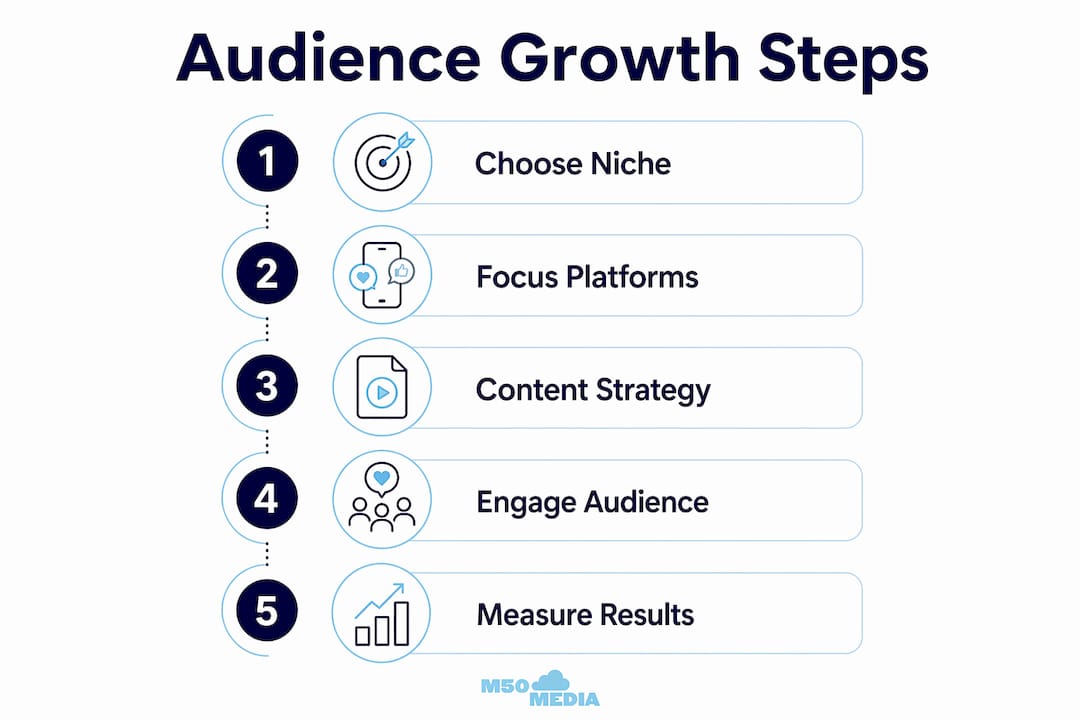
Consistency is the single most important factor in audience growth, and the data backs that up. Platform algorithms in 2026 reward consistent posting and early engagement signals, which means showing up irregularly is basically invisible to the algorithm. Volume beats perfection, especially early on.
Here is a practical publishing framework you can start this week:
Commit to one post per day for 100 days. This sounds intense, but it is the minimum threshold for building consistent audience and developing your content instincts. Most people quit at day 12. Don’t be most people.
Use Reels for reach and carousels for engagement. Reels generate 36% more reach than standard posts, while carousels drive 12% more engagement. Use Reels to attract new eyes and carousels to deepen the relationship with people already following you.
Batch your content once a week. Set aside two to three hours on a Sunday to film, write, and schedule your content for the week. Tools like Buffer, Later, or Meta Business Suite make scheduling painless.
Write hooks that stop the scroll. The first line of your caption and the first second of your video are everything. “I lost $10,000 on my first product launch. Here’s what I learned.” beats “Hey guys, welcome back!” every single time.
End every post with a call to action pointing to an owned channel. Ask people to join your email list, reply to your story, or visit your link in bio. Social discovery is great, but you want to move people somewhere you control.
Pro Tip: Repurpose one long-form piece of content (a blog post, podcast episode, or YouTube video) into five to seven shorter social posts each week. You are not creating more content. You are just slicing it differently.
Weak hooks and inconsistent publishing are the two most common reasons small businesses stall out. Fix those two things and you will outperform 80% of your competitors without doing anything else differently.
Should you build an email list alongside your social media?
Yes. Full stop. Social media offers discovery but not control. An algorithm change, an account suspension, or a platform going the way of Vine can wipe out years of work overnight. Your email list is yours. Nobody can take it away.
Here is how social followers and an email list compare:
Feature | Social media followers | Email list subscribers |
Ownership | Platform owns the relationship | You own the relationship |
Reach | Algorithm-dependent (often 2 to 10%) | Direct delivery (avg. 20 to 40% open rates) |
Monetisation | Ad revenue or brand deals | Direct sales, offers, and promotions |
Portability | Locked to the platform | Exportable and transferable |
Long-term value | Vulnerable to algorithm shifts | Stable, compounding asset |
Beehiiv and ConvertKit are the two best tools for small businesses starting an email list. Beehiiv is ideal if you want a newsletter-first approach with built-in growth tools. ConvertKit (now rebranded as Kit) is better for creators who want automation and tagging from day one. Both have free tiers that are genuinely useful. Start with whichever feels less intimidating and upgrade when you need to.
Your opt-in offer (also called a lead magnet) is what convinces someone to hand over their email address. A free checklist, a mini-course, a discount code, or a swipe file all work well. The key is that it solves one specific problem your audience has right now. “Free guide to 10 things” is weak. “The exact email sequence I used to book 12 clients in 30 days” is irresistible.
A smaller, engaged email list with a 40% open rate outperforms a bloated list of 50,000 cold subscribers with a 5% open rate. Quality beats quantity every time. Focus on attracting the right people, not just more people.
Pro Tip: Add a link to your email opt-in in every single social post, story, and bio. Treat it like a reflex. Every piece of content you create should have one job: move people toward your list.
Engagement tactics that actually increase your reach
Engagement is not just a vanity metric. Replying to comments within 15 to 20 minutes after posting boosts engagement by 21% and sends a strong signal to the algorithm that your content is worth distributing further. That is a free reach boost hiding in plain sight.
Here are the engagement habits that move the needle:
Reply to every comment in the first 20 minutes after posting. Set a timer if you need to. This is the single highest-leverage activity you can do right after hitting publish.
Use polls and question stickers in Stories. Interactive content invites participation, and participation tells the algorithm your audience is genuinely interested. Instagram Stories with polls get significantly higher tap-through rates than passive image posts.
Ask questions in your captions. “What’s the biggest challenge you face with [topic]?” generates replies, which generate reach. Simple but wildly effective.
Encourage user-generated content. Ask your customers to tag you when they use your product or service. Repost their content (with credit). This builds community and gives you free content at the same time.
Turn audience questions into new content. If three people ask you the same question in your comments or DMs, that is your next post. Your audience is literally handing you a content calendar.
Pro Tip: Check your audience engagement strategies weekly and identify which posts generated the most replies. Double down on those topics and formats. The algorithm is telling you what your audience loves. Listen to it.
Engagement is not just about growth. It is about relationship building. People buy from people they trust, and trust is built through consistent, genuine interaction. Treat every comment like a conversation starter, not a notification to dismiss.
How do you measure and optimise your audience growth?
You cannot improve what you do not measure. The good news is that most platforms give you free analytics that are genuinely useful if you know what to look for.
Metric | What it tells you | What to do with it |
Reach | How many unique accounts saw your content | Track weekly to spot growth trends |
Engagement rate | How actively your audience interacts | Aim for 3 to 6% on Instagram |
Email open rate | How compelling your subject lines are | Test different subject line styles |
Click-through rate | How persuasive your content and CTAs are | Improve your offers and link placement |
Follower growth rate | Net new followers over time | Identify which content types drive growth |
Weekly data audits and retention graphs help you identify exactly where your audience loses interest, so you can fix your hooks and improve your content value. Watch where people drop off in your Reels or stop reading your carousels. That drop-off point is your problem to solve.
Avoid chasing vanity metrics like follower count. A thousand engaged followers who open your emails and buy your products are worth more than 100,000 passive scrollers who never interact. Focus on reach, engagement rate, and email open rates as your core growth indicators. Adjust your hooks, formats, and publishing times based on what the data shows, not what you feel like doing. Data is your best creative director.
Key takeaways
Sustainable audience growth requires niche specificity, daily content publishing on one platform, and an owned email list built from day one.
Point | Details |
Niche and platform focus | Pick one specific topic and one platform where your audience already spends time. |
Daily publishing commitment | Post at least once per day for 100 days to build algorithmic momentum and content skill. |
Own your audience with email | Use Beehiiv or ConvertKit to build an email list that no algorithm can take away from you. |
Engage early and often | Reply to comments within 20 minutes of posting to boost reach by up to 21%. |
Measure what matters | Track reach, engagement rate, and email open rates weekly and adjust based on data. |
The uncomfortable truth about building a loyal audience
Here is something most marketing content will not tell you: the hardest part of audience growth is not the strategy. It is the patience.
I have worked with dozens of small business owners who had solid content, a clear niche, and a decent posting schedule. They quit at week six because they did not see explosive results. And that is the trap. Audience growth is not a sprint. It is more like training for a marathon while also running a business, raising kids, and trying to remember to hydrate.
The strategy in this guide works. Niche specificity, daily publishing, and email ownership are not opinions. They are the documented habits of every creator and small business that has built a real, monetisable audience. But they only work if you stick with them long enough for compounding to kick in.
The other thing I want to push back on is the obsession with follower count. I have seen businesses with 800 Instagram followers generating six figures in revenue because they built a tight, engaged email list and showed up consistently for the right people. I have also seen accounts with 50,000 followers who could not sell a $27 digital product. The number on your profile means nothing. The relationship you build with the people behind those numbers means everything.
Authenticity is not a buzzword here. It is a growth strategy. People can smell a copy-paste content calendar from a kilometre away. Show up as yourself, talk about real problems, share real wins and losses, and your audience will grow because they actually want to hear from you. That is the version of audience building that sustains a business long-term.
— Karl
Ready to grow faster with expert support?
Building an audience on your own is absolutely doable. But having someone in your corner who has done it before? That speeds things up considerably.
At M50media, Karl Lundgren works directly with small business owners to build personalised audience growth strategies that actually fit their business, their schedule, and their goals. Whether you need help choosing your niche, setting up your email list, or figuring out why your content is not converting, there is a coaching option for you. Start with a free marketing SOS call to get a clear picture of where you are and what to do next. Or explore the full coaching programme to go deeper. Either way, you do not have to figure this out alone.
FAQ
How long does it take to grow an audience from zero?
Most small businesses see meaningful traction after 90 to 100 days of consistent daily publishing on a single platform. Growth compounds over time, so the first 30 days feel slow and the next 70 feel much faster.
What is the best platform to grow an audience in 2026?
The best platform is the one your specific audience already uses. Instagram and TikTok work well for visual and product-based businesses, LinkedIn suits B2B services, and YouTube is ideal for education-heavy niches.
Do I really need an email list if I have social media followers?
Yes. Social media offers discovery but not ownership. An email list is a permanent, portable asset that no algorithm change can take from you, making it the most reliable tool for long-term audience retention and monetisation.
How do I increase audience engagement on my posts?
Reply to every comment within the first 15 to 20 minutes after posting, use polls and question stickers in Stories, and end every post with a direct question. These habits signal to the algorithm that your content is worth distributing further.
How do I grow an email list as a small business?
Create a specific lead magnet that solves one real problem your audience has, promote it in every post and bio, and use a tool like Beehiiv or ConvertKit to manage subscribers. Focus on attracting engaged subscribers rather than chasing a large list size.
Recommended
Comments