Unlock the power of mobile marketing for small business
- karl7209
- 7 hours ago
- 8 min read

TL;DR:
Over 70% of digital engagement occurs on mobile devices, making mobile marketing essential.
Mobile marketing offers targeted, cost-effective, and immediate promotional tactics for small businesses.
A hybrid approach combining traditional awareness campaigns with mobile conversions yields the best results.
Over 70% of digital engagement now happens on mobile devices, and if your marketing strategy still treats desktop as king, you might be living in 2012 (no offence to anyone still rocking a BlackBerry). Most small business owners know they should be doing something with mobile marketing, but the “what exactly” part? That’s where things get fuzzy. The good news is that mobile marketing offers precise targeting, cost-effectiveness, and high engagement that traditional methods simply can’t match. This article is your no-nonsense roadmap to understanding mobile marketing, comparing it to traditional approaches, and actually putting it to work for your business. Let’s sort this out together.
Table of Contents
Key Takeaways
Point | Details |
Mobile marketing defined | Mobile marketing uses tactics designed for smartphones and tablets, enabling personalized outreach. |
Mobile vs. traditional | Mobile strategies offer lower costs, higher engagement, and better targeting compared to traditional advertising. |
Practical strategies | SMS campaigns, mobile-friendly emails, and location-based advertising drive results in real business scenarios. |
Track performance | Use analytics tools to measure conversion rates, click-throughs, and refine mobile campaigns for optimal ROI. |
Hybrid approach wins | Combining mobile and traditional marketing builds awareness and secures conversions for Canadian small businesses. |
Defining mobile marketing: Essentials for small business
So, what actually is mobile marketing? In plain terms, it’s any promotional activity designed specifically for smartphones and tablets. Not just “make your website smaller.” We’re talking about a whole ecosystem of tactics built around how people actually use their phones (which, let’s be honest, is constantly).
Here’s a quick rundown of what falls under the mobile marketing umbrella:
SMS and MMS campaigns: text messages with offers, reminders, or updates sent directly to a customer’s phone
Mobile apps: branded apps or in-app advertising within popular platforms
Social media marketing: Instagram, Facebook, TikTok ads optimised for mobile feeds
Location-based advertising: push notifications or ads triggered when someone is near your store
Mobile-friendly email: emails designed for small screens with thumb-friendly buttons
What makes mobile marketing genuinely exciting is the combination of personalisation and immediacy. You can reach someone the moment they’re walking past your shop. You can send a birthday discount right to their pocket. That’s a level of connection that a newspaper ad simply cannot replicate.
Compared to desktop marketing, mobile goes further because it follows the user. Desktop assumes someone is sitting down, focused, and ready to browse. Mobile meets people in the middle of their day, on the bus, in the queue at Tim Hortons, or waiting for their kid’s hockey practice to wrap up. That context matters enormously.
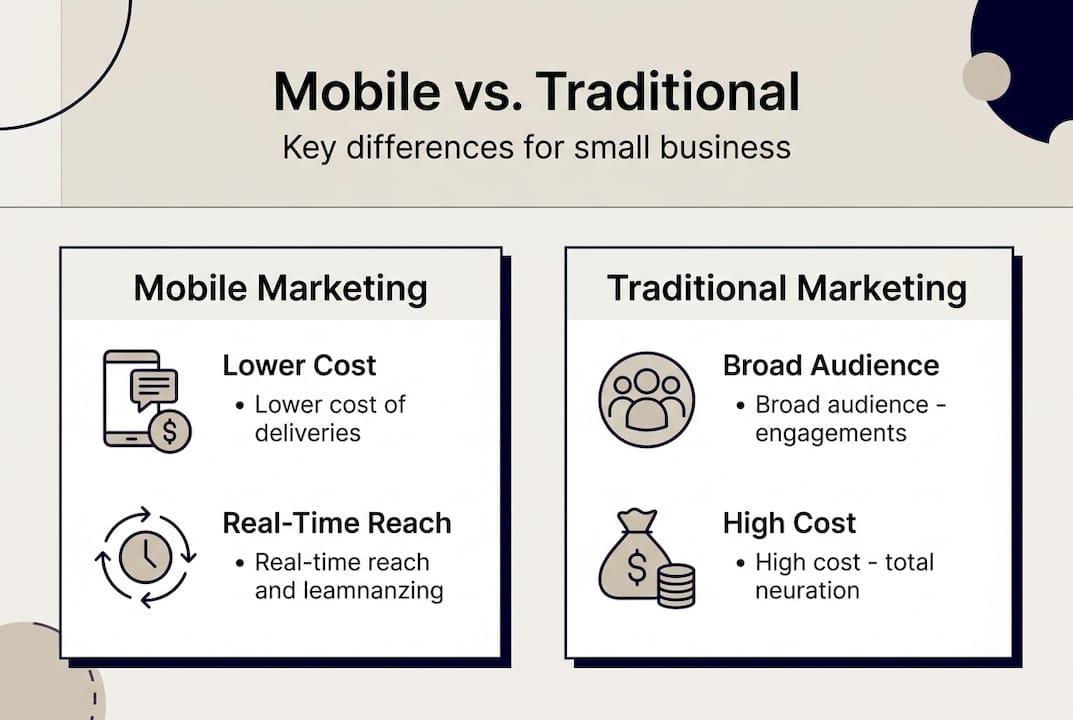
Traditional marketing (think flyers, radio spots, billboards) casts a wide net and hopes for the best. Mobile marketing, on the other hand, offers targeting, engagement, and lower costs that make every dollar work harder. For a small business with a tight budget, that’s not just nice to have. That’s a game-changer.
Understanding these mobile marketing advantages early on helps you make smarter decisions about where to invest your time and money.
Pro Tip: Before you launch any mobile campaign, audit your website on your own phone. If it’s slow, cluttered, or hard to tap through, fix that first. A great ad driving traffic to a terrible mobile experience is like inviting someone to a party and forgetting to unlock the front door.
Comparing mobile versus traditional marketing
Now that you know what mobile marketing is, let’s see how it actually stacks up against traditional approaches. Spoiler: it’s not a knockout in every category, but mobile holds its own in some pretty important ways.
Here’s a side-by-side look at the key differences:
Factor | Mobile marketing | Traditional marketing |
Cost | Generally lower CPC and flexible budgets | Higher upfront costs (print, broadcast) |
Targeting | Behaviour, location, demographics | Broad demographic targeting |
Engagement | Immediate, personal, interactive | Passive, one-directional |
Measurability | Real-time analytics and tracking | Limited, delayed feedback |
Trust building | Growing, but privacy concerns exist | Strong, established credibility |
Reach | Global or hyper-local | Often local or regional |
The numbers tell a compelling story. Mobile marketing excels in targeting and cost-effectiveness compared to traditional marketing’s broad reach but higher cost and lower measurability. That said, traditional marketing isn’t dead. Far from it.
Here’s what each side does best:
Mobile wins on: personalisation, real-time feedback, budget flexibility, and direct conversion
Traditional wins on: mass awareness, brand credibility, and reaching audiences who aren’t glued to their phones
The social media benefits alone make mobile a powerhouse for small businesses looking to build community and drive sales without blowing the budget.
“Mobile excels in personalisation and ROI but faces privacy challenges that traditional marketing simply doesn’t have to navigate.”
The privacy piece is real. With evolving regulations and consumers becoming more savvy about data, you need to be transparent about how you collect and use information. But handled well, mobile marketing remains one of the most powerful tools in your kit. Check out this mobile marketing overview for a deeper look at the landscape.

Top mobile marketing strategies and real-world examples
Understanding the differences gives you a strategic edge. Now let’s get into the actual tactics you can use starting this week.
Here are five mobile marketing strategies worth your attention:
SMS campaigns: Short, punchy text messages with a clear offer work brilliantly for time-sensitive promotions. A local café in Vancouver, for example, uses SMS blasts every Tuesday afternoon to fill their slowest hours with a “2-for-1 latte until 4pm” deal. Simple. Effective. Delicious.
Mobile-friendly email marketing: Most emails are opened on phones now, so if your email looks like a spreadsheet on mobile, people will delete it faster than a Monday morning alarm. Keep layouts single-column, subject lines short, and buttons big enough to tap without a magnifying glass.
Social media ads on Instagram and Facebook: These platforms are built for mobile. You can target by location, interest, age, and behaviour. A well-designed story ad or reel can reach exactly the right person at exactly the right moment.
Location-based push notifications: If you have an app or use a platform that supports geo-fencing, you can send notifications when customers are nearby. It’s like having a friendly sign-spinner, but way less exhausting.
Video content optimised for mobile: Short-form video on TikTok, Instagram Reels, or YouTube Shorts is where attention lives right now. Learn more about video marketing on mobile to see how small businesses are using it to punch above their weight.
Mobile techniques like these combine precise targeting via behaviours and location with cost-efficiency and high engagement. That’s a triple threat.
For a broader look at how these fit into your overall plan, explore these marketing strategies tailored for small businesses.
Pro Tip: Resist the urge to send the same generic message to everyone. Use purchase history, location data, or browsing behaviour to personalise. “Hey, we noticed you love our cinnamon rolls” lands way better than “Dear Valued Customer.”
Measuring mobile marketing success: Tracking and analytics
Deploying strategies is only half the battle. Measuring performance ensures your efforts are truly working and not just making you feel busy.
Here’s the thing about mobile marketing: it’s highly measurable compared to traditional forms. You don’t have to guess whether your billboard worked. You can see exactly how many people clicked, converted, and came back.
Key metrics to track for your mobile campaigns:
KPI | What it tells you | Target benchmark |
Click-through rate (CTR) | How compelling your ad or message is | 2-5% for most mobile ads |
Conversion rate | How many clicks turn into sales or sign-ups | Varies by industry, aim for 3%+ |
Return on investment (ROI) | Whether you’re making money on the campaign | Positive ROI is the goal |
Customer retention rate | Are people coming back? | Higher is always better |
Cost per acquisition (CPA) | What it costs to gain one new customer | Lower than your average customer value |
Popular tools to help you track all of this include Google Analytics (free and powerful), Facebook Insights (great for social ad performance), and your SMS platform’s built-in dashboard.
Here’s a quick checklist for reviewing your campaigns:
Check CTR weekly to catch underperforming ads early
Compare conversion rates across channels to find your strongest performer
Review audience segments to see who’s engaging most
A/B test subject lines, images, and calls to action regularly
Adjust budget toward what’s working, away from what isn’t
For more on making sense of your data, dig into these marketing analytics tips and build out a solid digital marketing plan that ties everything together.
Our perspective: Why hybrid marketing wins for Canadian small businesses
Here’s an opinion that might ruffle a few feathers: going all-in on mobile marketing without a traditional foundation is like building a house on a trampoline. Exciting, but unstable.
After working with Canadian entrepreneurs across industries, the pattern is clear. The businesses that thrive aren’t the ones chasing every shiny new mobile trend. They’re the ones who use traditional marketing to build brand trust and broad awareness, then layer mobile on top for direct conversions and personalised follow-ups.
Think of it this way: your flyer or local radio spot plants the seed. Your SMS campaign or Instagram ad is what gets someone off the couch and through your door.
Hybrid approaches that use traditional for awareness and mobile for conversion consistently outperform single-channel strategies. And the data backs that up.
That said, mobile does have real challenges around privacy and attribution that you can’t ignore. Be upfront with your audience about data use, and don’t over-automate to the point where you lose the human touch.
Explore the full range of online marketing advantages to see how blending channels can work for your specific situation.
Pro Tip: Start with one small mobile pilot campaign running alongside your best-performing traditional effort. Measure both. Let the results guide your next move rather than gut instinct alone.
Take your small business mobile: Next steps with M50 Media
You’ve got the knowledge. Now it’s time to actually do something with it (because reading about marketing and doing marketing are very different sports).

At M50 Media, we help small business owners like you cut through the noise and build mobile marketing strategies that actually fit your goals, your budget, and your sanity. Whether you’re starting from scratch or trying to level up what you’ve already got, we’ve got you covered. Book a free marketing SOS call and let’s figure out your next move together. Or if you prefer to learn at your own pace, check out our business coaching options and keep exploring the M50 blog for fresh insights every week.
Frequently asked questions
What is the main advantage of mobile marketing for small businesses?
Mobile marketing allows precise targeting, personal engagement, and often lower costs compared to traditional advertising, making it ideal for businesses with lean budgets.
How can I track the effectiveness of my mobile marketing campaigns?
Track key metrics like conversion rates, click-throughs, and ROI using tools like Google Analytics or your SMS platform’s dashboard. Mobile marketing enables measurability that most traditional advertising simply can’t offer.
Is a hybrid approach of mobile and traditional marketing effective?
Absolutely. Combining traditional channels for brand awareness and mobile for conversion delivers strong results, especially for Canadian small businesses building local credibility while growing their digital reach.
What are common mistakes in mobile marketing?
Generic messaging and ignoring mobile design are the biggest pitfalls. Always personalise and optimise for mobile devices to keep your audience engaged and your campaigns converting.
Recommended
Comments