The role of digital ads in growing your small business

Small businesses face a digital advertising paradox in 2026. While Meta ad costs had skyrocketed on platforms once considered essential, new channels like Connected TV offer fresh opportunities at lower price points. The landscape has shifted dramatically, with streaming now commanding significant viewer attention and traditional social platforms delivering diminishing returns. This article reveals how savvy small business owners are navigating these changes, leveraging refreshed strategies and emerging platforms to drive measurable growth without breaking the bank. You’ll discover actionable tactics to optimise your ad spend, choose the right channels, and capitalise on evolving consumer behaviour.
Table of Contents
How Digital Advertising Is Evolving For Small Businesses In 2026
Maximising Engagement Through Refreshed Ad Strategies And Platform Choices
How Connected TV Advertising Can Transform Small Business Growth
Comparing Major Digital Ad Channels For Small Businesses In 2026
Enhance Your Digital Advertising Strategy With Expert Coaching
Key takeaways
Point | Details |
Refresh creatives regularly | Updating ad content every 6 to 8 weeks can boost engagement by 15 to 20%. |
Explore CTV advertising | Connected TV offers big-screen reach at competitive CPMs of $20 to $30 for local spots. |
Social costs are rising | Customer acquisition costs on Instagram and Facebook climbed from $22 to $38 in 18 months. |
Time campaigns strategically | Early year spending in January and February often yields better results than waiting for peak seasons. |
Diversify platform mix | Combining CTV with social media reduces risk and improves overall campaign performance. |
How digital advertising is evolving for small businesses in 2026
The digital advertising ecosystem has transformed dramatically over the past two years. Small business owners who once relied exclusively on Facebook and Instagram now face a harsh reality: customer acquisition costs climbing from $22 to $38 in just 18 months. This sharp increase has forced many entrepreneurs to rethink their entire marketing approach and explore alternative channels that deliver better value.
Streaming platforms have fundamentally altered how audiences consume content. Streaming accounts for roughly 42% of all TV viewing time in North America, representing a massive shift in viewer attention away from traditional cable and broadcast television. This migration creates both challenges and opportunities for small businesses seeking to reach engaged audiences where they actually spend their time.
Connected TV advertising has emerged as a game-changing solution for budget-conscious businesses. Unlike the crowded, expensive social media landscape, CTV allows you to reach viewers on the big screen during popular content like live sports and streaming shows. As viewers migrate from cable to streaming, CTV advertising becomes the most efficient way to reach them without the premium costs associated with traditional television buys.
Local businesses particularly benefit from this shift. You can now access premium inventory during high-engagement programming at accessible price points. A dental practice in suburban Toronto or a home services company in Vancouver can run ads during streaming sports events and popular series, building brand awareness among local audiences who might never see their social media posts in increasingly algorithm-driven feeds.
The economics are compelling. While social platforms squeeze advertisers with rising costs and declining organic reach, streaming platforms offer fresh inventory and engaged viewers. This doesn’t mean abandoning social media entirely, but rather recognising that a digital advertising guide for small businesses in 2026 must include multiple channels working together strategically.
“The shift to streaming isn’t just about where people watch content. It’s about where your advertising dollars can work hardest. Small businesses that diversify beyond saturated social platforms often see immediate improvements in cost per acquisition and overall campaign performance.”
Consider these platform dynamics:
Social media feeds are increasingly pay-to-play, with organic reach declining year over year
Streaming viewers are often more engaged and less distracted than scrolling social media users
CTV ads can’t be skipped or blocked as easily as digital display ads
Big-screen viewing creates stronger brand recall compared to mobile scrolling
Maximising engagement through refreshed ad strategies and platform choices
Creative fatigue kills digital advertising performance faster than almost any other factor. Research shows that businesses refreshing ad creative every 6 to 8 weeks saw 15 to 20% higher engagement compared to those running static campaigns. This isn’t about creating entirely new concepts each time, but rather testing variations in messaging, visuals, and calls to action that keep your brand fresh in viewers’ minds.
Timing your advertising spend strategically can dramatically impact results. Contrary to popular belief, waiting for peak seasons isn’t always optimal. Data indicates that January and February might be a better time to ramp up TV spending than waiting for March for home services businesses. Early year campaigns often face less competition and lower costs, allowing your budget to stretch further whilst capturing motivated buyers.
Platform diversification reduces risk and improves overall marketing effectiveness. Relying solely on one channel exposes your business to algorithm changes, cost increases, and audience shifts beyond your control. A balanced approach combining CTV advertising with targeted social media advertising and other digital channels creates multiple touchpoints that reinforce your message across different contexts and devices.
Here’s a practical framework for optimising your digital advertising mix:
Allocate 40 to 50% of budget to your primary performance channel (typically social or search)
Dedicate 30 to 40% to emerging channels like CTV for brand building and new audience reach
Reserve 10 to 20% for testing new platforms, creative approaches, and seasonal opportunities
Review performance monthly and reallocate based on cost per acquisition and revenue attribution
Refresh creative assets every six to eight weeks across all active channels
The most successful small businesses treat digital advertising as an integrated system rather than isolated campaigns. Your CTV ads build awareness that makes social media retargeting more effective. Your social campaigns drive searches that benefit from your search engine marketing. Each channel amplifies the others when orchestrated properly within effective marketing strategies for small businesses.
Pro Tip: Create a simple creative calendar that schedules refreshes across all platforms. Set reminders every six weeks to review performance metrics and update underperforming ads. This systematic approach prevents creative fatigue before it impacts your bottom line.
Customer acquisition efficiency improves when you match platform strengths to campaign objectives. Use social media for direct response and retargeting. Deploy CTV for brand awareness and reaching new audiences. Leverage search for capturing high-intent prospects. This strategic alignment ensures each advertising pound works toward specific, measurable goals rather than hoping one platform solves every marketing challenge.
How connected tv advertising can transform small business growth
Connected TV advertising delivers measurable business results that extend far beyond traditional brand awareness metrics. A compelling case study shows that Birch & Barrel Home Goods grew online revenue by 41% after implementing streaming TV ads, demonstrating that CTV drives direct sales, not just impressions. This performance challenges the outdated notion that television advertising only works for large corporations with massive budgets.
Brand search volume provides another powerful indicator of CTV effectiveness. The same business found that branded search volume doubled within six weeks of launching their CTV campaign, showing how big-screen exposure translates into active online interest. When potential customers see your brand during their favourite streaming content, they’re motivated to learn more, creating a halo effect that benefits all your digital marketing efforts.
The impact on overall customer acquisition costs proves particularly compelling for small businesses. By adding CTV to their marketing mix, companies have seen cost per acquisition across all channels drop by a third. This improvement occurs because CTV awareness makes other channels more efficient, reducing the number of touchpoints needed to convert prospects into customers.
Accessibility represents a crucial advantage for small business owners. CTV advertising can be a cost-effective awareness channel with entry points that fit modest marketing budgets. You don’t need television production budgets or six-figure media buys to test streaming platforms. Many businesses start with localised campaigns targeting specific postal codes or demographic segments, learning what works before scaling investment.
Metric | Before CTV | After CTV | Change |
Online revenue growth | Baseline | 41% increase | +41% |
Branded search volume | Baseline | Doubled | +100% |
Cost per acquisition | $38 | $25 | -33% |
Return on ad spend | 2.6x | 3.8x | +46% |
Local targeting capabilities make CTV particularly valuable for service-area businesses. A plumbing company can reach households within their service radius during popular streaming content, building recognition that pays dividends when emergencies arise. This geographic precision, combined with demographic and behavioural targeting, ensures your ads reach the right audiences without waste.
Pro Tip: Start your CTV testing during shoulder seasons when inventory costs are lower and competition is reduced. Use this period to refine your creative, targeting, and measurement approach before scaling during peak demand periods.
The measurement ecosystem for CTV has matured significantly. You can now track website visits, phone calls, and conversions directly attributed to streaming campaigns. This accountability allows small businesses to optimise CTV performance just like any digital channel, adjusting targeting, creative, and budget allocation based on concrete data rather than assumptions about brand lift.
Small businesses can experiment with CTV advertising with a low entry point, testing different approaches without committing entire marketing budgets. This flexibility enables you to learn what resonates with your audience, refine your messaging, and scale what works. The combination of affordable entry, measurable results, and proven revenue impact makes CTV an essential component of modern online marketing advantages for small business strategies.
Comparing major digital ad channels for small businesses in 2026
Social media advertising remains a powerful tool but faces significant headwinds in 2026. Whilst platforms like Facebook and Instagram offer sophisticated targeting and massive reach, ROAS on Meta had dropped from 4.2x to 2.6x for many small businesses. This decline stems from increased competition, algorithm changes prioritising organic content, and rising costs that squeeze profit margins on customer acquisition.
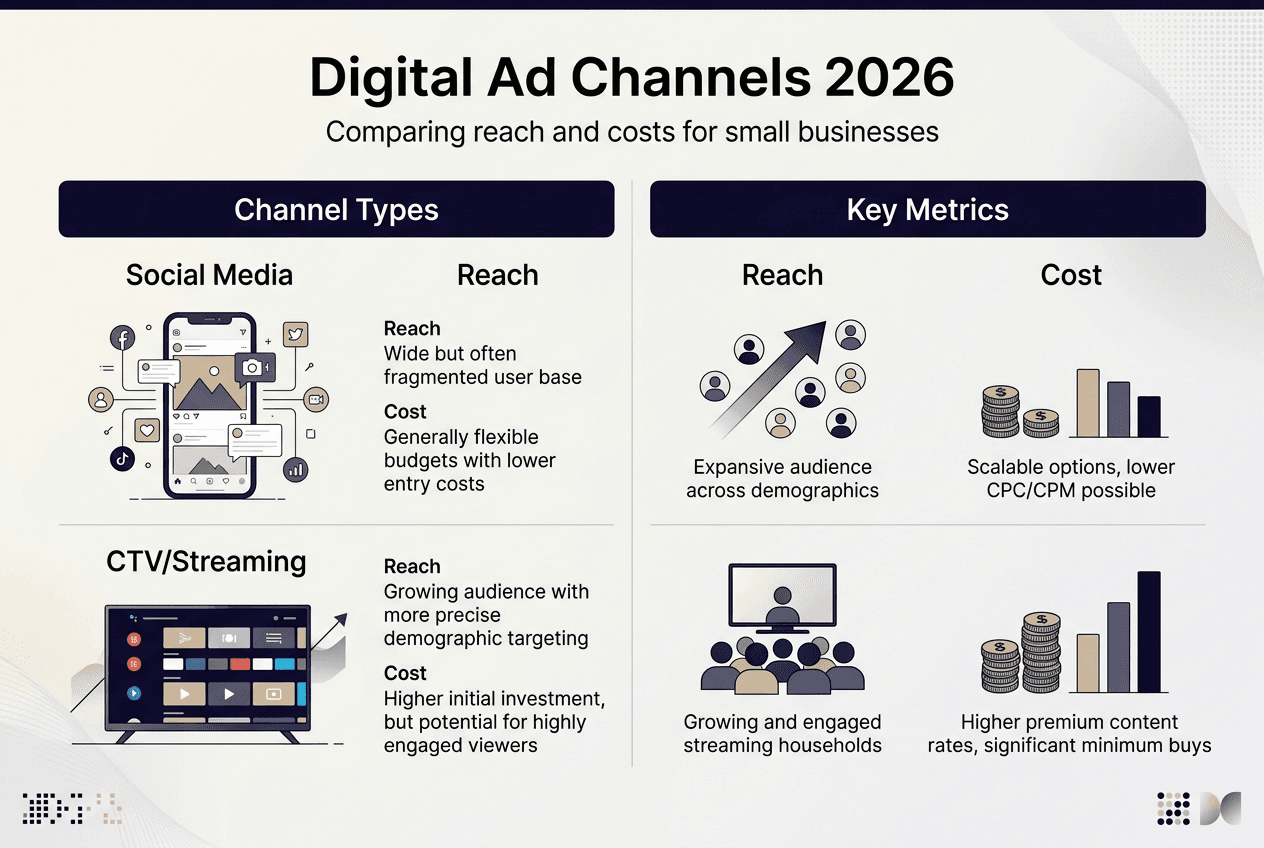
Streaming and CTV advertising present a compelling alternative with competitive economics. Average CPMs for local spots during live sports programming ranged from $20 to $30, often delivering better incremental reach than saturated social platforms. The big-screen viewing experience creates stronger brand recall, whilst advanced targeting ensures your ads reach relevant local audiences during high-engagement content.
Traditional digital ads, including display and search, fill specific roles in comprehensive marketing strategies. Search advertising captures high-intent prospects actively looking for solutions, delivering strong conversion rates despite rising costs. Display advertising works for retargeting and awareness but often struggles with engagement compared to video-based streaming formats that command viewer attention.
Channel | Typical CPM | Engagement Level | Best Use Case | Budget Entry Point |
Social Media | $8 to $15 | Medium | Direct response, retargeting | $500/month |
Connected TV | $20 to $30 | High | Brand awareness, local reach | $1,000/month |
Search Ads | Varies by CPC | Very High | High-intent conversion | $750/month |
Display Ads | $3 to $8 | Low to Medium | Retargeting, broad awareness | $300/month |
Choosing the right channel mix depends on your specific business objectives and customer journey. Consider these factors when allocating budget:
Product complexity: Higher-consideration purchases benefit from multi-touch campaigns combining awareness (CTV) and conversion (search, social)
Geographic focus: Local service businesses gain disproportionate value from geo-targeted CTV and local search
Customer lifetime value: Higher LTV justifies investment in brand-building channels like CTV alongside performance channels
Sales cycle length: Longer cycles require sustained awareness campaigns that keep your brand top of mind
Optimisation requirements vary significantly across channels. Social media demands constant creative refreshes and audience testing. CTV campaigns benefit from longer creative lifecycles but require careful daypart and programme selection. Search advertising needs ongoing keyword refinement and landing page optimisation. Success requires treating each channel according to its unique dynamics whilst maintaining strategic coherence.
The most effective approach combines channels strategically rather than treating them as competitors. Your CTV campaign builds awareness that improves social media conversion rates. Your social retargeting captures visitors driven by streaming ads. Your search campaigns benefit from the brand recognition created across other channels. This integrated perspective, detailed in comprehensive digital marketing plan guides, delivers superior results compared to channel-by-channel optimisation.
Regular performance reviews and budget reallocation keep your advertising mix aligned with business goals. Monthly analysis of cost per acquisition, customer lifetime value, and channel attribution reveals which platforms drive profitable growth. Shift budget toward high-performing channels whilst maintaining presence across your mix to capture different audience segments and purchase journey stages.
Enhance your digital advertising strategy with expert coaching
Navigating the complex digital advertising landscape requires expertise that most small business owners don’t have time to develop whilst running their companies. Professional digital coaching services provide personalised guidance tailored to your specific business challenges, competitive environment, and growth objectives. Rather than wasting budget on trial and error, you gain strategic direction from experienced marketers who understand what works in 2026.
Expert coaching ensures efficient budget allocation across emerging platforms like CTV and established channels like social media. You’ll learn how to balance brand-building activities with direct response campaigns, when to refresh creative assets, and how to interpret performance data for better decision-making. This knowledge compounds over time, building your marketing capabilities whilst driving immediate improvements in campaign results.
A free marketing SOS call offers an ideal starting point for diagnosing your current advertising challenges and identifying quick wins. During this consultation, you’ll receive honest feedback about your strategy, tactical recommendations for improvement, and a clear path forward. Whether you’re struggling with rising costs, declining performance, or simply want to explore new channels like Connected TV, professional guidance accelerates your progress and protects your investment. Strategic digital coaching supports your learning journey as digital advertising continues evolving rapidly through 2026 and beyond.
FAQ
What is the role of digital ads for small businesses today?
Digital ads help small businesses reach targeted audiences efficiently, build brand awareness, and drive measurable sales growth across multiple platforms in 2026. They provide cost-effective alternatives to traditional advertising whilst offering precise targeting and performance tracking. As consumer habits shift toward streaming and mobile consumption, digital ads become critical for staying competitive and capturing market share.
How can small businesses get the most value from digital ads in 2026?
Refresh ad creatives every six to eight weeks and test multiple platforms including CTV and social media to combat creative fatigue. Focus campaigns on genuine audience engagement rather than vanity metrics, adjusting spend based on cost per acquisition and revenue attribution data. Leverage professional coaching for strategy refinement when navigating complex platform choices or declining performance.
Why is connected tv advertising gaining popularity for small businesses?
CTV offers cost-effective big-screen reach and improved brand awareness at lower customer acquisition costs compared to saturated social platforms. It reaches audiences migrating from traditional cable to streaming services, capturing attention during high-engagement content. Small businesses can enter with modest budgets starting around $1,000 monthly and see measurable revenue growth within weeks of launching campaigns.
How does timing affect digital advertising effectiveness?
Certain months like January and February often deliver better results and lower costs for campaigns, especially in home services and professional services sectors. Strategic timing reduces competition for ad inventory and captures motivated buyers early in their decision process. Seasonal patterns vary by industry, making data analysis and testing essential for optimising your advertising calendar throughout the year.
Recommended
Comments