Social Media Marketing: Grow Customers 30% in 6 Months


You post regularly on Facebook and Instagram, but where are the new customers? Many small business owners spend hours crafting social media content only to watch their follower counts stagnate and their sales remain flat. The problem isn’t social media itself. It’s the lack of a clear, documented strategy tailored to your specific business goals. This guide breaks down exactly how to build and execute a social media marketing plan that will grow your audience and drive real sales within six months.
Table of Contents
Key Takeaways
Point | Details |
Strategy matters | Businesses with documented social media strategies are 313% more likely to succeed than those without one. |
Platform choice drives engagement | Selecting platforms where your target audience actively spends time boosts engagement rates significantly. |
Consistency beats perfection | Regular posting 3 to 5 times weekly with mobile optimized visuals delivers better results than sporadic bursts. |
Paid ads accelerate growth | Combining organic content with targeted paid advertising increases conversion rates by up to 45%. |
Metrics guide improvement | Tracking engagement, click through, and conversion rates for 3 to 6 months enables data driven strategy refinement. |
Prerequisites for Social Media Marketing
Before you dive into posting, you need the right foundation. Starting social media marketing without clear goals is like driving without a destination. You’ll burn fuel but get nowhere.
First, define your business goals. Do you want to increase website traffic by 50%? Generate 20 qualified leads per month? Boost in store visits by 30%? Your social media strategy must connect directly to these outcomes. Understanding your target customer demographics is equally critical. Know their age range, interests, pain points, and which platforms they use daily.
You’ll need active accounts on your chosen platforms and access to content scheduling tools like Buffer, Hootsuite, or Meta Business Suite. These tools save hours by letting you batch create and schedule posts in advance. Expect to allocate 6 to 12 hours weekly for content creation, community engagement, and performance analysis. This isn’t a set it and forget it channel.
The game changer? A documented social media strategy. Small businesses with a written plan are 313% more likely to report success compared to those winging it. Your strategy should outline goals, target platforms, content themes, posting schedules, and key performance indicators.
Pro Tip: Start by auditing your current social media presence. What’s working? What’s not? Use these insights as the baseline for your new strategy. Tie your social media goals directly to your broader digital marketing plan for maximum impact.
Essential prerequisites checklist:
Clear, measurable business goals tied to social media outcomes
Deep understanding of your ideal customer’s demographics and online behavior
Active accounts on chosen platforms with professional profiles
Content scheduling tool subscription or access
Weekly time commitment of 6 to 12 hours minimum
Written social media strategy document with goals and KPIs
Choosing the Right Social Media Platforms
Not all platforms deserve your time. Your audience hangs out in specific places, and spreading yourself too thin guarantees mediocre results everywhere.
Start by researching where your target customers spend their time. A B2B consulting firm will find more decision makers on LinkedIn than TikTok. A local bakery targeting young families should prioritize Instagram and Facebook. Look at competitor accounts. Where do they have the most engaged followers?
Engagement rates vary dramatically by platform. Facebook and Instagram average 1.6% to 1.7% engagement per post for small businesses, while LinkedIn typically sees lower rates but higher quality B2B leads. TikTok can deliver explosive reach for the right content, but requires consistent video production.
You face a critical tradeoff: focus deeply on one platform or spread across multiple. Starting with one platform lets you master its algorithm, content style, and audience before expanding. However, relying on a single channel creates risk if that platform’s algorithm changes or your account faces issues.
Consider your resources honestly. Managing Facebook, Instagram, LinkedIn, and TikTok simultaneously requires different content formats, posting schedules, and engagement strategies. Most small businesses should start with one or two platforms maximum.
Paid advertising integration matters too. Facebook and Instagram offer sophisticated targeting through Meta Ads Manager. LinkedIn ads cost more but reach professional audiences. Understanding the benefits of social media marketing on each platform helps you allocate budget effectively.
Platform comparison for small businesses:
Platform | Best For | Average Engagement | Ad Cost | Content Type |
Local businesses, 35+ audience | 1.6% | Low to Medium | Images, video, text | |
Visual brands, 18 to 45 audience | 1.7% | Low to Medium | Photos, reels, stories | |
B2B services, professional | 0.5% to 1% | High | Articles, industry insights | |
TikTok | Youth brands, entertainment | 5% to 8% | Medium | Short form video only |
Key platform selection factors:
Audience demographics alignment with your target customer
Content format requirements matching your production capabilities
Organic reach potential and engagement benchmarks
Paid advertising options and typical cost per result
Time investment needed for platform specific best practices
Content Planning and Scheduling
Consistency beats perfection every time. Your audience needs to see you regularly to remember you exist and trust you enough to buy.

Small businesses should post 3 to 5 times weekly minimum. Less than that, and you fade from memory. More than daily risks audience fatigue unless you’re a media company. Quality matters more than quantity, but consistency builds the foundation for everything else.
A content calendar transforms random posting into strategic communication. Plan your content themes monthly, then break them into weekly posts. Mix educational content, behind the scenes glimpses, customer testimonials, product showcases, and community engagement. This variety keeps your feed interesting while systematically moving followers toward purchase decisions.
Visual content dominates social media performance. Posts with images or videos consistently outperform text only updates. You don’t need professional photography. Smartphone cameras and free editing apps like Canva produce excellent results. Focus on good lighting and clear composition.
Here’s the critical factor most businesses miss: mobile optimization. Over 90% of social media access happens on smartphones. Failure to optimize for mobile results in up to 40% lower engagement rates. That means vertical video formats, large readable text, and quick loading images.
Consistent posting builds audience trust and signals platform algorithms that you’re an active, valuable account worth promoting. Gaps in your posting schedule hurt your organic reach for weeks afterward. Batch create content when you have creative energy, then schedule it to publish consistently.
Pro Tip: Create content themes for each day of the week. Monday motivation quotes, Tuesday tips, Wednesday customer wins, Thursday product features, Friday fun posts. This framework makes content creation faster and your brand more memorable.
Effective content planning steps:
Develop monthly content themes aligned with business goals and seasons
Create a posting schedule of 3 to 5 times per week minimum
Batch produce content in 2 to 4 hour creative sessions
Use scheduling tools to maintain consistency automatically
Prioritize visual content optimized for mobile viewing
Balance educational, promotional, and engaging content types
Review and adjust themes based on performance data monthly
Implementing effective marketing strategies through consistent, valuable content positions your business as the trusted expert in your space.
Leveraging Paid Social Media Ads
Organic reach has limits. Paid advertising accelerates growth by putting your content in front of precisely targeted potential customers who haven’t found you yet.
The smartest approach combines organic posting with strategic paid promotion. Your organic content builds community and trust. Paid ads expand your reach and drive specific actions like website visits, lead form submissions, or purchases. Together, they create a growth engine that outperforms either tactic alone.
Start small. Test ad campaigns with $5 to $10 daily budgets while you learn what resonates with your audience. Targeted paid ads yield 45% higher conversion rates than untargeted campaigns, but finding the right targeting takes experimentation. Test different audience demographics, interests, and behaviors. Let data guide your scaling decisions.
Common pitfalls waste massive ad budgets. Broad, untargeted audiences burn money reaching people who’ll never buy. Sending traffic to your homepage instead of a specific landing page tanks conversion rates. Running ads without tracking pixels means you can’t measure results or retarget interested visitors. Poor ad creative with unclear calls to action gets ignored.
A comprehensive digital marketing strategy integrates paid social ads with your other channels for maximum impact.
Steps to launch your first paid ad campaign:
Install tracking pixels on your website to measure conversions and build retargeting audiences.
Define one specific goal like generating leads, driving website traffic, or promoting a product launch.
Create 3 to 5 ad variations with different images, headlines, and descriptions to test performance.
Set up detailed audience targeting based on demographics, interests, behaviors, and location.
Start with a small daily budget of $5 to $10 while gathering performance data.
Run ads for at least 7 days before making optimization decisions based on results.
Scale budget on winning ad variations and pause underperforming ones.
Continuously refine targeting and creative based on cost per result metrics.
Paid ads make sense when you have proven organic content that resonates, a clear offer with strong conversion rates, and budget to test and optimize. Don’t start paid advertising until your organic foundation is solid.
Measuring Success and Analytics
Data separates guessing from knowing. Tracking the right metrics shows exactly what’s working and where you’re wasting effort.
Three metrics matter most for small businesses. Engagement rate measures how often people interact with your content through likes, comments, shares, and saves. Higher engagement signals that your content resonates and tells algorithms to show it to more people. Click through rate tracks how many people click your links to visit your website or landing pages. Conversion rate reveals how many of those clicks turn into actual customers or leads.
Expect a timeline of 3 to 6 months before seeing substantial results. Social media marketing is a compound interest game. Early months build audience and trust. Later months harvest the relationships you’ve cultivated. Businesses following documented strategies see an average 30% increase in customer acquisition within 6 months.
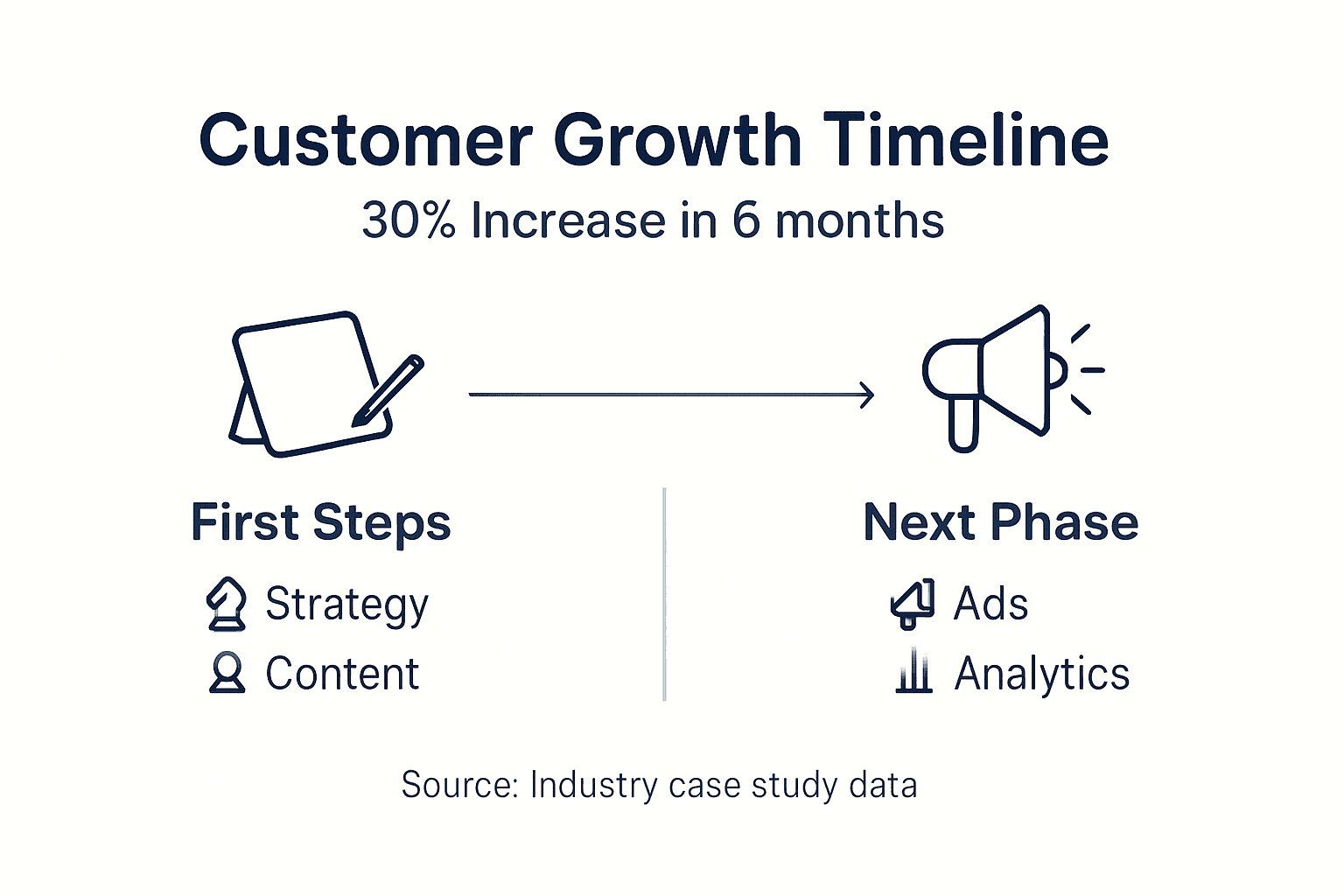
Data interpretation drives strategy improvement. If engagement rates drop, test different content formats or posting times. Low click through rates suggest weak calls to action or misaligned audience targeting. Poor conversion rates point to website or offer problems, not social media issues.
Track metrics consistently using platform analytics and Google Analytics. Weekly reviews catch trends early. Monthly deep dives inform strategic pivots. The essential marketing tools you choose for tracking directly impact your ability to optimize performance.
Critical metrics to monitor weekly:
Engagement rate percentage across all post types
Follower growth rate and audience demographics
Click through rate on posts with website links
Conversion rate from social traffic on your website
Cost per result for any paid advertising campaigns
Typical small business performance benchmarks:
Metric | Good Performance | Needs Improvement | Timeline to Results |
Engagement Rate | 1.5% to 3% | Below 1% | 1 to 3 months |
Follower Growth | 5% to 10% monthly | Below 3% monthly | 2 to 4 months |
Click Through Rate | 1% to 3% | Below 0.5% | 1 to 2 months |
Conversion Rate | 2% to 5% | Below 1% | 3 to 6 months |
Consistent tracking creates a feedback loop. Test, measure, learn, adjust, repeat. This cycle transforms average social media presence into a measurable customer acquisition channel.
Common Mistakes and How to Avoid Them
Learning from others’ mistakes saves you months of frustration and wasted budget. These errors plague most small businesses starting social media marketing.
Irregular posting kills momentum faster than anything else. 60% of small businesses cite inconsistent posting as their biggest social media failure. Your audience forgets you exist. Platform algorithms deprioritize your content. The fix is simple but requires discipline: create a content calendar and use scheduling tools to maintain consistent output even during busy periods.
Poor ad targeting wastes up to 25% of advertising budgets. Broad audiences might seem like they reach more people, but you’re paying to show ads to people who’ll never become customers. Start with narrow, specific targeting based on your best current customers. Test and refine before expanding reach.
Ignoring legal compliance risks account suspensions, fines, and reputation damage. Each platform has advertising policies about prohibited content, required disclosures, and targeting restrictions. Stay current with these rules. Violating data privacy regulations like GDPR or CANH SPAM laws creates legal liability.
Mobile unfriendly content cripples performance. Posts with tiny text, horizontal videos, or slow loading images lose up to 40% engagement compared to mobile optimized alternatives. Always preview your content on a smartphone before publishing.
“The biggest mistake I see is business owners treating social media as a megaphone instead of a conversation. You need to engage with your audience, respond to comments, and build relationships, not just broadcast sales messages.”
Common mistakes and solutions:
Irregular posting schedule damages algorithm performance and audience memory; fix with content calendars and scheduling tools
Overly promotional content drives followers away; maintain 80% valuable content to 20% promotional ratio
Ignoring comments and messages wastes relationship building opportunities; respond within 24 hours
Poor ad targeting burns budget on wrong audiences; start narrow and test systematically
Missing mobile optimization loses 40% potential engagement; always preview on smartphones
Neglecting legal compliance risks fines and suspensions; review platform policies quarterly
Copying competitors without testing loses your unique voice; let data guide your approach
Your digital marketing plan should include protocols to avoid these pitfalls from day one. Prevention costs far less than correction.
Expected Results and Outcomes
Realistic expectations prevent frustration and premature strategy abandonment. Social media marketing delivers substantial results, but rarely overnight.
Businesses implementing documented social media strategies experience an average 30% increase in customer acquisition within 6 months. This assumes consistent execution of the fundamentals: regular posting, audience engagement, strategic content, and performance optimization.
Engagement rates of 1.6% to 1.7% represent solid performance for small business Facebook and Instagram accounts. That might sound low, but it means 16 to 17 engaged people per 1,000 followers. With 5,000 followers, that’s 80 to 85 meaningful interactions per post. These engaged followers become your customer pipeline.
Consistent posting 3 to 5 times weekly is non negotiable for reaching these benchmarks. Gaps in your schedule reset your momentum and algorithm favor. Think of social media like exercise. Missing a few workouts erases weeks of progress.
The first 3 months focus on building foundation: growing followers, testing content types, and establishing consistent presence. Months 4 to 6 shift toward optimization and conversion as you understand what resonates with your specific audience. Clear ROI improvements typically emerge around month 5 or 6 for businesses executing properly.
Continuous adjustment based on performance data separates successful accounts from stagnant ones. What works in January might flop in July. Audience preferences evolve. Platform algorithms change. Your effective marketing strategies must adapt accordingly.
Realistic timeline and outcomes:
Month 1 to 2: Establish consistent posting rhythm and baseline metrics
Month 3 to 4: Audience growth accelerates as content strategy matures
Month 5 to 6: Customer acquisition increases become measurable
Beyond 6 months: Compounding effects drive sustained growth
Expected engagement: 1.5% to 2% with proper execution
Customer acquisition lift: 25% to 35% within 6 months
Patience combined with consistent execution and data driven optimization produces results. The businesses that quit after 2 months never experience the compound growth that starts around month 4.
Legal and Ethical Considerations
Playing by the rules protects your business and builds long term trust with your audience. Shortcuts in this area create expensive problems.
Platform policy violations risk account suspension without warning. Each platform publishes detailed community standards and advertising policies. Prohibited content includes misleading claims, inappropriate imagery, and restricted products. Violating these rules can get your account banned, losing all your followers and content history instantly.
Advertising guidelines are stricter than organic post rules. Claims must be substantiated. Before and after images need disclaimers. Financial and health products face additional restrictions. Review Meta’s, LinkedIn’s, and other platforms’ ad policies before launching campaigns. Ignorance isn’t an accepted defense.
Data privacy regulations like GDPR and CCPA impose serious obligations on how you collect, store, and use customer information. Using social media pixels to track website visitors creates data processing responsibilities. Collecting email addresses through lead forms requires explicit consent and easy opt out mechanisms. Violations trigger substantial fines.
Ethical marketing builds sustainable businesses. Authentic testimonials, transparent pricing, and honest product representations create trust. Manipulative tactics might generate short term sales but destroy long term reputation and violate platform policies.
Legal compliance essentials:
Review platform community standards and advertising policies quarterly
Ensure all claims in posts and ads are accurate and substantiated
Include required disclosures for testimonials, endorsements, and results
Implement proper data privacy practices for pixels and lead collection
Obtain explicit permission before featuring customers in content
Maintain transparency about sponsored content and partnerships
Stay current with evolving regulations in your jurisdiction
Protecting your business through compliant marketing strategies prevents costly disruptions and builds customer confidence. The time invested in understanding these requirements pays dividends through sustainable, uninterrupted growth.
Boost Your Social Media Success with Expert Coaching
You now have the roadmap, but execution separates knowledge from results. Implementing everything in this guide while running your business is challenging.
M50 Media specializes in helping small businesses like yours translate strategy into measurable growth. Our digital marketing planning services create customized social media strategies tailored to your specific business goals, audience, and resources.
Whether you need a comprehensive plan or targeted coaching on specific challenges, we offer flexible options. Our business coaching services provide ongoing support as you execute your strategy and optimize based on results. Not sure where to start? Book a free Marketing SOS call to discuss your biggest social media challenges and get actionable next steps. Stop guessing and start growing with expert guidance.
FAQ
What is the ideal posting frequency for small businesses on social media?
Posting 3 to 5 times per week balances maintaining audience engagement without overwhelming followers. Consistency matters more than volume. Regular posting trains platform algorithms to favor your content and keeps your business top of mind with followers.
How quickly can I expect to see customer growth using social media marketing?
Most small businesses see measurable customer acquisition improvements within 3 to 6 months of implementing a documented strategy. Early months build audience and establish trust. The compound effects of consistent, strategic posting typically become apparent around month 5. Results depend heavily on execution quality and industry competition.
Should small businesses focus on organic posts or paid ads?
Combining organic content with targeted paid advertising delivers faster, better results than either approach alone. Organic posting builds community, trust, and brand authority. Paid ads amplify your reach to precisely targeted potential customers. Start with strong organic fundamentals, then layer in paid promotion to accelerate growth and drive specific conversion actions.
What are some common mistakes to avoid in social media marketing?
Irregular posting is the most frequent mistake, undermining algorithm performance and audience retention. Use content calendars and scheduling tools to maintain consistency. Poor ad targeting wastes substantial budget by reaching wrong audiences. Test narrow targeting first, then expand based on data. Ignoring mobile optimization reduces engagement by up to 40% since over 90% of users access social media on smartphones. Finally, neglecting legal compliance with platform policies and privacy regulations risks account suspensions and fines.
Recommended
Comments