The real role of landing pages for small businesses
- karl7209
- Jun 5
- 8 min read

TL;DR:
Landing pages focus on a single offer with one clear call to action to maximize conversions. They outperform homepages by eliminating distractions and improving targeted ad ROI. Building a simple, message-matched landing page in hours can significantly boost paid campaign results.
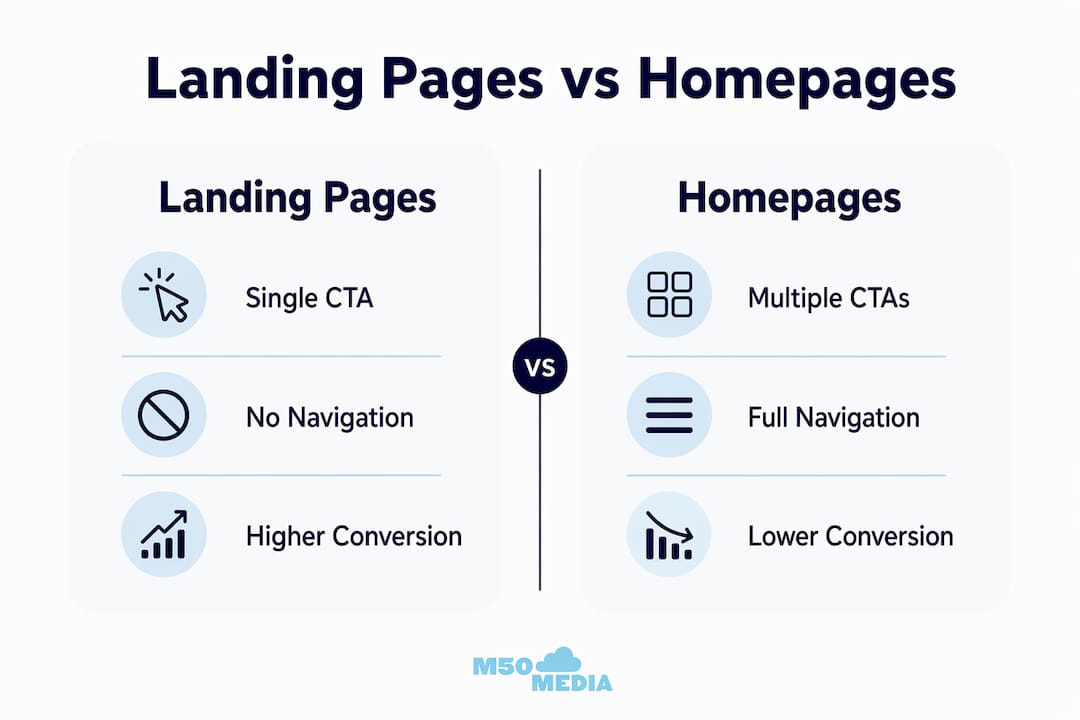
A landing page is a standalone web page built to do exactly one thing: convert a visitor into a lead, a buyer, or a subscriber. No distractions, no rabbit holes, no “oh look, an About Us page.” Just one offer, one call to action, and one clear path forward. If you’ve been sending paid ad traffic to your homepage and wondering why your results feel like a soggy Tim Hortons muffin, the role of landing pages is about to make a lot of sense to you.
How do landing pages improve conversion rates compared to homepages?
Landing pages convert at 2 to 5 times higher rates than general website pages for paid campaigns. One test showed a 17.1% conversion rate for a dedicated landing page versus 7.9% for a homepage sending the same traffic. That’s not a rounding error. That’s the difference between a campaign that pays for itself and one that quietly drains your budget.
The reason comes down to what marketers call the attention ratio. Your homepage has dozens of links, menus, social icons, and blog posts all competing for your visitor’s attention. A landing page has a 1:1 attention ratio, meaning one link matches one conversion goal. Think of it like the difference between walking into a Costco on a Saturday versus walking into a store where someone hands you exactly the thing you came for. One of those experiences ends in a purchase. The other ends in a $300 impulse buy and a giant bag of trail mix.
Decision fatigue is real, and each additional link on a page is a leak in your conversion funnel. When visitors have too many choices, they often make none. A landing page removes that friction entirely.
There’s also a financial argument here that’s hard to ignore. Using a dedicated landing page can reduce cost per click by about 37% in paid advertising, because platforms like Google Ads reward relevant, focused pages with better Quality Scores. Fail to use one, and your costs can balloon by up to 400%. That’s not a typo. Your homepage is literally costing you money every time you run an ad.
Feature | Homepage | Landing page |
Number of CTAs | Multiple | One |
Navigation menu | Yes | Removed |
Purpose | Brand awareness, exploration | Single campaign conversion |
Conversion rate (paid traffic) | Lower (avg. ~7-8%) | Higher (avg. ~17%+) |
Ad Quality Score impact | Negative | Positive |
Pro Tip: If you’re running Google Ads or Meta Ads and sending traffic to your homepage, pause the campaign right now. Seriously. Build a landing page first, then restart. Your wallet will thank you.
What essential elements make a landing page effective?
A high-performing landing page follows a predictable structure, and that predictability is actually a feature, not a bug. Visitors process familiar layouts faster, which means less friction and more conversions. The six sections every effective landing page needs are: a hero section, social proof, features or benefits, a “how it works” explanation, a FAQ block, and a final call to action.
Here’s the recommended sequence to follow when building yours:
Hero section — Your headline, subheadline, and primary CTA button. This is prime real estate. Nail it.
Social proof — Testimonials, logos, star ratings, or case study snippets. Trust is built early or not at all.
Features and benefits — What you offer and why it matters to this specific visitor.
How it works — A simple 3-step process removes the fear of the unknown.
FAQ block — Address objections before they become reasons to leave.
Final CTA — Repeat the offer and make it easy to say yes.
Message match is one of the most underrated factors in landing page effectiveness. When your ad says “Get 50% off your first month” and your landing page headline says “Welcome to Our Services,” visitors feel confused and leave. Matching the ad headline to the landing page headline can lift conversions by up to 212%. That’s not a design trick. That’s just keeping your promise.
Removing navigation is equally important. Navigation acts as an exit ramp, and removing it often doubles conversion rates by keeping visitors focused on the one action you want them to take.

For lead capture forms, keep it minimal. Every additional form field reduces completion rates by roughly 11%. Ask for a name and email. That’s it. You can collect more information later once trust is established.
Pro Tip: Spend 80% of your writing time on the headline and CTA button text. Visitors read those first and decide in seconds whether to stay. “Get my free guide” outperforms “Submit” every single time.
Landing pages vs. your website: when to use which?
Landing pages don’t replace your website. They complement it by serving intent-specific traffic with a tailored conversion path. The key is knowing which tool fits which job.
Traffic type | Best destination | Why |
Paid ads (Google, Meta) | Landing page | Focused message, higher conversion |
Brand name search (organic) | Homepage | Visitor is already interested, exploring |
Email campaign click | Landing page | Segmented offer, specific intent |
Retargeting ads | Landing page | Reinforce specific offer seen before |
General blog/SEO traffic | Website page | Awareness stage, needs exploration |
B2B long sales cycle | Website or case study page | Buyer needs context and depth |
Use landing pages when you’re running paid traffic, promoting a specific offer, testing different messages with A/B testing, or targeting a segmented audience. Use your homepage when someone is searching for your brand by name, browsing organically, or in the early awareness stage of the marketing funnel.
Landing pages also give you something your homepage never can: precise, campaign-level ROI measurement. You can compare conversion rates between your Google Ads campaign and your Facebook Ads campaign directly, because each has its own dedicated page. That data tells you exactly where to put your budget next month.
Effective landing page strategies also segment audiences by traffic source and intent rather than broad personas. A visitor clicking a retargeting ad for a specific product has very different needs than someone clicking a cold awareness ad. One landing page for all of them is a missed opportunity.
How to create a landing page quickly without coding skills
Good news: you do not need to know a single line of code to build a landing page that converts. Professional landing pages can be built in under 2 hours using pre-designed blocks and no-code tools. That’s less time than it takes to watch a season finale of Grey’s Anatomy (and arguably more productive ).
The block-based design approach is your best friend here. Instead of building from scratch, you pick pre-designed sections (hero, testimonials, CTA) and stack them in the right order. Most no-code platforms offer these out of the box. Popular options for small businesses include:
Leadpages — purpose-built for landing pages with strong conversion templates
Unbounce — excellent A/B testing features and AI copywriting assistance
Carrd — lightweight and affordable for simple single-page builds
Elementor (for WordPress users) — flexible drag-and-drop builder with landing page templates
Mailchimp — good for email-integrated lead capture pages
Once your page is built, do not publish it before connecting your form to a CRM or email marketing tool. Form integration with your CRM must happen before launch, or you’ll lose high-intent leads the moment they submit. Pair your landing page with a solid email follow-up sequence to turn those leads into actual customers.
Set up conversion tracking in Google Analytics or Meta Pixel before you go live. Without it, you’re flying blind. You need to know which traffic source is converting, which headline is winning, and where people are dropping off.
Pro Tip: Launch fast, then iterate. Your first landing page doesn’t need to be perfect. It needs to be live. Run it for two weeks, check your data, change one element at a time, and watch your conversion rate climb.
Key takeaways
Landing pages work because they remove every distraction between a visitor and a single, focused conversion goal, making them the most efficient tool for paid campaign performance.
Point | Details |
Conversion rate advantage | Landing pages convert at 2 to 5 times higher rates than homepages for paid traffic. |
Attention ratio matters | One CTA per page eliminates decision fatigue and keeps visitors on the conversion path. |
Message match is critical | Matching your ad headline to your landing page headline can lift conversions by up to 212%. |
Remove navigation | Eliminating menus reduces exit paths and often doubles conversion rates. |
Build fast, test often | No-code tools let you launch a landing page in under 2 hours; iterate based on real data. |
What I’ve actually learned from years of landing page work
Here’s something most articles won’t tell you: the biggest mistake small businesses make with landing pages isn’t a design problem. It’s a mindset problem. They treat the landing page like a brochure instead of a salesperson.
A brochure tells people about you. A salesperson listens to what the visitor came for and responds to that specific need. When I see a landing page with five CTAs, a navigation menu, three different offers, and a footer full of links, I know the business owner was trying to cover all their bases. What they actually did was create a page that converts nobody.
The other thing I see constantly is brand consistency being used as an excuse to avoid conversion focus. “But our brand colours are teal and we can’t use a big red button.” Friend, your conversion rate does not care about your brand colours. Test the red button. Test the orange button. Test the headline that sounds nothing like your usual tone. The data will tell you what works, and the data has no feelings.
Landing pages also changed how I think about running campaigns. Before I started using dedicated pages for every paid campaign, I was guessing at ROI. After? I had actual numbers. I knew which ad creative was driving sign-ups and which was just burning budget. That shift from guessing to knowing is worth more than any single design tweak.
My honest advice: build one landing page this week. Just one. Pick your best-performing ad or offer, strip everything down to one headline, one paragraph, one form, and one button. See what happens. You might be surprised how much simpler (and more profitable) your marketing gets.
— Karl
Ready to build landing pages that actually convert?
If you’ve been nodding along and thinking “okay, but where do I even start,” that’s exactly what M50media is here for. Karl works directly with small business owners and marketers to build campaigns and pages that perform, not just pages that look pretty.
Whether you want hands-on marketing coaching to build your landing page strategy from scratch, or you just need a quick gut-check on what’s working and what isn’t, M50media has you covered. Karl’s free marketing SOS call is a no-pressure, no-fluff conversation where you get real answers for your specific situation. No generic advice. No upsell pressure. Just clarity. Book your spot and let’s figure out what your landing pages need to start converting.
FAQ
What is the main role of a landing page?
A landing page is a focused, standalone web page designed to convert visitors by presenting one offer and one call to action. Its role is to eliminate distractions and guide visitors toward a single, measurable goal.
Why use landing pages instead of sending traffic to my homepage?
Landing pages convert at significantly higher rates than homepages for paid campaigns because they match visitor intent precisely and remove competing links. Homepages are built for exploration; landing pages are built for conversion.
How many CTAs should a landing page have?
One. A single CTA keeps the attention ratio at 1:1, which is the structure proven to drive the highest conversion rates. Multiple CTAs create confusion and reduce the likelihood of any action being taken.
How long does it take to build a landing page?
Using no-code tools like Leadpages, Unbounce, or Elementor, a small business owner can build a functional landing page in under 2 hours with pre-designed block templates. The copywriting, especially the headline and CTA, deserves the most attention.
What is message match and why does it matter?
Message match means your landing page headline directly reflects the promise made in the ad that brought the visitor there. Strong message match can lift conversions by up to 212% by confirming to visitors they’ve landed in the right place.
Recommended
Comments