The role of customer data in small business marketing

TL;DR:
Effective customer data management leads to more accurate segmentation, better personalization, and increased marketing ROI. Building trust through transparent privacy practices enhances data sharing, loyalty, and long-term revenue growth. Small businesses can leverage tools like CRMs and regular audits to turn customer insights into a competitive advantage.
Customer data is defined as the collected information about who your customers are, what they buy, and how they behave — and it is the single most important asset you have for building marketing that actually works. Small businesses that understand the role of customer data stop guessing and start making decisions backed by real signals. Think of it like having a GPS instead of a hand-drawn map from 1987. Tools like HubSpot CRM and Salesforce exist precisely because unified customer information drives better campaigns, stronger relationships, and measurable revenue growth. This article breaks down how to collect it, manage it, use it ethically, and turn it into your competitive edge.
How does customer data management improve marketing effectiveness?
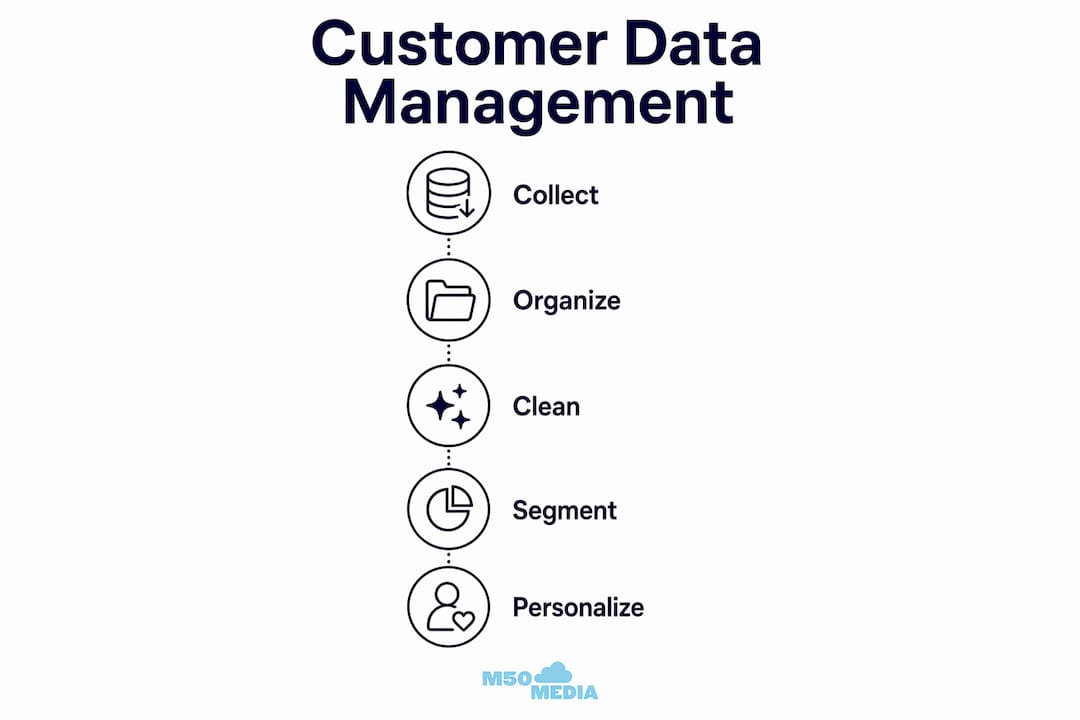
Customer data management (CDM) is the practice of collecting, organising, and maintaining accurate customer information across every system your business uses. It is the foundation that makes everything else possible. Without it, your marketing is basically shouting into a void and hoping someone shouts back.

A fragmented view of customer data leads to duplicated marketing, flawed analytics, and missed personalization opportunities. That means you could be emailing the same person three times from three different lists, annoying them into unsubscribing. Identity resolution, the process of linking customer records across platforms into one unified profile, is the fix.
Here is what good customer data management actually involves:
Unified customer profiles: Merge data from your CRM, email platform, e-commerce store, and social channels into one complete picture of each customer.
Data hygiene: Regularly remove duplicates, correct errors, and update outdated contact information so your analytics reflect reality.
Governance policies: Effective CDM involves not just technology but policies, workflows, and governance to ensure data accuracy and regulatory compliance.
Tool selection: Customer Data Platforms (CDPs) like Segment or Treasure Data, and CRMs like HubSpot or Salesforce, are built to centralise and activate your data.
The impact of customer data management on campaign success is direct. When your data is clean and unified, your segmentation is accurate, your messaging is relevant, and your ad spend goes to the right people. When it is not, you are paying to reach ghosts.
Pro Tip: Audit your contact database every quarter. Delete duplicates, merge split profiles, and tag customers by purchase history. Thirty minutes of data hygiene saves hours of wasted campaign spend.
What role does customer data play in personalising customer experiences?
Personalisation is not a nice-to-have. 80% of consumers prefer brands offering personalised experiences and spend 50% more on them. Faster-growing companies get 40% more revenue from personalisation than slower peers. That gap is enormous, and it is built entirely on how well a business uses its customer data.
Personalisation works by combining three types of customer information:
Behavioural data: Pages visited, products clicked, time spent browsing. This tells you what someone is interested in right now.
Transactional data: Purchase history, order frequency, average spend. This tells you what they have already committed to.
Preference data: Communication preferences, product categories, feedback responses. This tells you how they want to be treated.
When you combine these signals, you can deliver offers that feel like they were made specifically for that person. Because they were. AI-powered tools like Salesforce Einstein or HubSpot’s smart content features use real-time data to surface the right message at the right moment.
Here is the catch, though. Consumers feel personalisation is creepy if done without clear consent and benefit. Only 39% of consumers feel sharing data is worth the privacy cost. That is a trust gap you cannot afford to ignore.
“Zero-party data — information customers voluntarily share with you — forms the foundation of trusted personalisation.” This is data collected through quizzes, preference centres, and direct questions, not inferred from surveillance.
Pro Tip: Add a simple preference quiz to your welcome email sequence. Ask new subscribers what they are interested in. You get better data, they get more relevant content, and nobody feels like they are being watched.
The role of AI in marketing amplifies personalisation significantly, but only when the underlying customer data is clean and consented. Garbage in, garbage out. That is not a metaphor. That is just how algorithms work.
How can small businesses balance customer data use with privacy and trust?
Privacy is not the enemy of good marketing. It is the price of admission for sustainable marketing. Companies that treat customer data with privacy stewardship gain a competitive advantage through transparency and authentic customer-first values. That is not just feel-good advice. It is backed by research from Harvard Business School.
Transparent privacy compliance increases data sharing by generating 9% more purchase receipts and 5% more unique store visits. When customers trust you with their data, they give you more of it. More data means better personalisation. Better personalisation means more revenue. The cycle is real.
For Canadian small businesses, this matters even more. Canada’s Personal Information Protection and Electronic Documents Act (PIPEDA) and provincial privacy laws require meaningful consent for data collection. Treating compliance as a growth strategy rather than a legal checkbox is the smarter play.
Here are the strategies that build genuine data trust:
Be explicit about what you collect and why. A simple privacy notice in plain language beats a wall of legal text nobody reads.
Give customers control. Preference centres, easy unsubscribe options, and data deletion requests signal respect.
Use centralised consent management to avoid failed personalisation and prevent AI tools from ingesting data customers never authorised you to use.
Communicate the benefit. Tell customers what they get in exchange for sharing their information. “We use your purchase history to recommend products you will actually want” is honest and compelling.
Privacy stewardship as authentic care rather than a legal checklist creates a competitive advantage that is very hard for competitors to copy.
Building brand trust through ethical marketing is not just the right thing to do. It is the thing that keeps customers coming back when a competitor offers a slightly lower price.
What practical steps can entrepreneurs take to leverage customer data?
Knowing the importance of customer data is one thing. Putting it to work is another. Here is a practical sequence for small businesses starting from scratch or cleaning up a messy data situation.
Audit your current data sources. List every place customer information lives: your CRM, email platform, point-of-sale system, website analytics, and social media. You cannot unify what you have not mapped.
Choose a central tool. A CRM like HubSpot or Salesforce is the right starting point for most small businesses. A CDP makes sense once you are managing data across five or more channels.
Standardise your data collection. Use consistent field names, formats, and tagging conventions across every platform. “First Name” in HubSpot should not be “fname” in your e-commerce store.
Segment your audience. Group customers by purchase behaviour, location, engagement level, or lifecycle stage. Segmented campaigns consistently outperform broadcast emails.
Activate data across channels. Omnichannel selling lifts revenue by 8.9% by connecting data across all channels to drive measurable gains.
Measure and iterate. Track open rates, conversion rates, customer lifetime value, and churn. Let the numbers tell you what is working.
Here is a quick comparison of outcomes when customer data is managed well versus poorly:
Marketing Activity | Poor Data Management | Strong Data Management |
Email campaigns | High unsubscribe rates, low opens | Relevant content, higher conversions |
Ad targeting | Wasted spend on wrong audiences | Precise targeting, lower cost per acquisition |
Customer retention | Reactive, generic outreach | Proactive, personalised re-engagement |
Revenue from loyalty | Minimal repeat purchase rate | 30% higher customer loyalty and 26% more referrals |
Pro Tip: Connect your CRM to your omnichannel marketing strategy so customer behaviour on one channel updates their profile everywhere. A customer who clicks a product email should see that product featured in their next social ad.
Customer data analytics is not a one-time project. It is an ongoing practice. Schedule a monthly data review the same way you review your financials. Your data is a living asset, and it needs regular attention to stay useful.
Key takeaways
Customer data is the infrastructure that connects every marketing decision you make to the real people you are trying to reach.
Point | Details |
CDM is foundational | Unified, clean customer data makes every campaign more accurate and every marketing dollar work harder. |
Personalisation drives revenue | Brands offering personalised experiences see customers spend 50% more and grow revenue 40% faster. |
Privacy builds data volume | Transparent data practices increase customer data sharing, giving you more to work with over time. |
Omnichannel activation pays off | Connecting data across channels lifts revenue by 8.9% and increases customer loyalty by 30%. |
Governance is ongoing | Regular audits, consent management, and data hygiene are not one-time tasks. They are a continuous practice. |
Karl’s take: stop treating customer data like a filing cabinet
Here is something I see constantly with small business owners: they collect customer data, shove it into a spreadsheet or a CRM they barely open, and then wonder why their marketing feels like it is not connecting. The data is there. The opportunity is there. But nobody is actually using it.
The biggest misconception I run into is that customer data strategy is something only big companies with data science teams can pull off. That is simply not true. A well-maintained HubSpot account with clean contact records and a few smart segments will outperform a Fortune 500 company’s bloated, siloed database every single time.
What I have also learned is that the trust piece is not optional. Customers are paying attention to how you use their information. The businesses I have seen grow fastest are the ones that treat data transparency as a genuine value, not a legal formality. They tell customers what they collect, why they collect it, and what the customer gets in return. That honesty compounds over time into a loyalty that no ad budget can buy.
My honest advice: start small, stay consistent, and treat your customer data like the relationship it represents. Every record in your CRM is a real person who chose to do business with you. Honour that.
— Karl
Ready to put your customer data to work?
If reading this made you realise your customer data strategy needs some attention (or, let’s be honest, a full rescue mission), M50media is here for exactly that. Karl Lundgren works with small business owners and entrepreneurs to build marketing strategies grounded in real customer insights, not guesswork.

Whether you want to clean up your CRM, build a personalisation strategy, or figure out which tools actually make sense for your business size and budget, the M50media coaching programme gives you a clear path forward. Not sure where to start? Book a free Marketing SOS call with Karl and get straight answers about what your business needs next. No pressure, no pitch deck, just practical marketing advice from someone who has been in the trenches.
FAQ
What is the role of customer data in marketing?
The role of customer data in marketing is to replace guesswork with evidence. It tells you who your customers are, what they want, and when to reach them, so every campaign is more relevant and more effective.
How does customer data management improve campaign results?
Clean, unified customer data eliminates duplicate outreach, improves audience segmentation, and gives your analytics an accurate foundation. Poor data management leads to wasted ad spend and missed personalisation opportunities.
Why does customer data privacy matter for small businesses?
Transparent privacy practices increase data sharing and build the trust that turns one-time buyers into loyal customers. Canadian privacy laws like PIPEDA also require meaningful consent, making compliance a legal and strategic necessity.
What tools should small businesses use to manage customer data?
CRMs like HubSpot and Salesforce are the right starting point for most small businesses. Customer Data Platforms like Segment or Treasure Data make sense once you are managing data across multiple channels and need deeper identity resolution.
How can i use customer data to increase customer loyalty?
Data-driven engagement increases customer loyalty by 30% and makes customers 26% more likely to recommend your brand. Start by segmenting your audience by purchase history and sending personalised re-engagement campaigns to lapsed customers.
Recommended
Comments