What is a micro-influencer? Your 2026 marketing guide

TL;DR:
Micro-influencers, with 10,000 to 100,000 followers, build niche audiences that outperform larger creators in engagement and trust. They offer cost-effective, authentic content that drives conversions and provides reusable assets for sustainable marketing efforts. Building ongoing relationships and proper tracking maximize their long-term ROI for brands.
A micro-influencer is defined as a social media creator with 10,000 to 100,000 followers who builds niche-focused, highly engaged audiences on platforms like Instagram, TikTok, and YouTube. Think of them as the friendly neighbour who actually knows everyone on the block, rather than the celebrity waving from a limo. For social media marketers, brand managers, and small businesses, they represent one of the most cost-effective and authentic paths into influencer marketing today. This guide covers the micro-influencer definition, the real benefits, how to build a strategy, and what you can realistically expect to spend and earn.
What is a micro-influencer vs. macro, nano, and mega tiers?
The influencer world is basically a size chart, and knowing where each tier sits saves you a lot of budget heartache. Here is how the tiers break down by follower count, engagement, and practical use.
Tier | Follower range | Typical engagement rate | Avg. cost per post | Best use case |
Nano | Under 10,000 | 5–8% | Under $100 | Hyper-local or community campaigns |
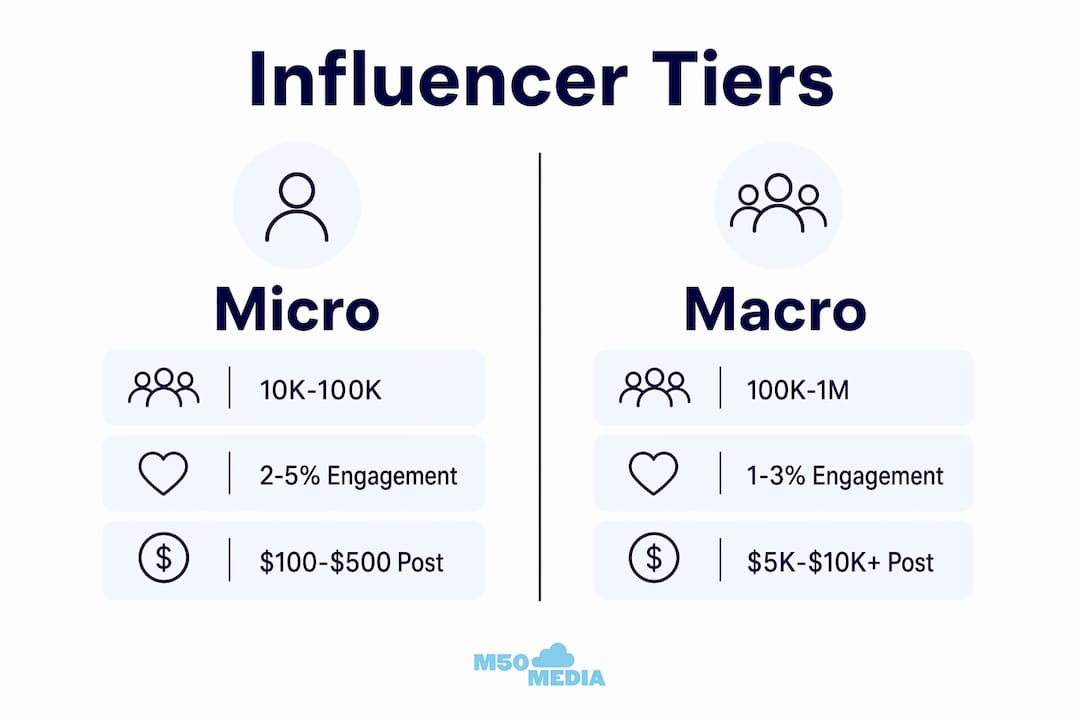
Micro | 10,000–100,000 | 2–5% | $100–$500 | Niche product launches, brand awareness |
Macro | 100,000–1 million | 1–2% | $5,000–$10,000+ | Mass reach, brand visibility |
Mega/Celebrity | 1 million+ | Under 1% | $10,000–$1 million+ | National campaigns, cultural moments |
Micro-influencers sit in a genuinely strategic middle ground. Their engagement rates of 2–5% outperform macro creators, meaning a higher proportion of their audience actually sees, likes, comments on, and acts on their content. That is not a small thing when you are trying to move product rather than just rack up impressions.
The content style differs too. Macro and mega creators often produce polished, studio-quality posts that feel like ads (because they are). Micro-influencers tend to post in a way that feels like a recommendation from a trusted friend, which is exactly the tone that drives conversions. Sprout Social describes this as content that feels like peer recommendations rather than celebrity endorsements. That distinction matters enormously for audience trust.
Pro Tip: If your budget is tight, do not automatically default to nano-influencers just because they are cheaper. Micro-influencers offer a better balance of reach and engagement, and their audiences are large enough to generate meaningful traffic and sales data.
Why use micro-influencers? The real benefits for your brand
Here is where things get genuinely exciting. The benefits of micro-influencers go well beyond “they are cheaper than Kylie Jenner” (though, yes, that is also true).

Authenticity that actually converts. Audiences follow micro-influencers because they trust their opinions. Authenticity and perceived similarity are the core drivers of micro-influencer effectiveness. When a fitness creator with 40,000 followers recommends a protein powder, their audience believes it. That belief translates into clicks, conversions, and repeat purchases in a way that a celebrity post simply does not replicate.
Niche targeting that macro creators cannot match. A macro influencer might reach a million people, but how many of them actually care about your handmade candles or B2B SaaS tool? Micro-influencers self-select their audiences around specific interests, which means your message lands in front of people who are already primed to care. This connects directly to micro-targeting strategies that precision-focused marketers use across channels.
Budget efficiency that scales beautifully. At $100 to $500 per post, you can partner with 10 to 20 micro-influencers for the same budget as a single macro post. That diversification reduces risk and increases your chances of finding a creator whose audience genuinely responds to your brand.
A sustainable content pipeline. This one surprises a lot of marketers. Repurposed creator assets from micro-influencer campaigns provide ongoing content you can use across email, paid social, and organic channels. You are not just buying a post. You are buying a piece of content that can work for you for months.
Here is a quick summary of the core benefits:
Higher engagement rates compared to macro and mega tiers
Niche audience alignment that improves conversion relevance
Lower cost per post with scalable multi-creator campaigns
Authentic, peer-style content that builds audience trust
Reusable creator content that extends campaign ROI
Community connections that support long-term brand loyalty
Pro Tip: Do not treat micro-influencer partnerships as one-off transactions. Building ongoing relationships with a bench of creators compounds brand value over time and gives you a reliable content source you can activate quickly.
How to build a micro-influencer marketing strategy that works
A solid micro-influencer marketing strategy is less about finding the “perfect” creator and more about building a repeatable system. Here is how to do it step by step.
Define your campaign goal first. Are you driving awareness, generating user-generated content, or pushing direct conversions? Your goal determines which creators you need, what content you brief, and which metrics you track. Skipping this step is the number one reason campaigns underperform.
Find creators aligned with your niche. Search hashtags related to your product category on Instagram and TikTok. Look at who is already talking about topics adjacent to your brand. Tools like AspireIQ, Grin, and Modash let you filter by follower count, engagement rate, and audience demographics. You can also check out influencer marketing guidance for small businesses to get a practical starting framework.
Engage multiple creators simultaneously. Campaigns involving 20 to 50 creators with individual affiliate codes and UTM tracking are standard practice for brands that do this well. Running multiple creators at once gives you comparative data and reduces dependence on any single creator’s performance.
Brief for authenticity, not scripts. Give creators a clear brief covering key messages, required disclosures, and any brand restrictions. Then let them do their thing. Over-scripted content kills the peer-recommendation quality that makes micro-influencers effective in the first place.
Build FTC compliance into every contract. FTC disclosure rules apply to every influencer regardless of follower count. If there is a material connection between the creator and your brand, that relationship must be clearly disclosed. Include disclosure language in your contracts and audit posts after they go live. The updated FTC Endorsement Guides (effective 2023) leave no wiggle room here.
Track conversion-relevant KPIs. Likes are nice. Sales are better. Funnel-aligned KPIs like cost per acquisition (CPA), return on ad spend (ROAS), and cost per mille (CPM) give you a real picture of campaign performance. Vanity metrics will make you feel good but will not help you justify the budget next quarter.
Pro Tip: Repurpose your best-performing creator content as paid social ads. A micro-influencer video that organically drove strong engagement will almost always outperform a polished studio ad in paid placements because it looks native to the feed.
What do micro-influencers cost, and what ROI can you expect?
Let’s talk numbers, because this is where a lot of brand managers get either pleasantly surprised or quietly confused.
Metric | Micro-influencer | Macro-influencer |
Avg. cost per post | $100–$500 | $5,000–$10,000+ |
Typical engagement rate | 2–5% | 1–2% |
Campaign scale (creators) | 10–50 creators | 1–5 creators |
Content reuse potential | High (authentic UGC style) | Low (polished, brand-specific) |
Attribution ease | High (affiliate codes, UTMs) | Moderate |
The cost efficiency is real, but the ROI story is more nuanced than “micro-influencers are cheaper, therefore better.” The actual advantage comes from niche targeting combined with higher engagement. A macro influencer reaching 500,000 people with a 1% engagement rate generates 5,000 interactions. A micro-influencer reaching 50,000 people with a 4% engagement rate generates 2,000 interactions, but those interactions come from a far more relevant audience. Run 10 micro-influencers at once and you have 20,000 highly targeted interactions for a fraction of the macro budget.
Micro-influencers also function as measurable performance channels when campaigns incorporate affiliate structures and clear tracking. That measurability is something macro campaigns often lack, making it genuinely difficult to attribute sales. With micro-influencers and proper UTM setup, you know exactly which creator drove which conversion.
The content asset angle adds another layer to the ROI calculation. A single micro-influencer campaign producing 20 pieces of authentic creator content gives you material for email newsletters, organic social posts, and paid ads for months. That extended utility changes the cost-per-asset math significantly.
Key takeaways
Micro-influencers deliver higher engagement, better niche targeting, and measurable attribution than macro creators, making them the most cost-efficient influencer tier for most small business and brand campaigns.
Point | Details |
Micro-influencer definition | Creators with 10,000 to 100,000 followers focused on niche topics and authentic audience connections. |
Engagement advantage | Micro-influencers average 2–5% engagement rates, outperforming macro and mega tiers. |
Cost efficiency | Posts range from $100 to $500, enabling multi-creator campaigns on modest budgets. |
Strategy essentials | Use affiliate codes, UTM tracking, and FTC-compliant contracts for measurable, legal campaigns. |
Long-term value | Repurposed creator content extends ROI well beyond the original post date. |
Why I think most brands are still underusing micro-influencers
Here is my honest read after years of working with brands on influencer strategy: most marketers intellectually understand the value of micro-influencers, but emotionally they still chase the big follower numbers because it feels more impressive in a boardroom presentation. “We partnered with a creator who has 2 million followers” sounds better than “we ran 30 micro-influencer activations,” even when the second approach drove three times the conversions.
The other mistake I see constantly is treating micro-influencer campaigns as a one-time test rather than a repeatable system. You run five creators, get mixed results, and conclude that micro-influencers “didn’t work.” But you didn’t build the tracking infrastructure, you didn’t brief for authenticity, and you picked creators based on aesthetics rather than audience alignment. That’s not a micro-influencer problem. That’s a strategy problem.
The compliance piece also gets ignored more than it should. FTC disclosure requirements are not optional, and the brands that skip proper contracts are one viral controversy away from a very bad news cycle. Build disclosure clauses into every agreement from day one. It takes five minutes and protects everyone.
What actually works, in my experience, is building a bench of 15 to 30 creators across your key niches, activating them on a rolling basis, repurposing their content across channels, and tracking CPA and ROAS religiously. That approach turns micro-influencer marketing from a campaign tactic into a genuine performance channel. Check out these social media campaign examples if you want to see what that looks like in practice.
The brands winning with micro-influencers in 2026 are not the ones with the biggest budgets. They are the ones with the most disciplined systems.
— Karl
Ready to build your micro-influencer strategy?
Knowing the theory is one thing. Building a campaign that actually converts is another, and that gap is exactly where most brands get stuck. At M50media, Karl works directly with social media marketers, brand managers, and small business owners to develop influencer strategies that are practical, compliant, and built for measurable results.

Whether you are starting from scratch or trying to fix a campaign that has not delivered, a coaching session with Karl gives you a clear, personalised roadmap. You can also explore the full range of marketing resources and services on the M50media site, including guides on authenticity in branding and influencer campaign management. Stop guessing and start building something that works.
FAQ
What is the micro-influencer definition by follower count?
A micro-influencer is a social media creator with 10,000 to 100,000 followers who focuses on a specific niche topic. This range distinguishes them from nano-influencers (under 10,000) and macro-influencers (over 100,000).
Why use micro-influencers instead of larger creators?
Micro-influencers deliver engagement rates of 2–5%, higher than macro or mega tiers, and their niche audiences are more likely to convert on relevant products. Their lower cost per post also allows brands to run multi-creator campaigns for the same budget as a single macro post.
How do I find micro-influencers for my brand?
Search niche hashtags on Instagram and TikTok, or use platforms like AspireIQ, Grin, or Modash to filter creators by follower count, engagement rate, and audience demographics. Look for creators who are already organically discussing topics related to your product category.
Do micro-influencers need to disclose brand partnerships?
Yes. FTC disclosure rules apply to all influencers regardless of size if there is a material connection to the brand. Brands should include disclosure clauses in every influencer contract and audit posts after publication to confirm compliance.
What ROI can I realistically expect from micro-influencer campaigns?
ROI varies by niche and campaign structure, but micro-influencers function as measurable performance channels when affiliate codes and UTM tracking are in place. Tracking CPA and ROAS rather than engagement alone gives you the clearest picture of actual return.
Recommended
Comments