What is reputation management for your business?

TL;DR:
Reputation management involves continuous efforts to influence how your business is perceived across digital and real-world channels. It encompasses monitoring, creating positive content, engaging authentically, and addressing harmful information to build and protect trust. A strategic, all-encompassing approach improves customer loyalty, ratings, and business performance over time.
Reputation management is the deliberate, continuous effort to shape how your business is perceived by customers, employees, and the public across every digital and real-world channel that matters. Think of it as the difference between letting strangers write your biography and actually holding the pen yourself. Gartner frames it as the collective perception stakeholders form from all experiences and external information, not just your own messaging. Tools like Brandwatch, platforms like Google Business Profile, and agencies like StatusLabs have built entire methodologies around this idea. In 2026, with AI-powered search surfaces surfacing reviews and summaries before a customer ever clicks your website, the importance of reputation management has never been more tangible or urgent.
What is reputation management and what does it actually involve?

Reputation management is the strategic process of influencing how an organisation is perceived by its stakeholders, covering everything from a one-star Google review to a viral social media post to a news article that refuses to disappear from page one. It is not a one-time fix. It is a living, breathing programme that runs in the background of your business every single day.
Brandwatch defines ORM through a four-stage cycle: monitor, analyse sentiment and reach, take action (amplify or respond), and maintain ongoing engagement. That cycle never stops. Your reputation is being shaped right now on search engines, review sites, social platforms, forums, and news outlets, whether you are paying attention or not.
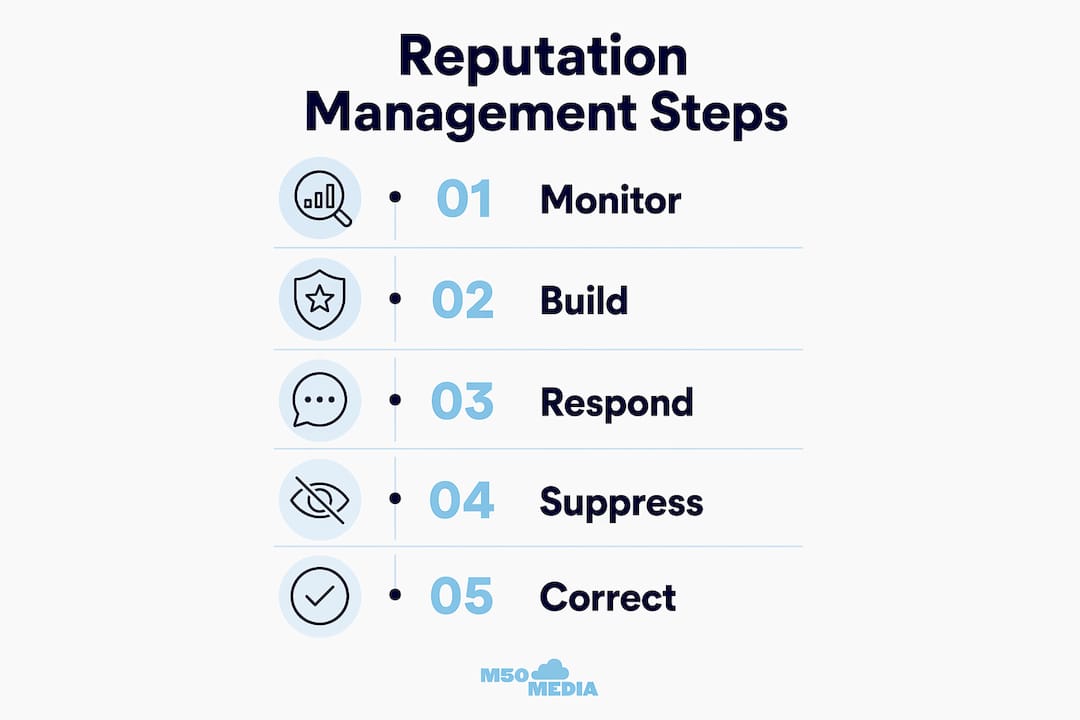
StatusLabs breaks it down into four core activities that every business needs to run simultaneously.
Monitor — Track mentions, reviews, and conversations across every channel your customers use.
Build — Create positive reputation assets like blog content, case studies, and earned media that reinforce your brand story.
Respond — Engage with feedback, both positive and negative, in a timely and authentic way.
Suppress or correct — Push down harmful content in search results and address misinformation directly.
Most businesses only do number three (responding), and only when something goes sideways. That is like only checking your bank account after you hear a suspicious noise from your wallet. A full strategy covers all four pillars, all the time.
Pro Tip: Set up Google Alerts for your business name, your key products, and even your own name as a founder. Pair it with a free tier of Brandwatch or a tool like Mention to catch conversations happening on social and forums that Google Alerts will miss. Always-on monitoring is the foundation everything else is built on.
How does reputation management impact trust and business performance?
Here is the part that should make every business owner sit up straight. ORM practices improve ratings, customer satisfaction, loyalty, and financial outcomes for small businesses. That is not a soft, feel-good claim. That is research from the Journal of Small Business Strategy connecting your Google star rating directly to your bottom line.
The mechanism behind trust loss is equally fascinating and a little unsettling. Research from the Corporate Reputation Review explains that trust loss follows a two-stage process: customers first assess whether your business is responsible for a negative event, then evaluate how severe that event actually is. Only when both boxes are ticked do they fully withdraw trust. This means a minor mistake handled well rarely destroys a relationship. A major mistake handled poorly almost always does.
“Effective reputation management requires alignment of internal behaviours with brand values and active promotion of positive narratives.” — Gartner
That quote is doing a lot of heavy lifting. It means your reputation is not just what you say online. It is the gap (or the alignment) between what you promise and what you actually deliver. Customers notice that gap faster than you think.
Pro Tip: Actively ask satisfied customers to leave reviews on Google and Yelp right after a positive interaction. A steady stream of fresh, genuine reviews builds a trust signal that is far more credible than a burst of reviews from three years ago. Platforms like Birdeye and Podium make this request process almost effortless to automate.
What are the best reputation management strategies and tools for 2026?
The best reputation management strategies combine proactive content creation, smart monitoring, and fast, authentic engagement. Here is what that looks like in practice for a business owner who does not have a full PR department on speed dial.
Proactive content is your first line of defence (and offence). Publishing blog posts, case studies, and thought leadership articles on your own site gives search engines positive, authoritative content to rank. When someone Googles your business name, you want your own story filling that first page, not someone else’s narrative. Integrating ORM with SEO is not optional in 2026. Integrating ORM with SEO amplifies positive content and helps you dominate AI-powered search summaries that potential customers see before they even visit your site.
Here is a quick comparison of popular tools to help you decide where to invest:
Tool | Best for | Key feature | Cost tier |
Google Alerts | Basic monitoring | Email alerts for brand mentions | Free |
Brandwatch | Deep sentiment analysis | Multi-channel monitoring and analytics | Paid (enterprise) |
Birdeye | Review management | Automated review requests and responses | Paid (SMB-friendly) |
Podium | Customer messaging | Review generation via SMS | Paid (SMB-friendly) |
Google Business Profile | Local search reputation | Direct review management and Q&A | Free |
A few other strategies worth building into your routine:
Respond to every review, positive or negative, within 24 hours. Speed signals that you care.
Create a content calendar that consistently publishes positive brand stories, not just when a crisis hits.
Monitor your competitors’ reviews to spot gaps in the market where your business can shine.
Align your internal team culture with your external brand promises. Employees talk, and their voices shape your reputation too.
Traditional PR and online reputation management (ORM) are not the same thing, but they work beautifully together. PR focuses on earned media and relationships with journalists. ORM focuses on the digital ecosystem where your customers actually live. Smart businesses use both.
How to handle negative feedback and reputation crises effectively?
Negative feedback is not the enemy. Ignoring it is. Reputation management fails when businesses restrict themselves to reactive engagement without a systemic, always-on monitoring system in place. By the time you notice a problem, it has often already spread.
When a negative review or crisis hits, here is what actually works:
Respond quickly and specifically. A generic “We’re sorry you had a bad experience” is the reputation management equivalent of a form letter. Customers can smell it from a kilometre away.
Acknowledge responsibility clearly when it is warranted. Research confirms that transparent communication addressing responsibility is what actually moves the needle on trust recovery. Vague non-apologies make things worse.
Address the severity directly. If something went seriously wrong, say so. Minimising a significant issue signals that you do not fully understand the customer’s experience.
Take the conversation offline when appropriate. Offer a direct contact method to resolve the issue privately, then follow through.
Use suppression strategies for genuinely harmful or false content. This involves publishing high-quality positive content that outranks the negative material in search results, or working with a reputation management service to address defamatory content through legal or platform channels.
Common pitfalls to avoid? Deleting negative comments (it almost always backfires and gets screenshotted), arguing publicly with reviewers (never a good look), and waiting too long to respond (silence reads as guilt). A well-handled complaint can actually turn a frustrated customer into a loyal advocate. It sounds counterintuitive, but people remember how you handled the problem more than the problem itself.
Pro Tip: Create a simple crisis response template in advance, before you ever need it. Having a pre-approved framework for acknowledging issues, stating next steps, and offering resolution means you respond in minutes instead of days. Speed and specificity are your two biggest assets in a reputation crisis.
Key takeaways
Reputation management works because it combines continuous monitoring, proactive content building, authentic engagement, and strategic crisis response into a single, always-on system that protects and grows customer trust.
Point | Details |
Four-pillar framework | Monitor, build, respond, and suppress or correct. Running all four simultaneously is what separates effective ORM from reactive damage control. |
Trust loss is a two-stage process | Customers assess responsibility first, then severity. Address both directly in any crisis communication to have a real chance at trust recovery. |
ORM drives measurable business outcomes | Research links ORM practices to improved ratings, customer loyalty, and financial performance for small businesses. |
Tools matter, but strategy comes first | Google Alerts, Birdeye, Podium, and Brandwatch each serve different needs. Choose based on your monitoring gaps, not just your budget. |
Proactive content is your best defence | Publishing positive, SEO-optimised content consistently means you control what customers find when they search your name. |
Karl’s honest take on reputation management in Canada
I have worked with a lot of small and medium-sized Canadian businesses, and the pattern I see most often is this: reputation management gets treated like a fire extinguisher. It sits in the corner, nobody thinks about it, and then the moment something goes wrong, everyone is scrambling to find it. That approach is exhausting and expensive.
The Canadian market has some nuances worth noting. Canadian consumers tend to be research-oriented and community-minded. A bad review on a local Facebook group or a regional forum can carry more weight here than a national news mention. Local reputation signals matter enormously, especially for service-based businesses in smaller cities and towns.
What I have found actually works is treating ORM as part of your regular brand-building online routine, not as a separate crisis management function. When you are consistently publishing good content, engaging authentically on social media, and asking happy customers for reviews, you are building a buffer. That buffer is what protects you when something inevitably goes sideways.
The businesses that struggle most are the ones waiting for a perfect moment to “start” managing their reputation. There is no perfect moment. Start now, start small, and build the habit. Your future self (and your Google rating) will thank you.
— Karl
Ready to take control of your brand’s reputation?
Understanding reputation management is the first step. Actually building a system that works for your specific business is where M50media comes in. Whether you are starting from scratch or trying to recover from a rough patch, getting a clear picture of where you stand is the most valuable thing you can do right now.

Karl offers a free Marketing SOS Call where you can talk through your reputation and digital marketing challenges one-on-one, no sales pitch, no fluff. If you are ready for something more structured, the digital coaching programme at M50media walks you through building a reputation and marketing strategy that actually fits your business. Your brand’s story is worth telling well. Let’s make sure it is.
FAQ
What is reputation management in simple terms?
Reputation management is the ongoing process of monitoring, shaping, and protecting how your business is perceived by customers and the public across digital and real-world channels. It includes responding to reviews, creating positive content, and addressing harmful information.
Why does reputation management matter for small businesses?
Research from the Journal of Small Business Strategy shows that ORM practices directly improve customer satisfaction, loyalty, and financial performance. For small businesses, a strong online reputation is often the deciding factor for a new customer choosing you over a competitor.
What does a reputation management service actually do?
A reputation management service handles monitoring brand mentions, responding to reviews, creating positive content to improve search rankings, and suppressing or correcting harmful content. Agencies like StatusLabs and platforms like Birdeye offer these services at different levels of involvement.
How do I start managing my online reputation today?
Start with free tools: set up Google Alerts for your business name, claim your Google Business Profile, and begin responding to all existing reviews. For a more thorough approach, check out this step-by-step guide for SMBs to build out a full monitoring and engagement system.
How long does it take to see results from reputation management?
Consistent ORM efforts typically show measurable improvements in review ratings and search visibility within three to six months. Trust recovery after a specific negative event depends on how quickly and transparently you address both the responsibility and severity of the issue, as research from the Corporate Reputation Review confirms.
Recommended
Comments