What is social commerce and how can it grow your business?


Social commerce isn’t just another marketing buzzword for 2026. It’s a fundamental shift in how consumers discover and purchase products online. This guide explains what social commerce is, why it matters for your small business, and how you can leverage it to boost sales and deepen customer engagement through strategic social media integration.
Table of Contents
Key takeaways
Point | Details |
Social commerce definition | Direct selling through social platforms eliminates redirects and creates seamless shopping experiences within social feeds. |
Platform integration | Instagram, Facebook, TikTok, and Pinterest now offer native shopping features that merge browsing and buying behaviours. |
Business benefits | Enhanced customer engagement, loyalty building, and streamlined purchasing paths drive measurable sales growth. |
Implementation challenges | Platform fees, content customisation requirements, and strategic influencer collaborations demand careful planning. |
Success factors | Authentic engagement, strategic content, and proper technical setup separate thriving social commerce from failed attempts. |
What is social commerce? A new way to shop on social media
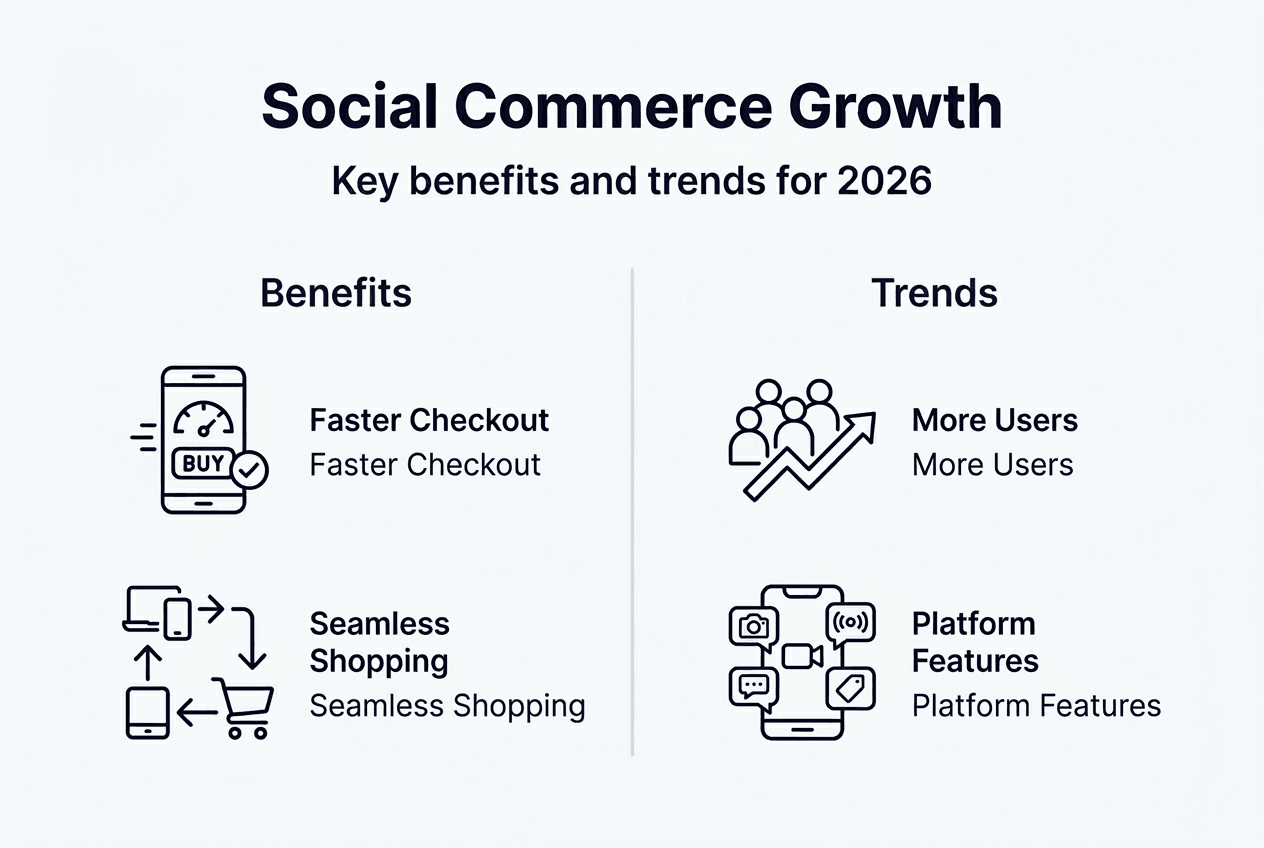
Social commerce enables customers to complete purchases directly within social platforms without leaving the app. Unlike traditional e-commerce that redirects users to external websites, social commerce merges browsing and buying into the same feed where people already spend hours daily.
The customer journey becomes remarkably streamlined. Someone scrolling through Instagram sees a product in their feed, taps the tagged item, views details, and completes checkout without ever opening a browser. This frictionless experience removes the traditional barriers between product discovery and purchase completion.
Major platforms supporting social commerce include:
Instagram Shopping with product tagging in posts, Reels, and Stories
Facebook Shops offering customisable storefronts
TikTok Shopping integrating product links in videos
Pinterest Product Pins enabling direct purchases from inspiration boards
Consumer adoption has accelerated dramatically in 2026. More shoppers expect to buy directly from their social feeds rather than clicking through to separate websites. This shift represents a fundamental change in online shopping behaviour that small businesses cannot ignore.
Social commerce fits naturally into broader digital marketing strategies by combining content creation, community building, and sales conversion in one unified channel. Exploring benefits of social media marketing for small business reveals how these integrated approaches amplify overall marketing effectiveness.
Why social commerce matters for small businesses in 2026
Businesses using social commerce report engagement rates up to 20% higher than traditional e-commerce channels. This increased interaction stems from the native social environment where customers already communicate with friends and discover new interests.
Small businesses gain specific advantages through social commerce:
Lower barriers to entry compared to building standalone e-commerce websites
Access to massive built-in audiences on established platforms
Enhanced trust through social proof and peer recommendations
Opportunity to showcase brand personality through authentic content
Direct communication channels with customers in real time
Building customer loyalty becomes easier when shopping integrates seamlessly with social interaction. Customers who purchase through social platforms often feel more connected to brands because the transaction occurs within their trusted social space rather than an impersonal checkout page.

Yet challenges exist. Platform fees can consume significant margins, with some retailers paying up to 35% in fees to social commerce platforms. Competition intensifies as more businesses adopt these tools, making standout content and strategic positioning essential.
Brands that master social commerce see measurable improvements in customer loyalty and sales performance. Success requires tailored content that resonates with platform-specific audiences and often involves influencer collaborations that feel authentic rather than purely transactional.
“The shift from scrolling to buying happens when businesses create content that educates, entertains, and inspires rather than just promoting products.”
Consumer behaviour has fundamentally changed. People now expect to complete purchases without leaving their favourite social apps. Understanding this shift through resources like our social media marketing guide grow customers and unlock online marketing advantages small business helps businesses adapt their strategies accordingly.
Key social commerce tools and features to use today
Setting up social commerce requires understanding platform-specific features and technical requirements. Each platform offers distinct tools that serve different business needs and audience preferences.
Instagram Shopping provides the most comprehensive integration for visual product discovery. The system syncs product catalogues and enables tagging in posts, Reels, and Stories that link directly to purchasable items. Customers tap tagged products to view pricing, descriptions, and purchasing options without interrupting their browsing experience.
Implementing Instagram Shopping follows these essential steps:
Create a product catalogue in Meta’s Commerce Manager with accurate product details and pricing
Connect your catalogue through Business Manager to enable Instagram native shopping features
Link your Instagram business account to the catalogue through account settings
Submit your account for shopping approval, which typically takes 24 to 48 hours
Begin tagging products in new posts, existing content, Stories, and Reels
Facebook Shops extends this functionality by creating customisable storefronts within your Facebook page. Customers browse your entire catalogue, save items, and complete purchases without leaving Facebook. The unified Commerce Manager system means inventory updates automatically across both Instagram and Facebook.
TikTok Shopping leverages the platform’s viral content potential by enabling product links in videos that drive impulse purchases. Pinterest Product Pins transform inspiration boards into shoppable catalogues where users planning projects can immediately purchase featured items.
Native shopping features eliminate friction points that traditionally caused cart abandonment. When checkout happens within familiar social interfaces using saved payment methods, conversion rates improve dramatically. Learning from social media campaign examples boost roi 11x 2026 shows how strategic implementation of these tools multiplies campaign effectiveness.
Best practices and common pitfalls in social commerce
Successful social commerce requires a fundamentally different approach than traditional e-commerce. Treating social commerce as a simple extension of existing online stores leads to poor performance and wasted resources.
Content customisation makes the critical difference. Social platforms reward authentic, engaging content that sparks conversation rather than generic product listings. Your posts should educate, entertain, or inspire before they sell. Share behind-the-scenes glimpses of your business, customer success stories, and practical tips related to your products.
Influencer collaborations amplify reach when partnerships feel genuine. Choose influencers whose audiences align with your target customers and whose values match your brand. Micro-influencers with 10,000 to 50,000 engaged followers often deliver better ROI than celebrity partnerships because their recommendations carry more weight with niche communities.
Key practices for social commerce success:
Post consistently to maintain visibility in algorithmic feeds
Respond promptly to comments and messages to build relationships
Use high-quality visuals that showcase products in realistic contexts
Test different content formats to identify what resonates with your audience
Analyse performance metrics to refine your strategy continuously
Platform fee structures significantly impact profitability. Before committing to specific platforms, calculate total costs including transaction fees, payment processing fees, and any subscription charges. Some platforms charge substantially more than others for similar services.
Platform | Transaction Fees | Best For | Key Limitation |
Instagram Shopping | Payment processor fees only | Visual products, lifestyle brands | Requires Facebook Business Manager setup |
Facebook Shops | Payment processor fees only | Broad audiences, catalogue-heavy businesses | Less discovery-focused than Instagram |
TikTok Shopping | Variable by region, up to 8% | Viral products, younger demographics | Still rolling out in some markets |
Pinterest Product Pins | Varies by integration | Home decor, fashion, DIY products | Smaller active buyer base |
Building genuine customer relationships matters more than aggressive selling. People use social platforms primarily for connection and entertainment, not shopping. Your social commerce strategy should prioritise providing value that naturally leads to purchases rather than constant promotional messaging.
Pro Tip: Plan content three weeks ahead to maintain consistency while allowing flexibility for trending topics and timely opportunities. This approach balances strategic planning with the authentic spontaneity that social audiences expect.
Refining your approach with insights from social media advertising guide lead generation helps you balance organic engagement with strategic promotional content that converts browsers into buyers.
How M50 Media can help you succeed with social commerce
Navigating social commerce successfully requires expertise in platform features, content strategy, and audience engagement. M50 Media specialises in helping small businesses implement effective social commerce strategies tailored to their unique products and target audiences.

Our coaching services with Karl Lundgren provide personalised guidance on selecting the right platforms, setting up technical integrations, and creating content that drives sales while building authentic community connections. We understand the challenges small business owners face when expanding their digital marketing footprint and offer practical solutions that fit real-world budgets and time constraints.
Whether you need strategic direction or hands-on implementation support, our digital coaching services help you leverage social commerce effectively without wasting resources on trial and error. Start with a free marketing SOS call to discuss your specific situation and discover how social commerce can accelerate your business growth in 2026.
Frequently asked questions about social commerce
How does social commerce differ from social media marketing?
Social media marketing builds awareness and engagement through content and advertising across social platforms. Social commerce specifically enables direct purchasing within those platforms without redirecting to external websites. While related, social commerce represents the transaction component of broader social media marketing strategies.
Which social commerce platform works best for small businesses?
Instagram Shopping typically delivers the strongest results for product-based small businesses due to its visual focus and seamless integration with Facebook’s commerce tools. However, the ideal platform depends on where your target customers spend time and what product types you sell. Test multiple platforms to identify which generates the best engagement and conversion rates for your specific audience.
Do I need a separate e-commerce website to use social commerce?
No, many businesses operate successfully using only social commerce platforms without standalone websites. However, owning your e-commerce presence provides independence from platform policy changes and fee structures. The best approach often combines social commerce for discovery and impulse purchases with a website for detailed product information and brand storytelling.
How much should I budget for social commerce platform fees?
Budget between 3% and 8% of gross sales for standard payment processing fees on platforms like Instagram and Facebook. Some platforms charge additional transaction fees or subscription costs. Calculate total platform costs including payment processing, transaction fees, and any premium features before committing to ensure profitability at your price points.
Can social commerce work for service-based businesses?
While social commerce platforms primarily serve product businesses, service providers can leverage booking integrations and appointment scheduling tools available on platforms like Instagram and Facebook. Service businesses often see better results focusing on lead generation through social media advertising rather than direct social commerce transactions.
Recommended
This post about social commerce and how it can grow your business is really informative. It highlights how social media platforms are becoming powerful tools for selling products. I remember working on an e-commerce project where I had to research similar trends and wanted to make sure my writing was clear. I used academic assignment help UK to help me structure my work. Good business insights and good support help you understand how to leverage social commerce effectively.
It showed me how self care matters. It helped me understand large projects better. Nice post . Your post make me smile.
Reading about social commerce reminded me of how quickly online habits have changed. I remember discovering small businesses through social media and being surprised by how naturally their products became part of everyday conversations. I am a PhD student and work part-time at Affordable Assignments. During my college days, I struggled academically, which inspired me to help others. Working with students has also shown me how important trust and communication are, much like Engineering Assignment Help in UK when students seek guidance. A very relatable post. I appreciate how openly you shared your thoughts and experience.😄
I was going through some coding help threads and noticed how many people rely on different learning methods when dealing with PHP problems. In the middle of one conversation, online php assignment help was mentioned as something people turn to when they get stuck with assignments or complex logic. It made me think about how programming is not just about knowing syntax but also about building problem-solving habits. I often find that I can read code and understand it, but writing it from scratch is a different challenge. Especially when working with arrays, forms, and database queries, small mistakes can completely change the output. Debugging also takes a lot of time, and sometimes the error messages are not very clear at…
Reading this article really made me think about how shopping on social media is changing fast. I remember last semester when I tried to figure out the best way to manage my thesis research while learning digital trends, and I actually used Affordable PhD thesis writing service to help organize my sources, which made the whole process smoother. Social commerce seems similar in that small steps, like better tools and planning, can really make a difference. It’s interesting to see how small adjustments online can lead to bigger engagement.