What is voice search optimisation for small businesses
- karl7209
- May 30
- 9 min read

TL;DR:
Voice search optimisation requires rewriting content to sound natural, answer questions directly, and focus on local intent. Small businesses can benefit by implementing FAQs, schema markup, and improving mobile speed to appear in voice results. Tracking question-based queries and optimizing local profiles helps increase voice search visibility and customer engagement.
Most small business owners think voice search optimisation is just about throwing a few extra keywords onto a page and calling it done. Spoiler: it’s not. Voice search optimisation, formally known as voice-activated search optimisation, is about rewriting how your content sounds and behaves so that Siri, Google Assistant, and Alexa actually pick your business when someone talks at their phone. And with voice queries running 7–9 times longer than typed searches, the rules of the game have genuinely changed.
Key takeaways
Point | Details |
Voice search differs from text SEO | Spoken queries are longer, conversational, and question-based, requiring a different content approach. |
Direct answers win voice results | Content structured around short, clear answers earns featured snippets that voice assistants read aloud. |
Local intent is dominant | Most voice searches have local intent, making your Google Business Profile your highest-priority asset. |
Schema markup matters a lot | Adding FAQPage, HowTo, and LocalBusiness schema helps search engines identify your content for voice delivery. |
Track with Search Console | Use question-based query filters in Google Search Console to measure and refine your voice search performance. |
What voice search optimisation actually means
So, what is voice search optimisation, really? Search Engine Land defines it as tailoring your website content and technical settings so voice assistants select your content when answering spoken queries. That sounds simple enough, but the gap between traditional SEO and voice-activated search optimisation is actually pretty wide.

Think of it this way. When someone types, they write like a robot: “best pizza downtown Toronto.” When someone speaks, they talk like a human: “Hey Google, what’s the best pizza place near me that’s open right now?” One is a string of keywords. The other is a full sentence with context, location intent, and urgency baked right in.
Here’s what makes voice search genuinely different from what you’re probably already doing:
Voice queries are conversational and phrased as full questions rather than keyword fragments.
Users expect a single, direct answer, not a list of ten blue links to scroll through.
Featured snippets and position-zero results are the primary source voice assistants read from, so snippet eligibility becomes your main goal.
Zero-click results mean your content needs to be the answer, not just point to one.
Voice searches skew heavily local, with “near me” and “open now” phrases appearing constantly.
The big mental shift here is understanding that voice search optimisation isn’t just another SEO checkbox. It’s about being findable in real-life moments, not just searchable in theory. Someone standing in a parking lot asking their phone where to get a quick oil change is not going to scroll. You either show up as the answer, or you don’t show up at all.
Voice search SEO strategies that actually work
Right, let’s get into the practical stuff. These are the voice search SEO strategies that move the needle for small businesses, not the generic “write good content” advice you’ve heard a thousand times.
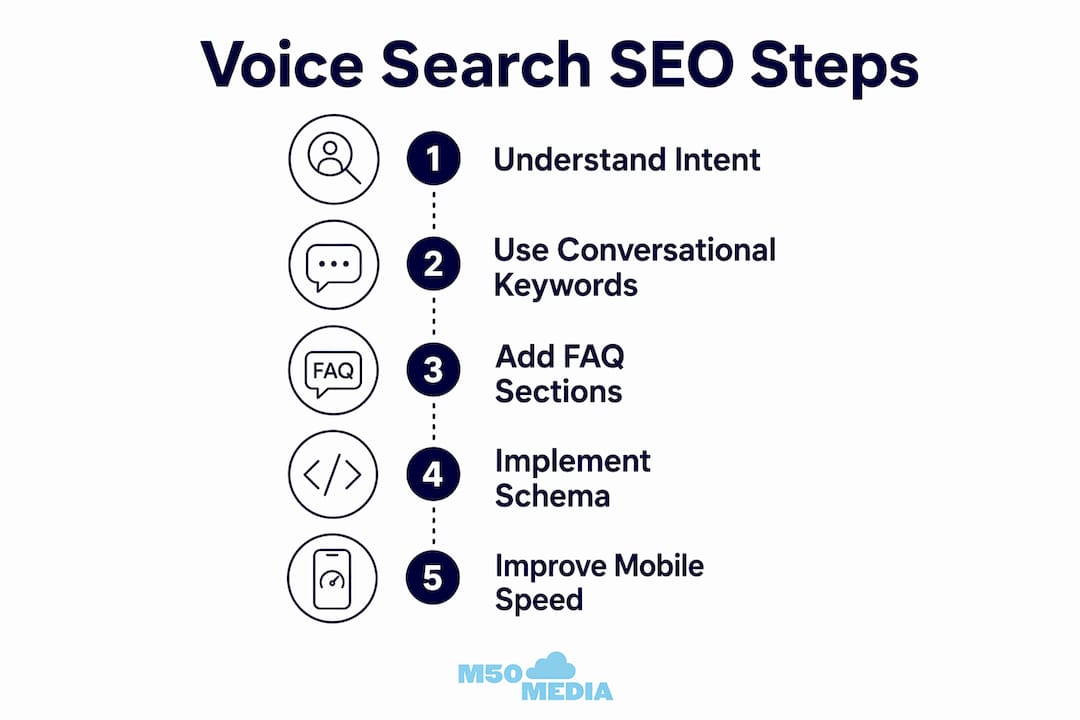
Write the way people actually talk
The single biggest upgrade you can make is shifting your keyword focus from short phrases to conversational long-tail queries. Instead of targeting “bakery Vancouver,” you target “where can I find fresh croissants in Vancouver on a Sunday morning?” That’s what your customers are literally saying out loud.
Your content should use contractions, short sentences (aim for 15 to 20 words each), and a Grade 8 reading level. Content written to sound natural when spoken gets selected more often by voice assistants. It’s not about dumbing things down. It’s about being clear and direct.
Build your content around FAQs
FAQ sections are genuinely one of the best voice search techniques available to small businesses. Why? Because people ask questions with their voices, and FAQ pages are structured as, well, questions and answers. When you write a question as a heading and follow it immediately with a concise, direct answer in the first sentence, you make it very easy for Google to extract and read your content aloud.
Rewriting pages so the opening sentences directly answer question-style headings increases extractability significantly. That’s not fluff. That’s how voice assistants decide what to read.
Use schema markup correctly
Schema markup is the behind-the-scenes code that tells search engines what your content means, not just what it says. For voice search, the most useful types are:
FAQPage schema: Marks up your Q&A content so Google recognises it as structured answers.
HowTo schema: Ideal for instructional content that walks users through a process step by step.
LocalBusiness schema: Signals your name, address, phone number, and hours to local search systems.
Schema types like FAQPage and LocalBusiness help search engines understand your content well enough to deliver it via voice. One important note: visible Q&A pairs should mirror your FAQPage schema exactly. If the content on the page doesn’t match what’s in the code, AI systems tend to ignore it entirely. Don’t try to mark up content that isn’t actually visible to readers.
Pro Tip: Want to explore the full range of schema types that can win you rich results? The guide on structured data for rich results is a genuinely useful deep dive.
Speed and mobile performance count
Voice queries are almost always triggered on mobile devices. Mobile-friendliness and fast loading speeds are core technical requirements for voice readiness. If your site takes four seconds to load on a phone, Google already knows it, and your voice search chances drop accordingly.
Here’s a quick comparison to frame the difference between traditional SEO content and voice-optimised content:
Feature | Traditional SEO content | Voice-optimised content |
Query type | Short keywords | Full conversational questions |
Content length | Long-form depth | Short, direct answers up front |
Structure | Keyword-dense headings | Question-and-answer format |
Schema focus | General structured data | FAQPage, HowTo, LocalBusiness |
Reading level | Flexible | Grade 8, sentence-friendly |
Measuring your voice search results
You can’t improve what you don’t track. The good news is you don’t need any fancy new tools to start measuring voice search performance. Here’s a simple process for improving voice search results over time:
Open Google Search Console and go to the Performance section. Filter queries by question words: “what,” “where,” “how,” “best,” “near me.” These are your voice-aligned queries, and they show you which questions Google is already connecting to your site.
Check your impressions and click-through rates for those question-based queries. Low clicks with decent impressions usually means your content is being found but not selected as the answer. That’s your cue to rewrite those sections for more direct, extractable answers.
Monitor your local pack rankings weekly. Voice assistants pull local recommendations directly from the local pack, so holding a position in the top three for your category matters enormously.
Track review velocity on your Google Business Profile. Recent reviews carry more weight than sheer volume in local voice search rankings. Encourage happy customers to leave reviews regularly, not just once in a while.
Update your FAQ and conversational content quarterly. User intent shifts, new question patterns emerge, and search engines reward freshness. A page you optimised six months ago may need a refresh to stay competitive.
Pro Tip: Use Search Console for long-tail queries as your primary voice search diagnostic tool. It’s free, accurate, and already tracking your site right now.
Why local voice search is where small businesses win
Here’s the thing about voice search: it’s practically made for local businesses. When someone asks their phone for a recommendation, they almost always want something nearby, something real, and something available right now. This is where small businesses can genuinely out-compete larger brands.
Local intent dominates voice search queries, and the businesses that show up as the first answer tend to share a few things in common:
A fully completed and regularly updated Google Business Profile with accurate hours, photos, services, and a description written in natural language.
Consistent NAP data, meaning your Name, Address, and Phone number match exactly across every online directory, your website, and your social profiles. Even a slight variation can confuse local ranking systems.
A steady stream of recent reviews, not just a pile of old ones from 2021.
Localised page content that uses neighbourhood names, landmarks, and city-specific phrases alongside your services.
An optimised local SEO strategy that treats voice search as a natural part of the mix.
The results are real. Businesses that implement conversational content alongside local data and schema optimisation have reported call volume increases of around 45% from voice-activated searches. That’s not a small number for a local shop or service business.
Local voice search factor | Why it matters |
Google Business Profile completeness | Voice assistants pull business details directly from this profile |
Consistent NAP data | Inconsistencies lower trust scores in local ranking algorithms |
Recent reviews | Freshness of reviews signals active, credible business status |
Localised page content | Helps match natural “near me” and neighbourhood-based voice queries |
Mobile site speed | Local searches happen on the go, almost entirely on mobile |
The digital marketing trends shaping 2026 all point toward voice and local search becoming even more intertwined. The businesses doing the groundwork now will have a serious advantage as these technologies keep maturing.
My honest take on voice search for small businesses
I’ve worked with a lot of small business owners who hear “voice search optimisation” and immediately picture a major technical overhaul that’ll take months and thousands of dollars. That is almost never the case. And I’ll be honest: the biggest wins I’ve seen have come from the simplest changes.
What I’ve learned is that most small business websites are just… not written for humans. They’re written for some imagined version of Google that rewards jargon and density. Voice search has actually been a forcing function for better writing. When you have to ask, “would someone say this sentence out loud to another person?” you start editing very differently.
The common pitfall I see is businesses loading up FAQ pages with schema but writing answers that are three paragraphs long. Voice assistants don’t want your memoir. They want a clear, direct answer in one to two sentences, with the rest of the detail available to readers who want to go deeper. Extractable formatting matters far more than content depth when it comes to voice selection.
The other thing I’d push back on is the idea that you have to choose between voice-friendly content and traditional SEO. You don’t. Writing clearly, answering questions directly, and structuring pages logically is just… good SEO. Voice search is the best argument I’ve ever found for ditching the keyword-stuffing habits of 2014 and writing content your actual customers would enjoy reading.
Start with your Google Business Profile and one FAQ page rewrite. Seriously. That’s enough to see a real difference.
— Karl
Ready to get found on voice search?
If reading this made you think, “okay, but I don’t even know where to start with my own site,” that’s completely normal and exactly why the team at M50media built coaching and support options tailored for small business owners like you. Whether it’s improving your local SEO, rewriting pages for voice readiness, or figuring out your schema setup, there’s no reason to figure it out alone.
Karl works directly with business owners through digital coaching sessions designed to get your digital presence actually working, including making sure you’re positioned for voice and local search. Not generic advice. Real, specific help for your actual business.
Or if you just want a quick gut-check on where things stand, book a free Marketing SOS call and let’s talk through it together. No pressure, no pitch. Just a focused conversation about what’s holding your visibility back and what you can do about it starting this week.
FAQ
What is voice search optimisation?
Voice search optimisation is the practice of adjusting your website content and technical setup so voice assistants like Siri and Google Assistant select your content as the answer to spoken queries. It focuses on natural-language phrasing, direct answers, and local relevance.
How is voice search different from regular SEO?
Voice queries are conversational, question-based, and significantly longer than typed searches. Traditional SEO targets short keyword phrases, while voice SEO focuses on full spoken questions, featured snippet eligibility, and direct answers that can be read aloud.
Why does local search matter for voice queries?
The majority of voice searches have strong local intent, with users asking for businesses, services, or information “near me” or in their city. A complete Google Business Profile with accurate details and recent reviews is the most important factor in winning these results.
How do I start optimising for voice search?
Start by adding an FAQ section to key pages with question-style headings and short answers, implement LocalBusiness and FAQPage schema, and make sure your Google Business Profile is fully filled out. Then use Google Search Console to find the question-based queries already bringing people to your site.
What kind of content wins voice search results?
Content written at a Grade 8 reading level, using short sentences (15 to 20 words), contractions, and direct answers to specific questions performs best. Featured snippet eligibility and clear formatting matter more than content length for voice assistant selection.
Recommended
Comments