Why choose market segmentation for your small business
- karl7209
- Jun 2
- 8 min read

TL;DR:
Market segmentation divides a broad market into smaller, well-defined groups to enable targeted marketing strategies that connect with customers. It improves conversion rates, reduces costs, and uncovers niche opportunities by focusing on customer behaviors and motivations. Small businesses should regularly revisit and simplify segments, prioritizing actionable groups based on actual customer actions.
Market segmentation is the practice of dividing a broad market into smaller, well-defined groups so you can craft targeted marketing strategies that actually connect with real people. Think of it like sorting your sock drawer. Sure, you could just throw everything in one pile, but finding what you need becomes a nightmare. Segmentation works the same way: it lets you stop shouting into the void and start speaking directly to the customers most likely to buy from you. For small businesses and entrepreneurs with limited budgets, that distinction is the difference between wasted spend and real growth.
Why choose market segmentation over one-size-fits-all marketing?

Most businesses cannot effectively target an entire market at once. That is not a weakness. It is just reality. Segmentation lets you avoid the enormous cost of building a unique marketing mix for every possible buyer by grouping similar customers together and serving them with one well-crafted approach.
The advantages of market segmentation go well beyond saving money. When your messaging matches what a specific group actually cares about, conversion rates climb. When your offers reflect real needs, customer loyalty follows. When you stop marketing to everyone, you start mattering to someone.
“Dividing broad markets by demographics, geography, psychographics, or behaviour increases marketing alignment and measurement accuracy.” — SurveyMonkey
Here is what that looks like in practice:
Higher conversion rates because your message speaks directly to a group’s specific motivations
Lower acquisition costs because you focus budget on people most likely to respond
Clearer measurement because each segment gives you a defined baseline to track
Niche opportunities you would never spot by looking at your market as one big blob
Stronger product positioning because you understand what each group values most
The importance of market segmentation becomes obvious the moment you compare a generic email blast to a targeted campaign built around a specific customer profile. The targeted version wins. Every time. Personalised marketing through segmentation better matches customer needs and sidesteps the inefficiencies of generic messaging.
What are the main types of market segmentation?
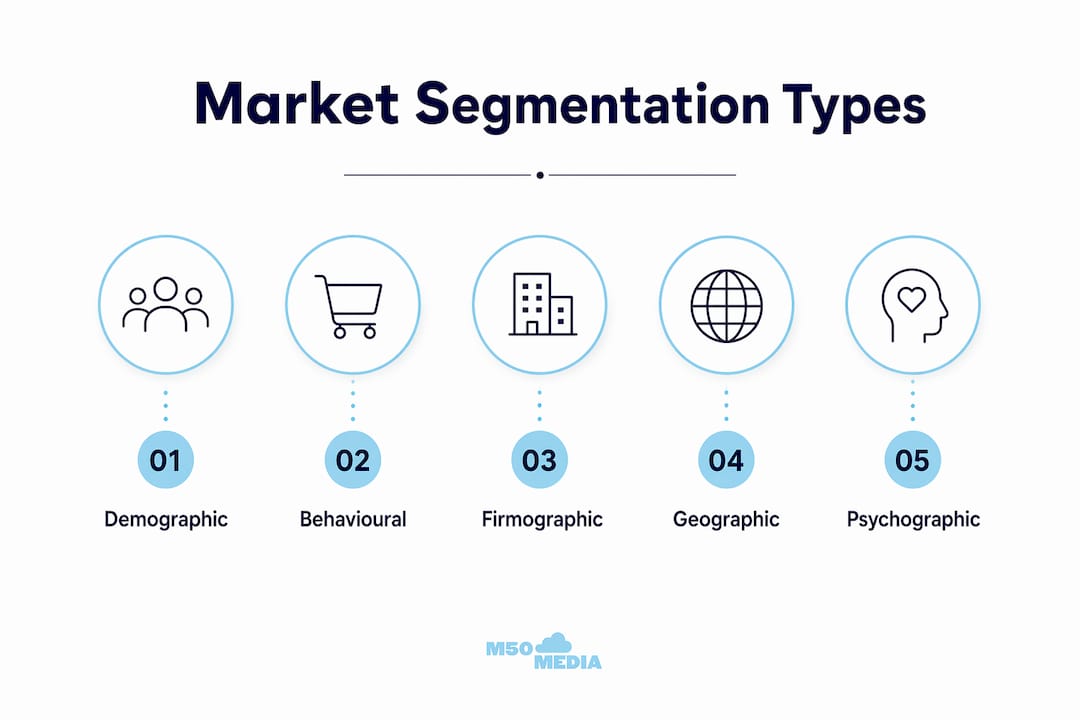
Not all segmentation is created equal. The type you choose shapes everything from your messaging to your channel selection. Here is a quick breakdown of the five main approaches:
Segmentation type | What it uses | Best for |
Demographic | Age, income, gender, education | Consumer products, broad reach campaigns |
Geographic | Location, region, climate | Local businesses, region-specific offers |
Psychographic | Values, lifestyle, personality | Brand storytelling, premium positioning |
Behavioural | Purchase history, usage, loyalty | Email marketing, retargeting, upsells |
Firmographic | Company size, industry, revenue | B2B businesses, SaaS, professional services |
Demographic segmentation is the easiest to start with because the data is widely available. But it has limits. Knowing someone is a 35-year-old woman in Toronto tells you very little about why she buys. Psychographic segmentation digs into motivations and values, which is where the real magic happens for brand building.
Behavioural segmentation is arguably the most powerful for small businesses because it is based on what customers actually do, not what they say they will do. A customer who has bought from you twice, opened your last three emails, and clicked on your sale banner is a very different prospect from someone who signed up for your newsletter six months ago and never engaged again. Tailoring messaging to segment-specific needs increases marketing effectiveness, and behavioural data gives you the clearest signal of who is ready to act.
Firmographic segmentation is the B2B equivalent of demographics. If you sell to businesses, knowing whether your prospect is a 10-person startup or a 500-person enterprise changes your pitch, your pricing, and your entire sales process.
Pro Tip: Start with one segmentation type that maps directly to a decision you can act on today. If you run email campaigns, start with behavioural segmentation. If you are launching in a new city, start with geographic. Pick the variable that changes what you actually do.
How to apply market segmentation effectively as a small business
Knowing the types is one thing. Putting them to work is another. Here is a practical process for entrepreneurs who want results without a PhD in marketing.
Choose variables that drive decisions. Segmentation variables should guide your choices on channel, offers, and pricing. If a variable does not change what you do, it is not worth tracking. “Customers aged 25 to 45” is a demographic fact. “Customers who buy within 48 hours of receiving a discount email” is a behaviour that tells you exactly what to do next.
Validate before you scale. Do not build an entire product line around a segment you have never tested. Low-risk tests like waitlists and small ad experiments give you real signals on whether a segment responds before you commit serious budget. Shopify calls this finding your product-market fit, and it applies just as much to segmentation as it does to product development.
Build a tailored marketing mix for each segment. Once you have validated a segment, design your messaging, channel, offer, and pricing specifically for that group. A family-focused segment might respond to convenience and value messaging. A health-conscious segment might need ingredient transparency and social proof from people like them.
Focus on behaviour, not just stated preferences. What customers say they want and what they actually buy are often two different things. Build your segments around observable actions: purchase frequency, page visits, email clicks, and product usage patterns.
Keep your number of segments manageable. Segmentation should only go as deep as you can realistically execute. Three well-served segments beat ten neglected ones. If you cannot create a distinct marketing mix for a segment, it is not a segment worth having.
Pro Tip: Use your email marketing campaigns as a low-cost segmentation lab. Split your list by purchase behaviour or engagement level, send different messages to each group, and watch the data tell you which segments are worth doubling down on.
What challenges do businesses face with market segmentation?
Here is the uncomfortable truth: most segmentation fails. Not because the concept is flawed, but because businesses build segments on shaky foundations.
The biggest problem is relying on self-reported customer data. When you ask customers why they bought something, they give you a tidy, rational answer. But human behaviour is rarely tidy or rational. Segmentation often fails because it describes customers instead of predicting their behaviour, which leads to abandoned marketing personas that gather dust in a Google Drive folder nobody opens.
Other common pitfalls include:
Building segments that are too broad to act on (the dreaded “millennials who like technology” segment)
Creating segments that describe demographics without specifying what offer or message would actually convert them
Segmenting once and never revisiting as customer behaviour evolves
Confusing segment size with segment value. A small, highly engaged segment often outperforms a large, disengaged one
The fix is to design segments that predict action. Ask not “who are these people?” but “what will make these people buy?” That shift in framing changes everything about how you build and use your segments. You can learn more about identifying your audience through behavioural and motivational lenses, which is where modern segmentation is heading.
Traditional versus predictive segmentation: which one actually works?
Traditional segmentation groups customers by attitudes, demographics, and survey responses. It is a solid starting point, but it has a ceiling. Knowing that your average customer is a 40-year-old homeowner with a household income over $80,000 does not tell you what message will make them click “buy now.”
Predictive segmentation takes a different approach. Instead of asking customers what they think, it watches what they do. Predictive segmentation clusters customers based on behavioural fingerprints rather than survey responses, producing personas that are actually useful for writing a campaign brief.
Approach | Data source | Output | Marketing use |
Traditional | Surveys, demographics, attitudes | Descriptive personas | Brand positioning, broad campaigns |
Predictive | Behaviour, purchase patterns, AI analysis | Actionable decision triggers | Targeted campaigns, personalised offers |
The predictive model does not replace traditional segmentation. It builds on top of it. You still need to know who your customers are. But you also need to know what triggers their decisions. AI-generated motivational architectures, as Bizcommunity describes them, help marketers design messages that convert by targeting real decision drivers rather than assumed ones.
Pro Tip: Pair your marketing analytics data with your segmentation work. Your analytics platform already holds behavioural fingerprints. Page visits, session duration, click paths, and purchase sequences are all telling you who your best customers are and what moves them.
Key takeaways
Market segmentation works because it replaces generic messaging with targeted communication that matches real customer behaviour, reducing wasted spend and increasing conversion rates.
Point | Details |
Segmentation beats broad marketing | Targeted messaging to defined groups consistently outperforms one-size-fits-all campaigns. |
Behaviour beats stated preferences | Build segments on what customers do, not what they say, for more accurate predictions. |
Validate before scaling | Use low-risk tests like waitlists and small ad budgets to confirm segment demand first. |
Keep segments actionable | Only segment as deep as you can realistically execute with a distinct marketing mix. |
Predictive beats descriptive | Segmentation that predicts decision triggers produces better campaign results than demographic profiles alone. |
Karl’s take on segmentation for small businesses
I have worked with a lot of small business owners who treat segmentation like a one-time homework assignment. They do it once, file it away, and then wonder why their marketing still feels like it is not connecting. That is the mistake I see most often.
The businesses that get real results from segmentation treat it like a living document. They revisit their segments every quarter. They test new variables. They retire segments that are no longer performing. It is less like building a spreadsheet and more like tending a garden. (Yes, I just used a garden metaphor. Stay with me.)
The other thing I always tell entrepreneurs: start simpler than you think you need to. Two or three well-defined segments with clear behavioural triggers will outperform ten beautifully described personas that nobody knows how to use. I have seen companies spend months building elaborate segmentation frameworks and then launch the exact same campaign to everyone anyway because the segments were too complicated to act on.
Start with your best customers. Who are they? What did they do before they bought? What message brought them in? That is your first segment. Build from there. Check out the small business segmentation guide on the M50media blog if you want a solid foundation before you start layering in the more advanced stuff.
The goal is not perfect segmentation. The goal is segmentation that makes your next campaign better than your last one.
— Karl
Ready to put segmentation to work for your business?
Understanding why segmentation matters is step one. Knowing how to build and execute a segmentation strategy that actually drives results is where most small businesses get stuck. That is exactly what M50media’s coaching programmes are designed to help with.

Karl works directly with small business owners and entrepreneurs to build marketing strategies grounded in real customer behaviour, not guesswork. Whether you need help identifying your best segments, crafting targeted messaging, or building a full marketing plan that connects the dots, the M50media coaching programme has you covered. Not sure where to start? Book a free Marketing SOS call and let’s figure it out together.
FAQ
What is market segmentation in simple terms?
Market segmentation is the process of dividing your broader market into smaller groups of customers who share common characteristics, so you can tailor your marketing to each group more effectively.
Why use market segmentation as a small business?
Small businesses benefit most from segmentation because it focuses limited budget on the customers most likely to buy, reducing wasted spend and improving conversion rates compared to broad, untargeted campaigns.
How do I segment a market without a big budget?
Start with behavioural data you already have: email open rates, purchase history, and website analytics. These free or low-cost signals reveal your most engaged segments without requiring expensive research tools.
What is the difference between demographic and behavioural segmentation?
Demographic segmentation groups customers by traits like age or income, while behavioural segmentation groups them by actions like purchase frequency or email engagement. Behavioural data is generally a stronger predictor of future buying decisions.
How many segments should a small business have?
Most small businesses perform best with two to four well-defined segments. Segmentation should only go as deep as you can realistically execute with a distinct marketing approach for each group.
Recommended
Comments