Why choose omnichannel marketing for small business
- karl7209
- Jun 21
- 8 min read

TL;DR:
Omnichannel marketing integrates all customer touchpoints into one connected experience, boosting loyalty and revenue. Small businesses should start by linking existing channels like email and in-store data to create seamless interactions and enhance customer satisfaction. Measuring key metrics such as conversion rates and customer lifetime value helps optimize strategies and sustain growth.
Omnichannel marketing is the strategic integration of all customer touchpoints, digital and physical, into one connected experience. If you’re wondering why choose omnichannel over other approaches, the short answer is this: customers who shop across multiple channels spend more and return more often than those who use just one. Salesforce defines omnichannel marketing as delivering content across channels using real data like browsing habits and in-store purchases to personalise every interaction. That’s not a nice-to-have for small businesses in 2026. That’s the whole game.
Why choose omnichannel: the core benefits for your business
The benefits of omnichannel marketing go well beyond just showing up on Instagram and having a website. True omnichannel means your customer can browse on their phone, walk into your shop, and pick up exactly where they left off, without having to repeat themselves like they’re talking to someone who never listens (we’ve all been that customer).

Salesforce reports that omnichannel drives higher engagement, loyalty, and conversion rates compared to multichannel approaches. That gap exists because omnichannel uses data to make every interaction feel relevant, not random.
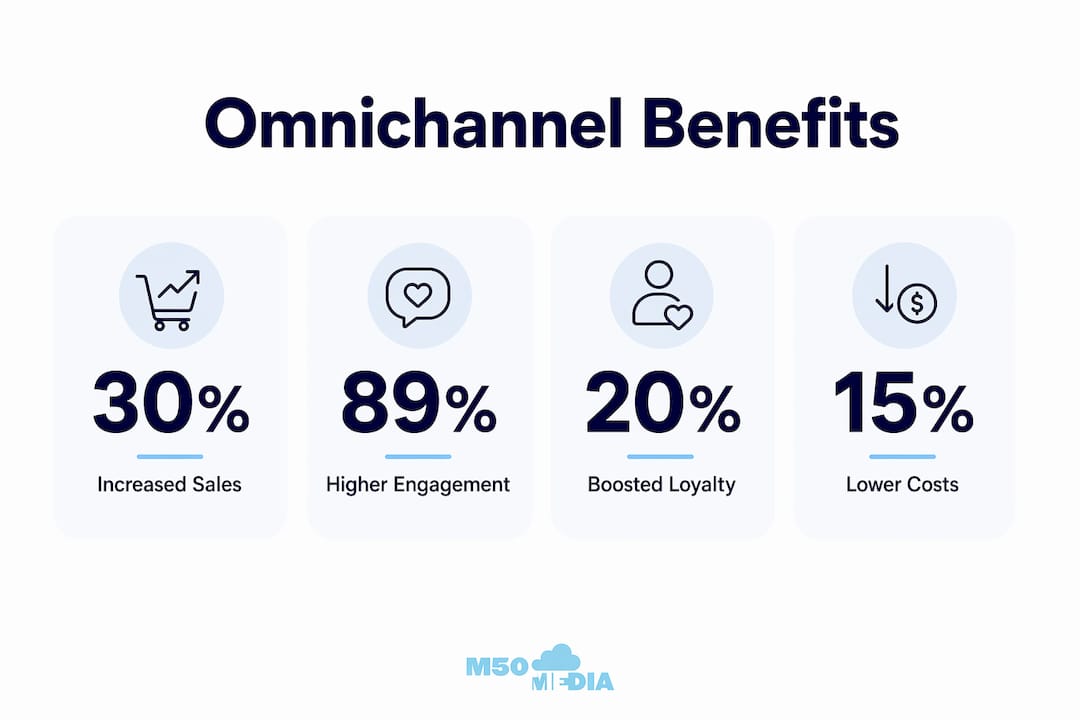
The business case gets even stronger when you look at the numbers. Linking digital ads to POS and loyalty data can lower cost per purchase by up to 15% and increase incremental store revenue by nearly 20%, according to Deloitte. For a small business watching every dollar, that kind of efficiency is not something you walk away from.
Here’s a quick summary of what the research says about omnichannel outcomes:
Benefit | What the data shows |
Customer loyalty | Omnichannel shoppers buy more frequently and spend more per visit |
Cost efficiency | Deloitte links POS and loyalty data integration to up to 15% lower cost per purchase |
Revenue growth | Incremental store revenue can increase by nearly 20% with connected data |
Sales lift | Brands using three or more platforms saw 494% higher sales versus single-platform brands |
Customer satisfaction | Cross-channel consistency reduces friction and builds trust |
Pro Tip: Don’t wait until you have a big tech budget to start. Even connecting your email list to your in-store purchase data is a meaningful first step toward omnichannel.
Omnichannel vs multichannel: what’s the actual difference?
This is where a lot of small business owners get tripped up, and honestly, it’s an easy mix-up. Multichannel marketing means you’re present on several channels, like email, social media, and a physical store. Omnichannel marketing means those channels actually talk to each other.
Think of multichannel like a group chat where nobody reads the other messages. Everyone’s technically in the same conversation, but nothing connects. Omnichannel is the group chat where everyone’s actually paying attention and the story makes sense from start to finish.
The importance of omnichannel lies in that connection. Multichannel adds channels. Omnichannel connects them with shared data and consistent messaging.
Feature | Multichannel | Omnichannel |
Channel integration | Channels operate independently | Channels share data and context |
Customer experience | Inconsistent across touchpoints | Consistent and personalised |
Data use | Siloed per channel | Unified customer profile |
Business outcome | Broader reach | Higher loyalty and conversion |
Complexity | Lower | Higher, but with greater returns |
The multichannel vs omnichannel distinction matters most when you’re deciding where to invest your time. Adding a new channel without connecting it to your existing data just creates more work for the same (or worse) results.
Pro Tip: Before adding a new channel, ask yourself: “Can this channel share data with my existing ones?” If the answer is no, fix the connection before you add the channel.
How to implement omnichannel as a small business
The biggest mistake small businesses make is treating omnichannel as a technology problem. It’s actually a customer experience problem. The goal is to build what Zendesk calls a “single source of truth” for every customer interaction, so your team always knows who they’re talking to and what’s already happened.
Here’s what that looks like in practice for a small business:
Build one customer profile. Combine your point-of-sale data, email list, and website behaviour into a single view. Tools like Klaviyo, Mailchimp, or Shopify’s built-in CRM can help you start small.
Keep messaging consistent. Your pricing, promotions, and tone should be the same whether a customer sees your Instagram ad, your email, or your in-store signage.
Use first-party data. Loyalty programmes, purchase history, and email sign-ups are gold. Privacy-first data integration protects your customers and keeps your campaigns compliant.
Reduce channel friction. If a customer adds something to their online cart, they should be able to ask about it in-store without starting over. That continuity is the whole point.
Start with two or three channels. You don’t need to be everywhere. You need to be connected where you already are.
Walmart Connect notes that 80–94% of retail shoppers engage with both in-store and digital channels. That means your customers are already behaving in an omnichannel way. The question is whether your business is keeping up with them.
Pro Tip: Your loyalty programme is one of the easiest omnichannel wins available. It captures first-party data, rewards repeat behaviour, and works both online and in-store. If you don’t have one yet, that’s your starting point.
Why connected customer service is the secret weapon
Most small businesses focus on marketing channels when they think about omnichannel. But the real loyalty builder is connected customer service. When a customer contacts you by email, then follows up on Instagram, then calls in, they should never have to repeat their story. That repetition is the number one frustration in customer service, and it’s completely avoidable.
The “single source of truth” in action
Zendesk explains that omnichannel customer support preserves customer identity and context across every channel. Your support team sees the full history, which speeds up resolution and makes customers feel genuinely valued. That’s not just good service. That’s a retention strategy.
The revenue impact of consistency
Cross-channel consistency in customer service lifts sales revenue by 2–7% and profitability by 1–2%, according to research cited by Shopify. For a small business with tight margins, a 2% revenue lift from better service processes is meaningful and achievable without a massive budget.
Operational integration matters too
Connecting your online and offline sales data gives you a complete picture of what’s actually selling and where. A customer who buys online and returns in-store, or vice versa, should show up as one customer in your records, not two separate transactions. That unified view makes your inventory decisions, marketing spend, and staffing choices sharper.
How to measure your omnichannel marketing results
You can’t improve what you don’t measure. The good news is that omnichannel measurement doesn’t require enterprise software. Small businesses can track meaningful progress with a focused set of metrics and a bit of discipline.
Track conversion rates by channel. Know which channels are actually driving purchases, not just traffic.
Measure cost per purchase. Connecting your ad spend to actual sales data (including in-store) shows you where your budget is working hardest.
Monitor customer lifetime value. Omnichannel customers tend to have higher lifetime value. Tracking this over time shows whether your connected experience is building loyalty.
Connect offline and online data. Use your POS system alongside your digital analytics. Even a simple spreadsheet linking the two is better than keeping them separate.
Review and adapt quarterly. Omnichannel isn’t a set-and-forget strategy. Customer behaviour shifts, and your campaigns should shift with it.
Privacy compliance is non-negotiable here. Collecting first-party data through loyalty programmes and email sign-ups keeps you on the right side of Canadian privacy law (PIPEDA) while giving you the insights you need. Using AI-driven personalisation tools can also help you make sense of that data faster and act on it more precisely.
Key takeaways
Omnichannel marketing works because it connects customer data across every channel, creating consistent experiences that drive higher loyalty, lower costs, and measurable revenue growth.
Point | Details |
Omnichannel vs multichannel | Omnichannel connects channels with shared data; multichannel just adds more channels independently. |
Revenue impact | Brands using three or more connected platforms saw 494% higher sales versus single-platform brands. |
Cost efficiency | Linking POS and loyalty data can lower cost per purchase by up to 15%. |
Customer service | Preserving customer context across channels lifts revenue by 2–7% and reduces friction. |
Small business starting point | Connect two or three existing channels with shared data before adding new ones. |
Karl’s take: stop adding channels and start connecting them
Here’s something I see constantly with small business owners: they hear “omnichannel” and immediately think they need to be on TikTok, Pinterest, a podcast, a newsletter, and have a physical store, all at once. That’s not omnichannel. That’s just exhausting.
The businesses I’ve worked with that see real results from an omnichannel approach are the ones who got serious about connecting what they already had. One retail client I worked with had a solid email list and a busy shop, but the two never talked to each other. Once we linked their POS data to their email platform, they could send genuinely relevant follow-ups based on actual purchases. Open rates went up. Repeat visits went up. It wasn’t magic. It was just connection.
The misconception I want to bust is that omnichannel is only for big brands with big budgets. Shopify, Klaviyo, and even basic CRM tools make connected experiences accessible at every price point. The omnichannel customer experience isn’t about having the fanciest tech stack. It’s about making your customer feel like you actually remember them.
Start with two channels. Connect them properly. Measure what happens. Then grow from there. That’s the pragmatic path, and it works.
— Karl
Ready to build your omnichannel strategy?
If this article got your wheels turning, that’s great. But reading about omnichannel and actually building it are two very different things. Karl Lundgren at M50media works directly with small business owners to cut through the noise and build marketing approaches that actually connect.
Whether you’re starting from scratch or trying to make sense of what you already have, the M50media coaching programme gives you a clear path forward. Karl also offers a free Marketing SOS call for business owners who want a quick gut-check on their current marketing setup. No pressure, no pitch. Just honest advice from someone who’s been in the trenches with businesses like yours.
Head over to M50media to see how Karl can help you turn your channels into a connected, revenue-generating machine.
FAQ
What is omnichannel marketing?
Omnichannel marketing is the integration of all customer channels, online and offline, into one connected experience using shared customer data. Salesforce defines it as delivering personalised content across channels based on real interactions like browsing and purchase history.
How does omnichannel differ from multichannel?
Multichannel marketing uses several independent channels without sharing data between them. Omnichannel connects those channels so customer context and messaging stay consistent across every touchpoint.
Why should small businesses use an omnichannel approach?
Small businesses benefit because omnichannel customers spend more, buy more often, and are more loyal. Deloitte research shows connected data integration can lower cost per purchase by up to 15% and boost store revenue by nearly 20%.
How do I start implementing omnichannel on a small budget?
Start by connecting two channels you already use, such as your email list and your point-of-sale system. Tools like Shopify, Klaviyo, and Mailchimp make basic data integration accessible without enterprise-level costs.
What metrics should I track for omnichannel success?
Track conversion rates by channel, cost per purchase, and customer lifetime value. Connecting your offline POS data to your digital analytics gives you the clearest picture of what’s actually working.
Recommended
Comments