Why reputation management is important for your business
- karl7209
- May 25
- 8 min read

TL;DR:
In 2026, reputation management is essential for small businesses because online reviews and AI summaries heavily influence customer trust and search rankings. Regular monitoring, responding to reviews, and maintaining consistent listings build trust, increase inquiries, and drive growth. Treating reputation management as a ongoing habit rather than a one-time task ensures long-term success and competitiveness.
Your business could be doing everything right and still losing customers to a competitor with a slicker online presence. That’s the uncomfortable reality of reputation management in 2026. Why is reputation management important? Because 98% of consumers read reviews before making a buying decision, and if your online reputation isn’t actively managed, you’re essentially handing those customers to someone else. It’s not a “nice to have.” It’s the invisible salesperson working for you (or against you) around the clock.
Table of Contents
Key takeaways
Point | Details |
Reputation drives decisions | Nearly all consumers research reviews before buying, making your online reputation your most persuasive sales tool. |
Visibility alone isn’t enough | Attracting traffic means nothing if your reputation doesn’t convert that attention into trust and paying customers. |
AI now reads your reputation | Search tools in 2026 synthesise your reviews, listings, and social signals to describe your business before visitors even reach your site. |
Responding to reviews builds loyalty | Thoughtful replies to both good and bad reviews signal accountability and turn fence-sitters into fans. |
Proactive beats reactive | Waiting for a PR crisis to start managing your reputation costs far more time, money, and customers than staying ahead of it. |
Why reputation management matters for small businesses
Let’s clear something up right away. Reputation management isn’t just for big corporations trying to spin bad press after a scandal. It’s for the local plumber who wants more calls. It’s for the boutique owner who wants to fill their appointment book. It’s for you.
At its core, reputation management is the ongoing practice of monitoring, building, responding to, and shaping how your business is perceived online. Think of it as tending a garden. Leave it alone and the weeds (bad reviews, outdated listings, zero engagement) take over. Stay on top of it and you’ve got something customers actually want to visit.
The main activities involved include:
Monitoring mentions and reviews across Google, Yelp, social media, and industry directories
Encouraging happy customers to share their experiences publicly
Responding to feedback, good and bad, in a timely and professional way
Keeping your business listings accurate and consistent across every platform
Publishing content that reinforces your expertise and builds brand authority
Here’s the thing that most small business owners miss. Visibility and reputation are not the same thing. You can rank on page one of Google and still have people click away the moment they see a two-star rating and zero responses from the owner. Visibility attracts attention. Reputation determines whether people actually trust you enough to pick up the phone.
A strong reputation also does some heavy lifting when it comes to retaining loyal customers. People return to businesses they trust. They refer their friends. They leave more glowing reviews. It becomes a self-reinforcing cycle that grows your business without you spending an extra dollar on ads.

Pro Tip: Set up a free Google Alert for your business name right now. It takes two minutes and will notify you anytime someone mentions you online, so you’re never caught off guard.
Reputation’s role in SEO and AI search visibility
Here’s where things get genuinely interesting, and where small business owners are leaving serious money on the table.
Traditional SEO has always cared about your reputation signals. Google uses review quantity, recency, star ratings, and listing consistency as ranking factors for local search. Businesses with well-managed reviews and listings get more clicks, more calls, and more bookings. Full stop.
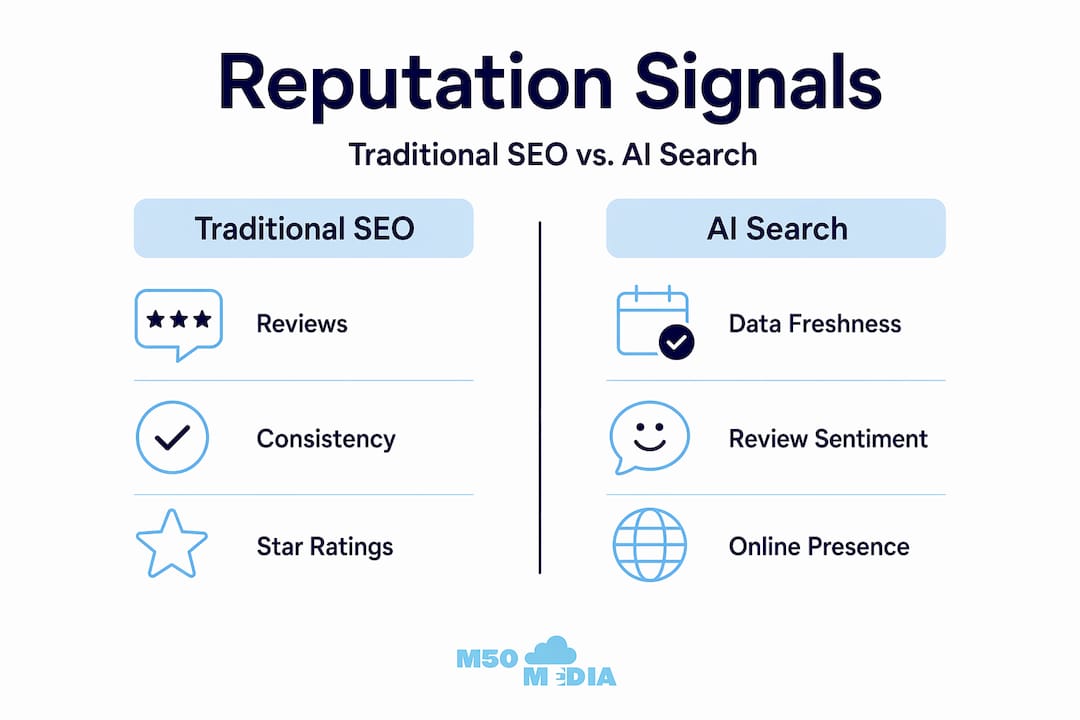
But in 2026, there’s a newer wrinkle. AI-powered search tools like ChatGPT, Google’s AI Overviews, and Perplexity are now synthesising your entire online footprint to generate brand summaries before a potential customer ever visits your website. Think about that for a second. An AI is writing your first impression.
If your data is sparse, inconsistent, or riddled with unaddressed negative reviews, AI platforms may omit or misrepresent your business entirely. And once you’re invisible in an AI summary, you’re genuinely competing with one hand tied behind your back.
Reputation factor | Impact on traditional SEO | Impact on AI search |
Review quantity and recency | Boosts local pack rankings | Signals active, trustworthy business to AI |
Listing consistency (NAP) | Confirms legitimacy to Google | Feeds accurate data to AI summaries |
Response to reviews | Minor direct ranking signal | Demonstrates engagement and reliability |
Social sentiment and mentions | Indirect authority signal | Synthesised into brand descriptions |
Quality content and blogging | Builds topical authority | Establishes expertise for AI citations |
The connection between local SEO and reputation management is tighter than most people realise. They’re not two separate strategies. They’re the same strategy wearing different hats.
Pro Tip: Ask your top five customers to leave a Google review specifically mentioning the service or product they used. Keyword-rich reviews give your local SEO a meaningful boost beyond just star ratings.
How reputation affects trust, conversions, and growth
Now let’s talk dollars and sense (pun absolutely intended).
When potential customers research your business online before contacting you, a strong reputation does the selling before you’ve said a single word. Businesses with strong reputations generate significantly more inquiries and close at higher conversion rates than their less-reviewed competitors. That’s not a marketing theory. That’s just people behaving like people.
Here’s what managing your reputation actually does for your bottom line:
Higher conversion rates because trust is already established before first contact
Lower customer acquisition costs since referrals and organic search drive more traffic
Competitive pricing power, because people pay more for businesses they perceive as reliable
Better talent attraction, because good employees research employer reputation too
Stronger partnerships and investor confidence, since reputation shapes all aspects of business viability beyond just sales
Let’s talk about negative reviews for a second, because this is where a lot of small business owners go full ostrich (head in the sand, hoping no one notices). Ignoring negative feedback is one of the most expensive mistakes you can make. A well-handled negative review is actually an opportunity to show accountability and demonstrate to every future customer reading that thread that you take your work seriously.
Think about it from a customer’s perspective. You see a two-star review where the owner lashed out defensively versus a two-star review where the owner apologised sincerely and offered a fix. Which business do you trust more? Exactly.
Learning how reviews boost sales isn’t complicated. It starts with simply showing up and responding like a human being who cares.
Practical reputation management strategies
Alright, enough theory. Here’s how you actually do this without it taking over your life.
Set up monitoring first. You cannot manage what you cannot see. Use Google Alerts, your Google Business Profile notifications, and a social listening tool to track mentions of your business name across the web. This is your early warning system.
Ask for reviews systematically. A happy customer rarely reviews you without a nudge. Build a simple follow-up process: a text, an email, or even a verbal ask at the end of a great interaction. Make it easy by sending a direct link to your Google review page. The businesses getting 50 reviews while you have 4 aren’t luckier. They’re just asking.
Respond to every review, every time. Yes, every one. Thank the five-star reviewers with a specific, personal reply. Address the one-star reviewers calmly, professionally, and without excuses. This shows future customers the kind of business you run. Responding to negative feedback consistently builds reliability in the eyes of anyone reading along.
Publish content that shapes your narrative. Blog posts, social updates, case studies, and even FAQ pages all contribute to how your business is perceived. A blog that answers common customer questions positions you as the expert. Blogs build trust and visibility in ways that no paid ad can replicate long-term.
Audit and clean up your listings. Your business name, address, and phone number should be identical across Google, Yelp, Facebook, and every directory you’re listed in. Inconsistencies confuse both customers and search engines. Pick one afternoon, go through the major platforms, and get your information consistent.
Avoid the piecemeal trap. Fragmented ORM approaches create gaps and drive up long-term costs. An integrated strategy where monitoring, responding, content, and listings all work together delivers results you can actually measure.
The importance of reputation management compounds over time, just like interest in a savings account. The work you do today builds a foundation that keeps paying off for years.
My honest take on reputation management
I’ve worked with dozens of small business owners over the years, and the pattern I see over and over is this: reputation management gets treated like something to deal with “eventually.” Maybe after the busy season. Maybe once things slow down.
Here’s what I’ve learned. Things don’t slow down. And by the time a business owner finally looks at their online presence, there’s usually a mess to clean up that would have taken ten minutes a week to prevent.
What I find genuinely fascinating in 2026 is the AI dimension. I used to tell clients to focus on Google reviews for SEO. Now I tell them to think of their entire online footprint as a data source that AI is reading and summarising in real time. Your reputation isn’t just what shows up in a Google search anymore. It’s what an AI says about you when someone asks for a recommendation. That’s a fundamentally different game.
The businesses I’ve seen thrive are the ones who stopped waiting for reputation management to feel urgent and started treating it like any other business priority. Not a panic response. A habit. Reputation management is now inseparable from overall business growth, full stop.
Small businesses actually have an advantage here. You can be more personal, more responsive, and more genuine than any large corporation trying to manage reputation at scale. Use that.
— Karl
Ready to take your reputation seriously?
If you’ve read this far, you already know that reputation management isn’t optional. The businesses building trust online right now are the ones customers call first, pay more for, and refer to their friends. The question is whether you want to be one of them.

At M50media, Karl works directly with small business owners to build the kind of online presence that actually drives growth. Whether that’s cleaning up your listings, building a review strategy, or understanding how AI search tools are representing your brand, the guidance is practical and specific to your situation. Check out the coaching services to see what a focused, hands-on approach looks like. Or if you’d rather start with a conversation, book a free marketing SOS call and get a clear picture of where your reputation stands and what to do about it.
FAQ
Why is reputation management important for small businesses?
Reputation management is important because nearly all consumers research businesses online before making contact. A strong, well-managed reputation directly increases inquiries, conversions, and customer loyalty.
How does reputation affect search rankings?
Search engines use review quantity, recency, and listing consistency as ranking signals. Businesses that actively manage these factors rank higher in local search and appear more favourably in AI-generated summaries.
What is the difference between reputation and visibility?
Visibility means people can find you online. Reputation determines whether they choose you. You can have all the traffic in the world, but a poor reputation will stop conversions cold.
How should I respond to negative reviews?
Respond calmly, acknowledge the concern, and offer a genuine resolution. A thoughtful response to a negative review demonstrates accountability and often reassures other potential customers more than the complaint ever could.
How often should I be managing my reputation?
Reputation management works best as a consistent weekly habit rather than a one-time fix. Set aside a small block of time each week to check reviews, respond to feedback, and update your listings as needed.
Recommended
Comments