Why utilize cross selling to grow your revenue
- karl7209
- Jun 19
- 8 min read

TL;DR:
Cross-selling increases revenue by offering relevant, complementary products to existing customers and builds trust. It is more effective and cost-efficient than acquiring new customers, contributing up to 21% of revenue. Successful cross-selling relies on relevance, limited offers, proper timing, and personalized data usage.
Cross-selling is the practice of offering customers complementary products or services alongside their primary purchase to increase sales and deepen the customer relationship. If you have ever bought a laptop and been offered a carrying case at checkout, congratulations, you have been cross-sold (and you probably bought the case). For small business owners, the importance of cross-selling goes way beyond a clever checkout trick. Cross-selling contributes an average of 21% to a company’s revenue, with potential profit boosts up to 30%. That is not pocket change. It is a growth strategy hiding in plain sight.
Why utilize cross selling instead of chasing new customers
Here is a stat that should make you put down your coffee: the success rate for selling to existing customers sits at 60–70%, compared to just 5–20% for new prospects. Selling to someone who already trusts you is dramatically easier than convincing a stranger. That gap is the entire business case for cross-selling in one number.
Acquiring a new customer costs significantly more than retaining and growing an existing one. When you cross-sell, you are working with someone who has already said yes to your brand. Their guard is down, their wallet is open (metaphorically speaking), and they are already in a buying mindset. That is a beautiful place to be.
Cross-selling and upselling together can increase revenues by up to 43% while also improving customer retention. That combination of revenue growth and loyalty is rare in any single strategy. Most tactics do one or the other. Cross-selling does both.
Metric | New customer acquisition | Cross-selling to existing customers |
Sales success rate | 5–20% | 60–70% |
Revenue contribution | Variable | Up to 21% of total revenue |
Cost efficiency | High cost per acquisition | Lower cost, higher return |
Customer relationship impact | Neutral at start | Strengthens existing trust |
Pro Tip: Track your average order value before and after adding a cross-sell offer. Even a modest 10% lift in average order value compounds fast over hundreds of transactions.
What psychology makes cross-selling offers actually work?
Cross-selling works because of how human brains are wired, not because of pushy sales tactics. Three psychological principles drive acceptance: completeness bias, the anchoring effect, and decision fatigue reduction.

Completeness bias is the urge to feel like a purchase is “whole.” When someone buys a camera, they feel a nagging sense of incompleteness without a memory card. A well-timed cross-sell offer resolves that feeling instantly. The anchoring effect means that after spending $500 on a camera, a $40 memory card feels almost trivial by comparison. The brain anchors to the big number and the add-on looks like a bargain.
Decision fatigue reduction is the third driver. Most customers prefer bundled products because bundles simplify decision-making and save mental effort. Nobody wants to spend 20 minutes researching which memory card is compatible. When you solve that problem for them, you are doing them a favour, not selling to them.
“Cross-selling should be framed as helping customers win by anticipating their needs, which builds trust rather than alienating buyers.” — VWO
The categories that generate the highest acceptance rates are accessories, consumables, complementary items, protection plans, and services. A yoga studio selling a mat and then offering a strap and block set is a perfect example. The add-ons are relevant, low-cost relative to the main purchase, and genuinely useful.
Roughly 70% of buyers show interest in product bundling, viewing it as helpful convenience rather than a sales push. That number tells you something important: most customers are not annoyed by cross-sell offers. They are annoyed by irrelevant ones.
What are the best cross-selling strategies for small businesses?
Good cross-selling is not guesswork. It is a system. Here are the most effective methods you can put to work right now.
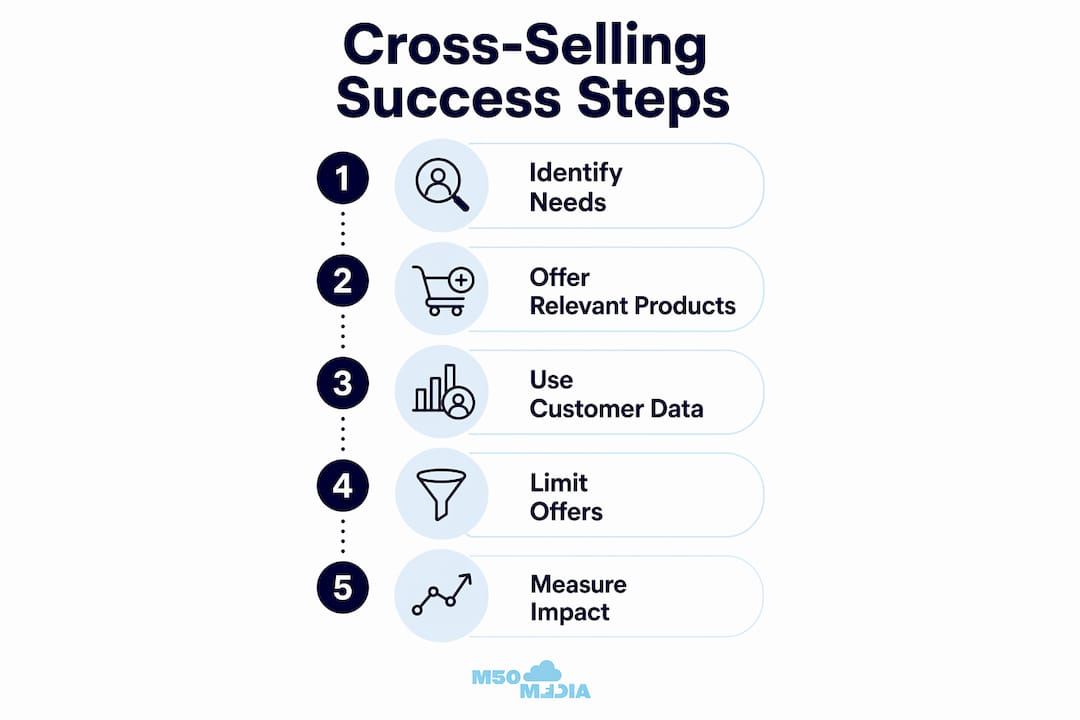
Lead with relevance above everything else. Relevant cross-sell recommendations convert 5 times better than generic ones. A customer buying running shoes should see running socks, not a yoga mat. Match the offer to the purchase, every single time.
Limit your touchpoints. Successful practitioners limit cross-sell offers to two touchpoints per session. More than two and you start feeling like that overeager salesperson at a car dealership. Two is friendly. Three is annoying. Four is a lost customer.
Price your add-ons in the sweet spot. Keep cross-sell items priced at 10–25% of the primary product price. A $200 jacket pairs well with a $30 scarf. A $200 jacket paired with a $180 belt feels like a second full purchase. The psychology shifts completely.
Time your offers strategically. The checkout page, the order confirmation email, and the post-purchase follow-up are your three highest-converting moments. Well-placed cross-sell recommendations convert at click-through rates of 3–8%, driving 10–30% of total ecommerce revenue. That is not a small slice.
Use your CRM data. Personalisation is the multiplier. When you know a customer bought a French press last month, offering them a bag of specialty coffee this month is not a sales pitch. It is a service. Connecting your CRM to your ecommerce platform makes this kind of targeting possible even for small businesses.
Explore AI-driven recommendations. AI-powered recommendation systems detect moments of high purchase intent and surface the right offer at the right time. Platforms like Bloomreach and Klaviyo use real-time behavioural signals to move cross-selling from static bundles to intent-based experiences.
Pro Tip: Start with your top three selling products and map out one or two natural cross-sell companions for each. You do not need a 50-product matrix to start. Three products, six cross-sell pairings, and a checkout prompt will get you moving.
What mistakes kill cross-selling results?
Cross-selling done badly is worse than not doing it at all. Here are the pitfalls that trip up small business owners most often.
Irrelevant recommendations. Offering a customer who just bought a baby stroller a set of golf clubs is not cross-selling. It is noise. Irrelevant offers erode trust faster than almost any other customer experience failure.
Offer overload. Bombarding customers with five add-on suggestions at checkout creates decision paralysis. They freeze, close the tab, and you lose the original sale too. Keep it to two options maximum.
Ignoring your data. Only 23% of sellers effectively use Customer Data Platforms to personalise their cross-sell offers. That means 77% of businesses are leaving personalisation on the table. If you have purchase history data and you are not using it, you are flying blind.
Skipping the post-purchase window. Most small businesses focus all their cross-sell energy on the checkout page and forget the follow-up email sequence. A well-timed email three days after purchase, referencing what the customer bought, converts surprisingly well.
Never measuring results. If you are not tracking click-through rates, add-to-cart rates, and conversion rates on your cross-sell offers, you cannot improve them. Set up a simple tracking system in your CRM or ecommerce platform from day one.
The fix for most of these mistakes is the same: use your customer data strategically and keep your offers tightly relevant to what the customer just bought.
Which tools support cross-selling for small businesses?
You do not need enterprise-level software to run effective cross-selling. Several accessible platforms make it straightforward.
ClickUp integrates sales and marketing workflows, making it easier to track customer interactions and coordinate cross-sell campaigns across your team. The ClickUp cross-selling guide is also a solid free resource.
Klaviyo is built for ecommerce email automation and makes post-purchase cross-sell sequences easy to set up, even without a developer.
Bloomreach uses AI-driven continuous optimisation to adapt cross-sell offers based on browsing and engagement data in real time.
HubSpot CRM (free tier included) lets you segment customers by purchase history and trigger personalised follow-up offers automatically.
Shopify has built-in product recommendation features and a marketplace of apps like ReConvert and Frequently Bought Together that handle cross-sell logic without custom coding.
The common thread across all these tools is data. The more you know about what your customers have bought and browsed, the more relevant your offers become. Check out M50media’s platform and tools recommendations for a curated list of what actually works for small businesses.
Tool | Best for | Key cross-sell feature |
Klaviyo | Email automation | Post-purchase sequences |
Bloomreach | Ecommerce personalisation | Real-time AI recommendations |
HubSpot CRM | Customer segmentation | Automated follow-up triggers |
Shopify apps | Online stores | Checkout and cart upsells |
ClickUp | Team workflow | Campaign coordination |
Key takeaways
Cross-selling is the highest-return sales strategy available to small businesses because it converts existing customer trust into additional revenue without the cost of acquisition.
Point | Details |
Revenue impact is significant | Cross-selling contributes an average of 21% to company revenue, with profit boosts up to 30%. |
Existing customers convert far better | Selling to existing customers succeeds at 60–70%, versus just 5–20% for new prospects. |
Relevance is the deciding factor | Relevant recommendations convert 5 times better than generic ones, so match offers tightly to the purchase. |
Two touchpoints is the limit | Capping cross-sell offers at two per session keeps customers receptive rather than overwhelmed. |
Data and tools multiply results | Only 23% of sellers use customer data platforms effectively, making personalisation a major competitive advantage. |
Karl’s honest take on cross-selling for small businesses
I have worked with a lot of small business owners who hear “cross-selling” and immediately picture that guy at the electronics store who follows you around the whole time you are just trying to buy a phone charger. That is not cross-selling. That is a trauma response.
Real cross-selling feels like a thoughtful recommendation from someone who actually knows you. The first time I helped a client set up a simple post-purchase email sequence offering a complementary product, they were nervous it would annoy their customers. Within 30 days, their average order value had climbed noticeably and their unsubscribe rate had not budged. Customers appreciated the relevance.
The thing most small business owners miss is that cross-selling is not about squeezing more money out of people. It is about solving the next problem your customer does not know they have yet. When you frame it that way internally, your offers become genuinely helpful. And genuinely helpful offers convert.
Start small. Pick your best-selling product. Think about what a customer naturally needs next. Build one offer. Test it. Then build another. You do not need a sophisticated AI system on day one. You need one relevant offer and the courage to put it in front of your customers. The data will tell you the rest.
For more on building a full sales growth strategy around your existing customer base, the M50media blog has you covered.
— Karl
Ready to put cross-selling to work for your business?
Cross-selling is one of the fastest ways to grow revenue without spending more on ads or chasing cold leads. The strategies above give you a solid foundation, but putting them into practice for your specific business is where the real gains happen.

At M50media, Karl works directly with small business owners to build personalised sales and marketing strategies, including cross-selling systems that actually fit your business model. Whether you are just getting started or looking to sharpen what you already have, Karl’s coaching programmes are built for exactly this. Book a free Marketing SOS call and let’s figure out where the quick wins are hiding in your current customer base. No fluff, no generic advice, just real strategy for your real business.
FAQ
What is cross-selling in simple terms?
Cross-selling is offering a customer a related or complementary product alongside their main purchase. Think of it as the “would you like fries with that?” of your business, except the fries are actually relevant to what the customer ordered.
How much revenue can cross-selling add to a small business?
Cross-selling contributes an average of 21% to company revenue and can boost profits by up to 30%. Combined with upselling, the two strategies together can increase total revenues by up to 43%.
How many cross-sell offers should I show at once?
Limit cross-sell offers to two per shopping session or customer interaction. More than two creates decision fatigue and can actually reduce your overall conversion rate.
Does cross-selling work for service-based businesses?
Absolutely. A web designer can cross-sell ongoing maintenance. A bookkeeper can cross-sell tax preparation. The principle is identical: identify what your customer needs next and offer it at the right moment.
What is the difference between cross-selling and upselling?
Cross-selling offers a different, complementary product alongside the main purchase. Upselling encourages the customer to buy a more expensive version of the same product. Both improve customer retention and revenue, and they work best when used together.
Recommended
Comments